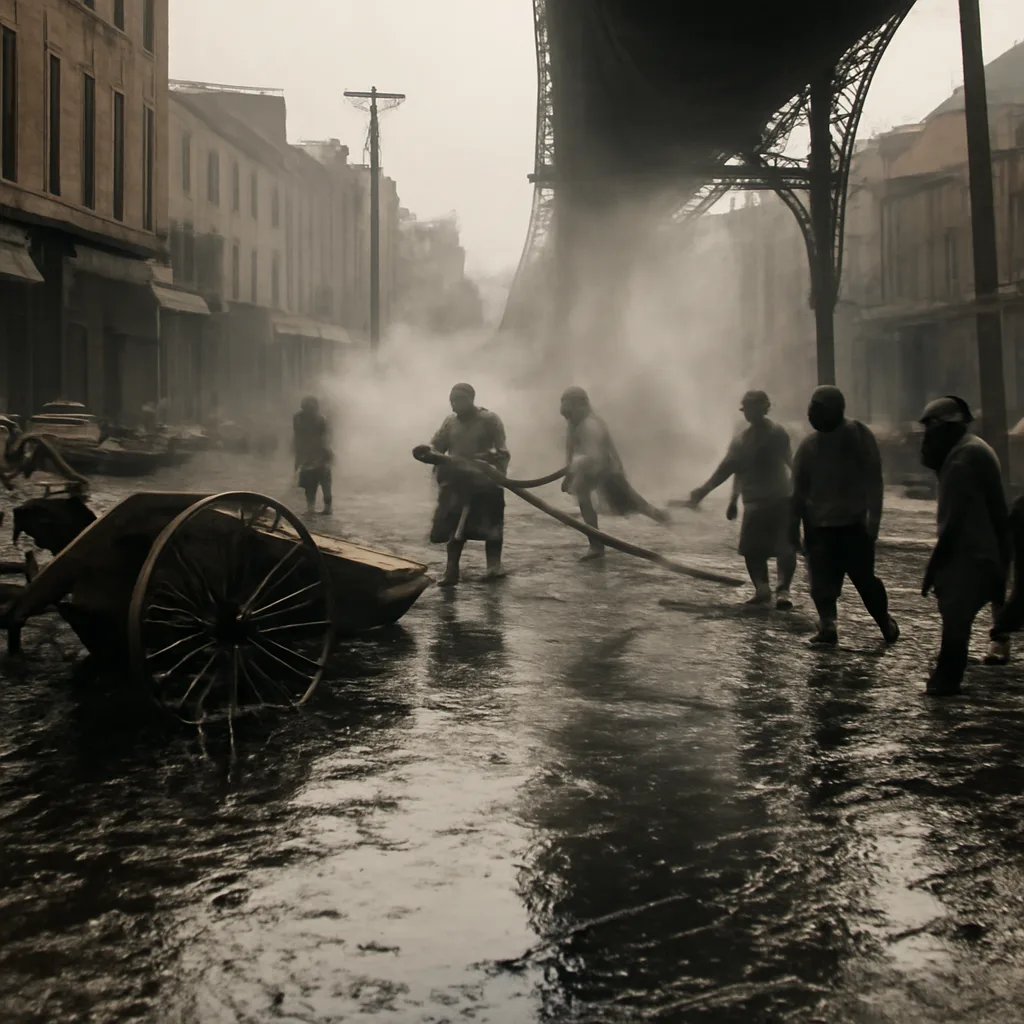
The Boston Molasses Flood of 1919 Killed 21 People
On January 15, 1919, a large steel tank of molasses burst in Boston’s North End, sending a wave of molasses through the neighborhood that killed 21 people, injured scores, and caused widespread damage.
On the afternoon of January 15, 1919, a 50-foot-tall steel storage tank holding roughly 2.3 million gallons of molasses ruptured at the United States Industrial Alcohol Company’s facility in Boston’s North End. The tank released a fast-moving wave of molasses that swept through streets, collapsing buildings, destroying vehicles, and entrapping people and animals. By the time the molasses settled and rescue work concluded, 21 people were dead and about 150 were injured.
The scene immediately after the collapse was chaotic. Contemporary accounts describe a brown inundation that moved at an estimated 35 mph, leveling a brick building and crumpling a metal elevated train structure. Rescuers—police, firemen, neighbors, and soldiers from nearby barracks—worked in freezing conditions, hindered by the sticky, viscous liquid and by temperatures that dropped rapidly. Bodies and debris were recovered over days; clean-up required salt water from fireboats, sand and salt, and large quantities of hot water to wash molasses from streets and buildings.
The tank had been built the previous year and was reportedly leaking from the start. Workers described hearing rumbling and noticing small leaks in the days before the disaster. Investigations after the disaster revealed that the tank’s steel plate was too thin and poorly riveted, and that the company had filled the tank rapidly and, according to later testimony, had not adequately tested its integrity. The construction and inspection methods used have been cited as contributing factors, as has the decision to overfill and to allow the tank to be subject to thermal expansion and fermentation gases.
Legal consequences followed. Families of victims and property owners brought suit against the United States Industrial Alcohol Company. In a lengthy case heard in Massachusetts courts, plaintiffs argued the company’s negligence and faulty construction caused the catastrophe. The company argued sabotage was a possible cause; that theory was never substantiated. In 1925, after protracted litigation, the company settled many claims for a fund paid to victims and their families—payments that acknowledged corporate responsibility without a single criminal conviction for the disaster.
Public and engineering responses to the disaster influenced industrial safety and building practices. The failure became a notable example in engineering ethics and structural engineering courses: design, inspection, materials, and maintenance must match the intended use and contain redundant safety margins. The Boston Molasses Flood also left a social and cultural imprint. Residents recalled lingering smells of molasses into the summer, and the event entered local lore and history as a peculiar and tragic industrial accident.
Historians continue to rely on contemporary newspaper reports, court records, engineering testimony, and municipal records to reconstruct the event. While some details—such as precise wave speed estimates or the exact sequence of every structural failure—are subject to interpretation based on available evidence, the broad facts are well documented: a poorly constructed storage tank failed, releasing a massive quantity of molasses that caused widespread destruction and 21 confirmed deaths on January 15, 1919.