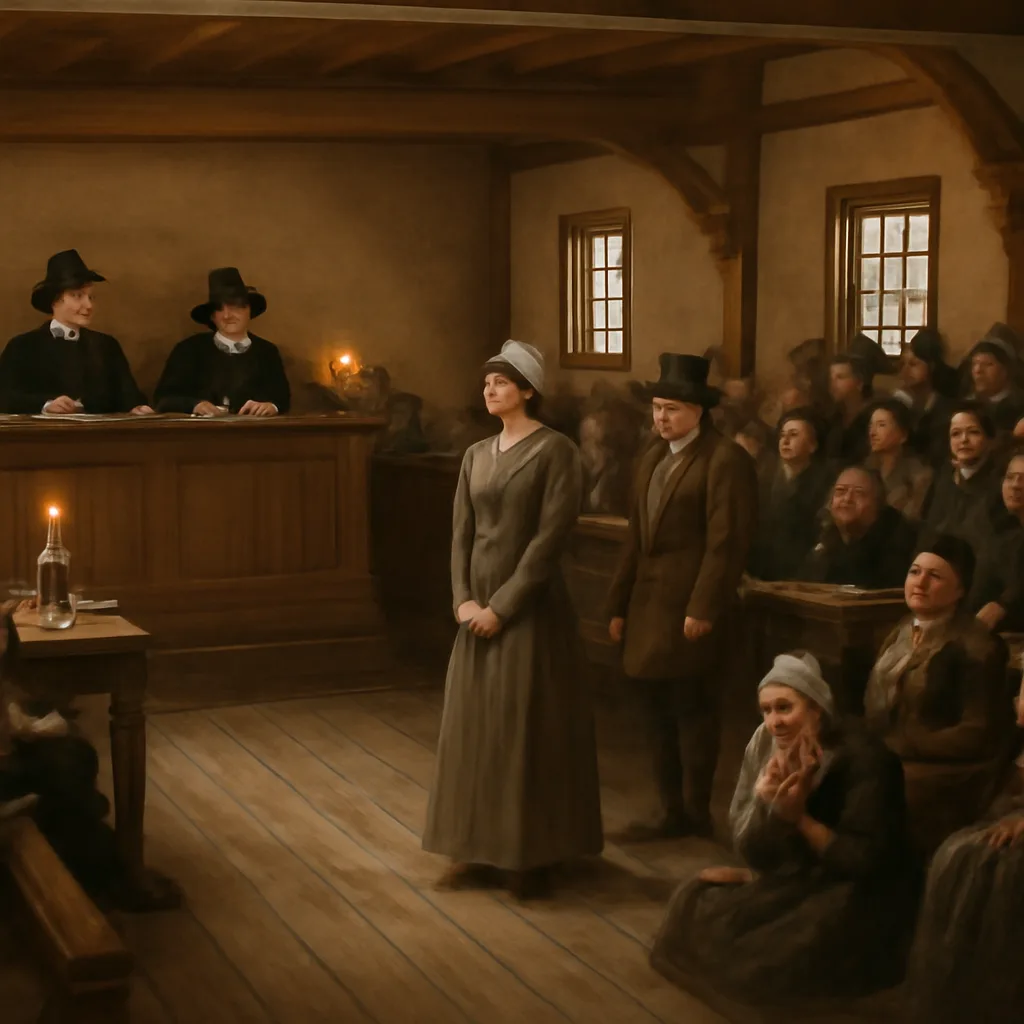
Special Court Reconvenes in Salem to Hear Witchcraft Cases
On March 27, 1692, a special court convened in Salem, Massachusetts, to adjudicate numerous accusations of witchcraft stemming from a wave of local examinations and arrests earlier that month. The court’s procedures and reliance on spectral evidence would soon draw controversy.
In late March 1692, colonial Massachusetts faced an escalating crisis that culminated on March 27 when a special court met in Salem to try individuals accused of witchcraft. The proceedings followed a series of examinations, complaints and arrests that began earlier that month in the towns of Salem Village (now Danvers) and Salem Town. Accusations spread rapidly through family, religious and civic networks amid social tensions, recent smallpox outbreaks, frontier anxieties with Indigenous peoples, and long-standing local disputes.
The court established in Salem in 1692 was not a standard county court. With sessions beginning in late March, it operated under rules shaped by local magistrates and ministers. Early in the crisis, magistrates such as Jonathan Corwin and John Hathorne conducted preliminary examinations; those deemed to have sufficient cause were indicted before higher authority. The special court’s procedures included receiving testimony from accusers, witnesses and the accused, as well as admitting forms of evidence that modern readers find problematic—most notably ‘‘spectral evidence,’’ the claim that an afflicted person’s specter or shape appeared to complainants and afflicted witnesses.
Spectral evidence, while accepted by some contemporaries, was controversial even at the time. Ministers and magistrates differed on its reliability; some ministers warned against reliance on dreams and visions, while others treated afflicted testimony as substantive. The lack of consistent legal standards, combined with community pressures and religious beliefs about diabolical agency, produced a trial environment in which confessions, fits by the afflicted, physical marks on the accused and the testimony of familiar neighbors could carry considerable weight.
Court sessions typically included public examinations and depositions, often recorded by clerks. Proceedings could be swift: once accused, individuals faced imprisonment, interrogation and the social stigma of suspicion. Defendants were frequently marginalized by gender, economic status or prior disputes, and the tests applied to prove witchcraft—such as pressing for a confession or searching for ‘‘witch’s marks’’—did not conform to the evidentiary norms later developed in Anglo-American law.
Within months, the special court’s actions led to numerous indictments and trials across Essex County. The intensifying crisis prompted local and colonial leaders to grapple with how to proceed. By late 1692 and into 1693, criticism of the trials mounted. Prominent ministers, including Increase Mather, voiced skepticism about spectral evidence; Governor William Phips eventually intervened, influenced in part by petitions and public unease, and disbanded the special court. Subsequent reviews and pronouncements led to the release of many prisoners and, in later years, formal apologies and indemnities for some victims and families.
Historians emphasize that the Salem trials were the product of multiple intersecting factors: Puritan theology that perceived the world as a battleground with Satan, local quarrels and economic divisions, the stresses of frontier warfare and epidemics, and legal practices that permitted certain extraordinary forms of testimony. While the events of March 27, 1692, mark a specific convening of judicial authority in Salem, the broader witchcraft crisis unfolded over 1692–1693 and had long-term ramifications for colonial legal practice and collective memory in New England.
The record of the special court’s sessions—court minutes, depositions and contemporaneous accounts—provides the primary basis for historians’ reconstructions. These sources show both the procedural details of trials and the human consequences: arrests, executions, confessions extracted under duress and lifelong reputational damage. Modern scholarship continues to examine the trials’ causes, the courtroom dynamics of the special court, and how the episode shaped American legal and cultural attitudes toward due process and evidence.