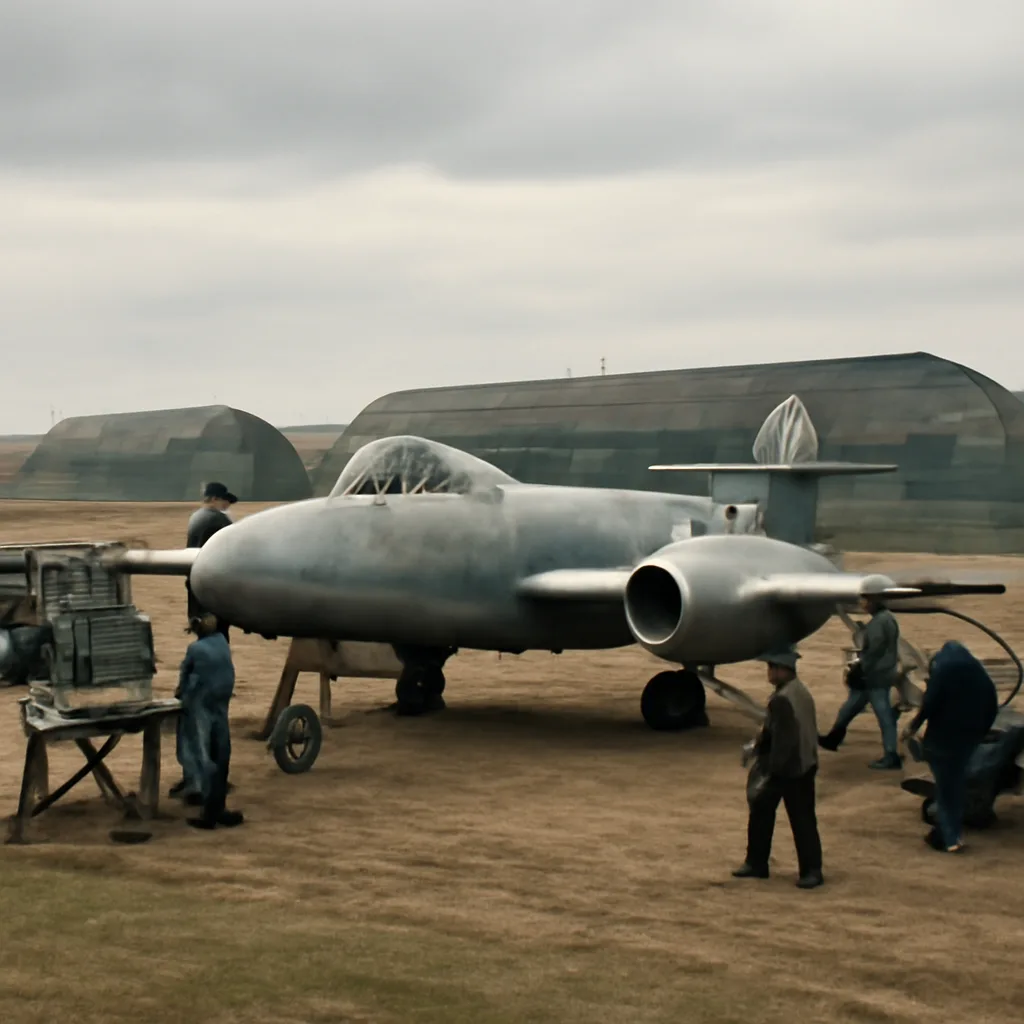
The Gloster Meteor was the United Kingdom’s first operational jet fighter and the first jet aircraft to enter Allied service. Development began in the late 1930s and accelerated after the invention of the turbojet by Sir Frank Whittle and his collaborators. Gloster Aircraft Company adapted these early engines into a twin-engine airframe designed to exploit the higher speeds and different performance characteristics offered by jet propulsion. The Meteor’s prototype trials took place in the early 1940s. Early flights used powerplants developed from Whittle’s work; these engines were still in an experimental stage, and refining them was a major part of the Meteor program. The Meteor became operational with the Royal Air Force (RAF) during World War II, entering service in 1944. Its introduction provided the Allies with their first operational jet fighter capability, initially used in roles such as intercepting V-1 flying bombs and later in limited combat operations over Europe. Although jet technology promised superior speed and climb compared with piston-engined fighters, early jets like the Meteor had limitations: engines were temperamental, range was relatively short, and handling characteristics at high speed required new pilot techniques. Nonetheless, the Meteor’s service validated jet propulsion for military aviation and provided operational experience that informed subsequent designs. Variants of the Meteor continued in production after the war, serving with the RAF and numerous foreign air forces into the 1950s. The type was used for training, reconnaissance, and ground-attack roles as engines and airframes were improved. The Meteor also contributed to postwar aviation research, including trials of swept wings and high-speed flight characteristics. Historical records are clear that the Meteor was the Allied powers’ first operational jet fighter, but precise attributions of a single “maiden flight” date can vary in summary accounts. The program’s key milestones spanned several years of prototype flights, engine tests, and incremental service introductions rather than a single publicized debut event. Legacy: The Gloster Meteor occupies a pivotal place in aviation history as the platform that transitioned Allied air forces from piston-driven to jet-powered fighters. It gave engineers and pilots practical experience with turbojet operation and maintenance and bridged wartime innovation into the postwar era of high-speed flight.