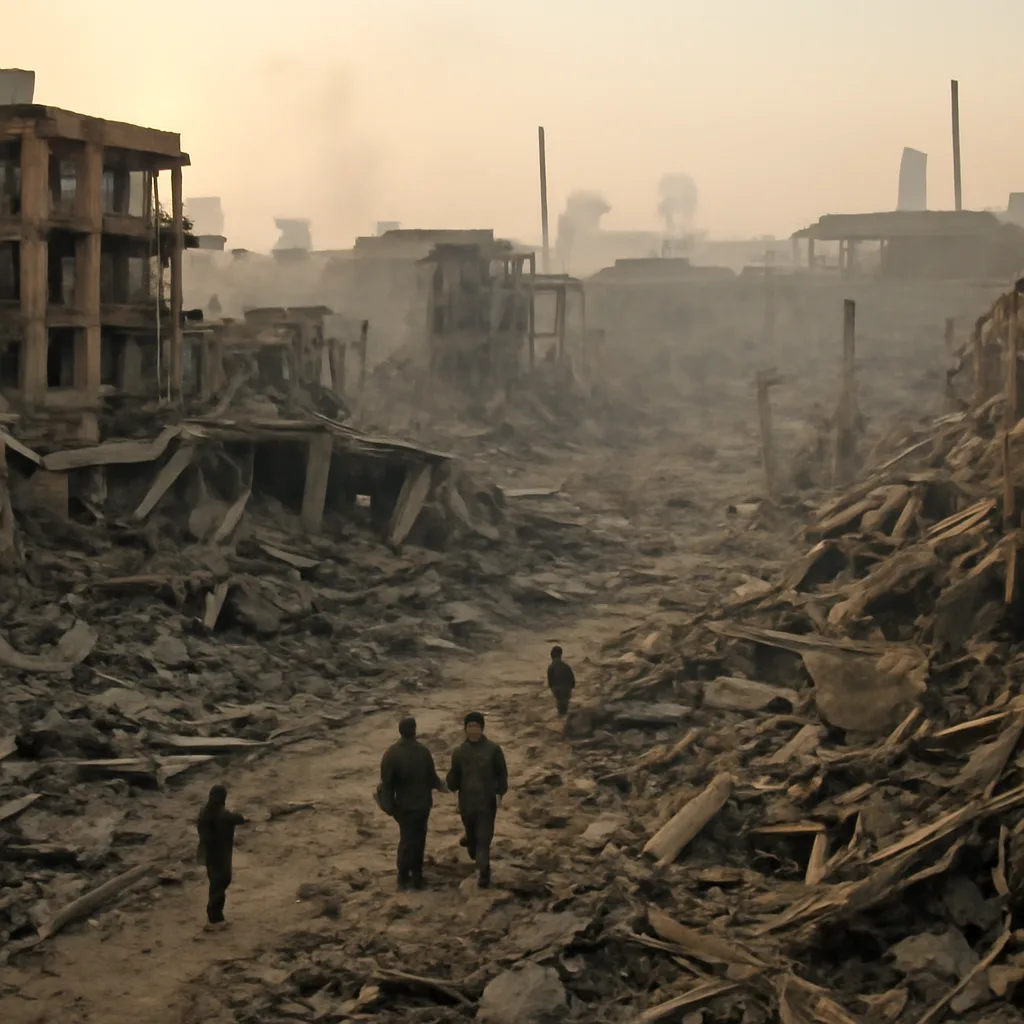
1976 Tangshan Earthquake Levels City in Deadly July Quake
On the night of July 28, 1976, a catastrophic earthquake struck Tangshan in Hebei province, China, destroying much of the city and causing an immense loss of life; estimates of the death toll vary and the full human cost remains subject to historical debate.
On July 28, 1976, at approximately 3:42 a.m. local time, a powerful earthquake struck the industrial city of Tangshan in Hebei province, north China. The quake—reported with a magnitude commonly cited near 7.6—occurred suddenly in the pre-dawn hours, when many residents were asleep. Strong ground shaking and widespread collapse of buildings and infrastructure transformed large areas of the city into rubble within minutes.
Immediate effects
The earthquake destroyed residential blocks, factories, public buildings and utilities across Tangshan and nearby areas. Eyewitness accounts and later surveys describe pancaked apartment buildings, ruptured roads and rail lines, gas leaks, and fires. Communications and emergency services were severely disrupted in the first hours following the disaster, complicating rescue efforts.
Casualties and uncertainty
The human toll was enormous but remains disputed. Chinese government figures released in the weeks after the disaster gave an official death toll of around 242,000 people (including those declared dead or missing). Independent scholars and later researchers have noted a range of estimates—some lower, some suggesting comparable or higher numbers—reflecting difficulties with accounting amid mass destruction, the rapid handling of corpses, and restricted access to information at the time. Injuries numbered in the hundreds of thousands, and many thousands were left homeless.
Response and rescue
Local workers, surviving police and fire personnel, and civilian volunteers were among the first to conduct rescues, often using improvised tools and bare hands to pull survivors from collapsed buildings. Medical facilities in Tangshan were overwhelmed; injured people were transported to hospitals in neighboring cities when possible. The national government mobilized military units and resources to assist with search, rescue, medical care and later reconstruction, though the speed and transparency of official communications were affected by the political climate of the era.
Aftermath and reconstruction
The earthquake devastated Tangshan’s housing and industrial base. In the months and years that followed, large-scale recovery and reconstruction efforts rebuilt much of the city’s infrastructure and industry. Reconstruction prioritized industrial recovery and rapid rehousing; urban layout and construction practices were also altered in subsequent rebuilding programs. Memorials and commemorations were eventually established, though the portrayal and public discussion of the disaster evolved over time.
Historical context and legacy
The Tangshan earthquake occurred during a politically sensitive period in China’s modern history. Restrictions on media and external access at the time contributed to limited contemporaneous international reporting. Over subsequent decades, historians, seismologists and journalists have examined the event’s causes, human impact and the ways the disaster was managed and commemorated. The earthquake remains one of the deadliest seismic events of the 20th century and has been the subject of ongoing study in earthquake engineering, emergency management and Chinese modern history.
Uncertainties and sources
Key details—particularly the precise death toll and aspects of the official response—remain subjects of differing accounts and interpretations. Estimates vary because of the chaotic conditions during and after the quake, differences in methodology for counting casualties, and constraints on information at the time. Contemporary seismological records, post-disaster surveys and later historical research provide the basis for most accepted facts about the event.
The Tangshan earthquake stands as a major human and geological tragedy of the 20th century, notable both for its immediate devastation and for the longer-term questions it prompted about preparedness, construction practices and disaster response.