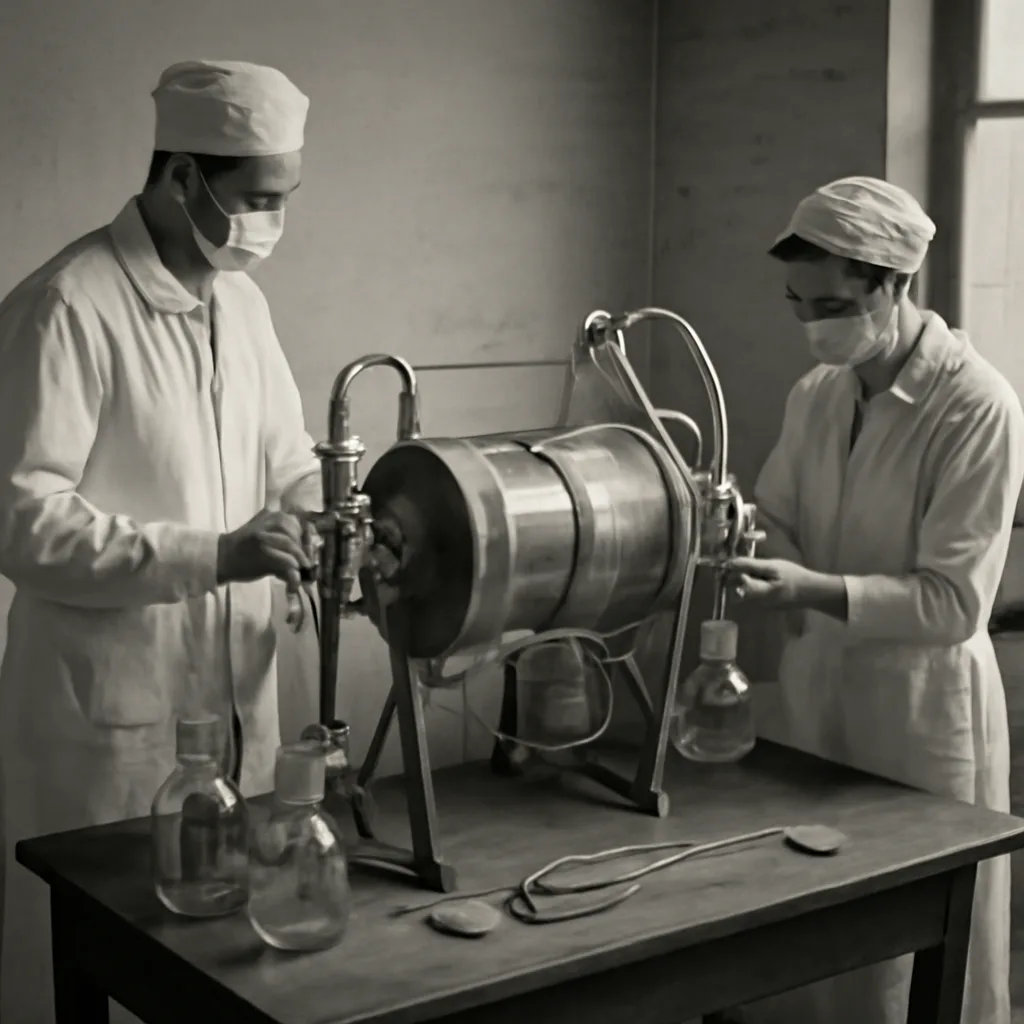
On June 6, 1943, in Kampen, the Netherlands, Dr. Willem Johan Kolff conducted what is widely regarded as the first successful clinical trial of an artificial kidney—an early hemodialysis device built around a rotating cellulose-acetate membrane drum. Working under wartime constraints and severe material shortages, Kolff and his team treated a patient with acute renal failure and demonstrated that blood could be cleansed externally of metabolic waste products, a foundational achievement for modern dialysis. Background and invention Kolff, who had trained in internal medicine and pathology, began experimenting with extracorporeal blood purification in the late 1930s and early 1940s. He sought alternatives to existing methods of treating renal failure, which were largely ineffective at removing uremic toxins. Using improvised materials—including sausage casings, cellophane, glass tubing and parts scavenged from wartime shortages—he constructed a drum-type device in which patient blood circulated on one side of a semi-permeable membrane while a dialysis fluid flowed on the other. The membrane removed small solutes by diffusion, recreating in principle the filtration function of the kidney. The 1943 test The June 6 test followed earlier animal experiments and limited human trials. Kolff’s rotating drum artificial kidney placed patient blood in contact with the cellulose membrane, while the drum’s rotation maintained fresh dialysis fluid and exposed new membrane surface to the blood. The system required careful anticoagulation, temperature control and sterile technique. Reports from Kolff and subsequent historical accounts indicate that the device reduced circulating levels of urea and other toxins sufficiently to produce clinical improvement in the treated patient—an outcome that contemporaries and later historians have viewed as the first clear clinical success of dialysis as a therapy. Context and consequences Kolff’s achievement occurred during World War II under difficult conditions; materials and laboratory support were limited, and detailed peer-reviewed publication was delayed. Nevertheless, the demonstration proved the core feasibility of extracorporeal blood cleaning. After the war, Kolff continued refining dialysis technology and shared his designs and experience internationally. His work inspired subsequent engineers and physicians—particularly in the United States and Europe—to develop more reliable membranes, pumps, anticoagulation protocols and vascular access techniques. These advances, accelerated in the 1950s and 1960s, produced practical long-term hemodialysis machines and, ultimately, the widespread clinical use of dialysis for chronic kidney failure. Limitations and historiography Primary documentation from 1943 is limited; Kolff’s early reports and later recollections, along with secondary historical analyses, form the chief basis for dating the milestone to June 6, 1943. Some details—such as exact clinical parameters for the treated patient and day-to-day procedural steps—remain incompletely documented in contemporaneous peer-reviewed literature. Historians broadly credit Kolff with the first successful clinical demonstration of dialysis, while noting that the technology’s maturation required many contributors and subsequent innovations. Legacy The rotating drum artificial kidney established the scientific and technical foundation for renal replacement therapy. Kolff’s 1943 work is commemorated in histories of nephrology as a turning point that transformed dialysis from experimental concept to lifesaving therapy over the following decades. Modern hemodialysis machines retain the same basic principle—diffusive solute removal across a membrane—even as materials science, pump systems and vascular access have improved safety, efficacy and availability.