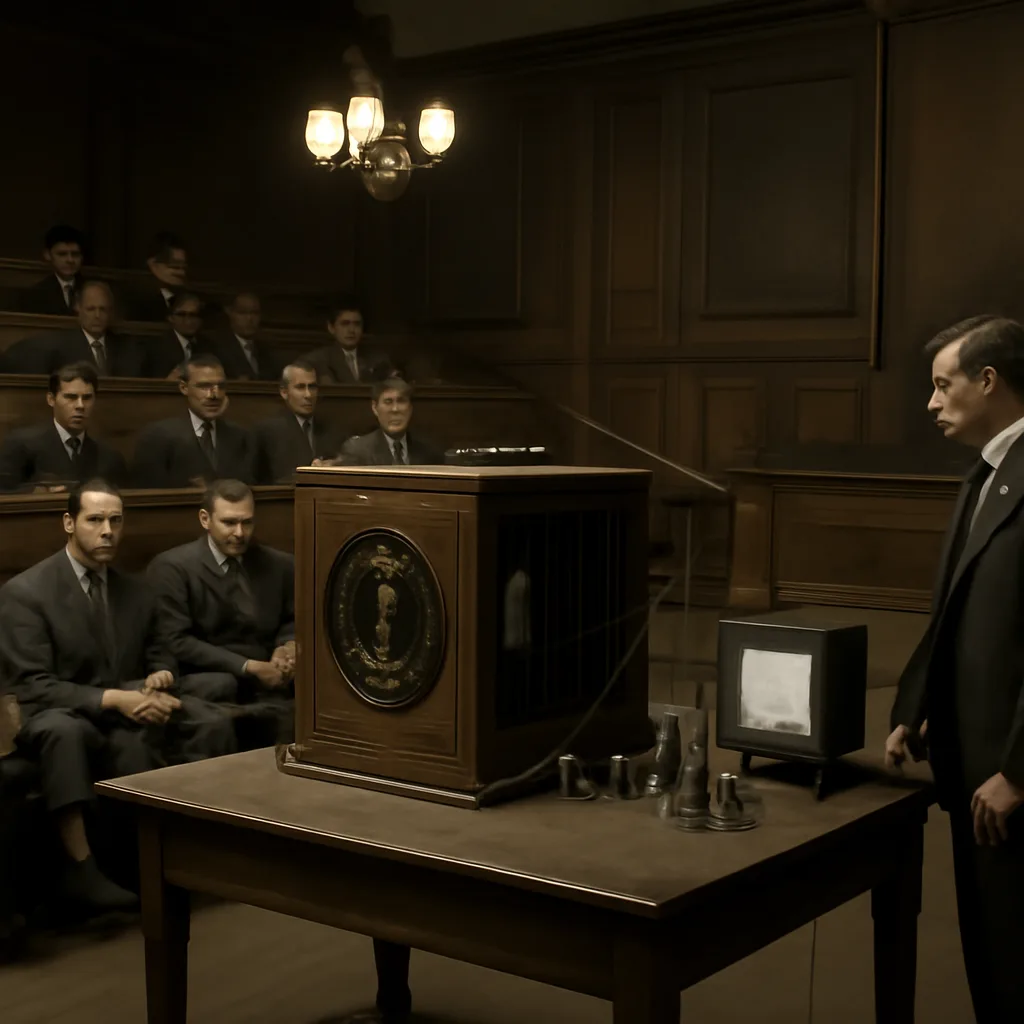
On 26 January 1926, John Logie Baird staged what is widely recognized as the first public demonstration of a working television system. The demonstration took place at the Royal Institution in London and presented moving, low-resolution grayscale images transmitted electrically from one room to another using a mechanical scanning system. Baird’s apparatus employed a rotating Nipkow disc to scan images line by line, and a neon lamp and selenium cell in the receiver to reproduce them. The images were small — a few inches across — and showed crude outlines and features rather than fine detail, but they made visible for the first time the basic principle of transmitting visual information over a distance. Baird’s demonstration was the culmination of several years of experiments. He had been working with mechanical scanning and electromechanical conversion of light into electrical signals since the early 1920s and had previously achieved transatlantic transmissions of silhouette images and other experiments. The 1926 public demonstration was intended to show that a sequence of scanned images could be transmitted, received, and viewed as moving pictures in real time, establishing television as a feasible technology rather than mere laboratory curiosity. Technically, Baird’s system was mechanical rather than electronic: the Nipkow disc, with a spiral of holes, provided line-by-line scanning at the transmitter and receiver, synchronized to reconstruct the image. Illumination and photoconductive cells converted light into varying electrical signals; amplification and synchronization equipment transmitted those signals to the receiver where a bright lamp reproduced the varying intensity to recreate the image. The resulting pictures were low in resolution (commonly cited as 30 lines in early demonstrations) and flickered, but they demonstrated motion and recognizable human facial features at close range. Contemporary press and scientific audiences received the demonstration with interest and some skepticism. The demonstration showed the potential of televised moving images, but many limitations were apparent: mechanical systems had practical constraints on resolution and frame rate, image size was small, and lighting requirements were demanding. Baird’s approach competed with and was eventually supplanted by fully electronic systems developed later in the decade and 1930s, notably those using cathode-ray tubes and electronic scanning methods pioneered by other inventors and research teams. Historically, Baird’s 1926 demonstration is significant because it brought the concept of television into public awareness and provided a practical proof of concept for transmitting moving visual images. It helped spur further research and investment in television technologies across Britain and internationally. While later developments moved away from mechanical scanning, Baird continued to contribute to television research, including experiments in color and stereoscopic television in subsequent years. Scholars note that “firsts” in the history of technology can be contested: earlier experimental transmissions and demonstrations by others existed in various forms, and contemporaneous developments in Germany, the United States, and elsewhere contributed to television’s evolution. Nonetheless, Baird’s 26 January 1926 demonstration at the Royal Institution is commonly cited in historical accounts as the first public demonstration of a working television system that showed moving images to an assembled audience. Sources for this account include contemporary reports of the Royal Institution demonstration, Baird’s published descriptions of his apparatus, and later historical studies of early television technology. Where specific technical details or claims vary in different accounts, historians qualify the descriptions: resolution figures, precise apparatus arrangements, and the audience size reported in sources are not always uniform across primary and secondary records.