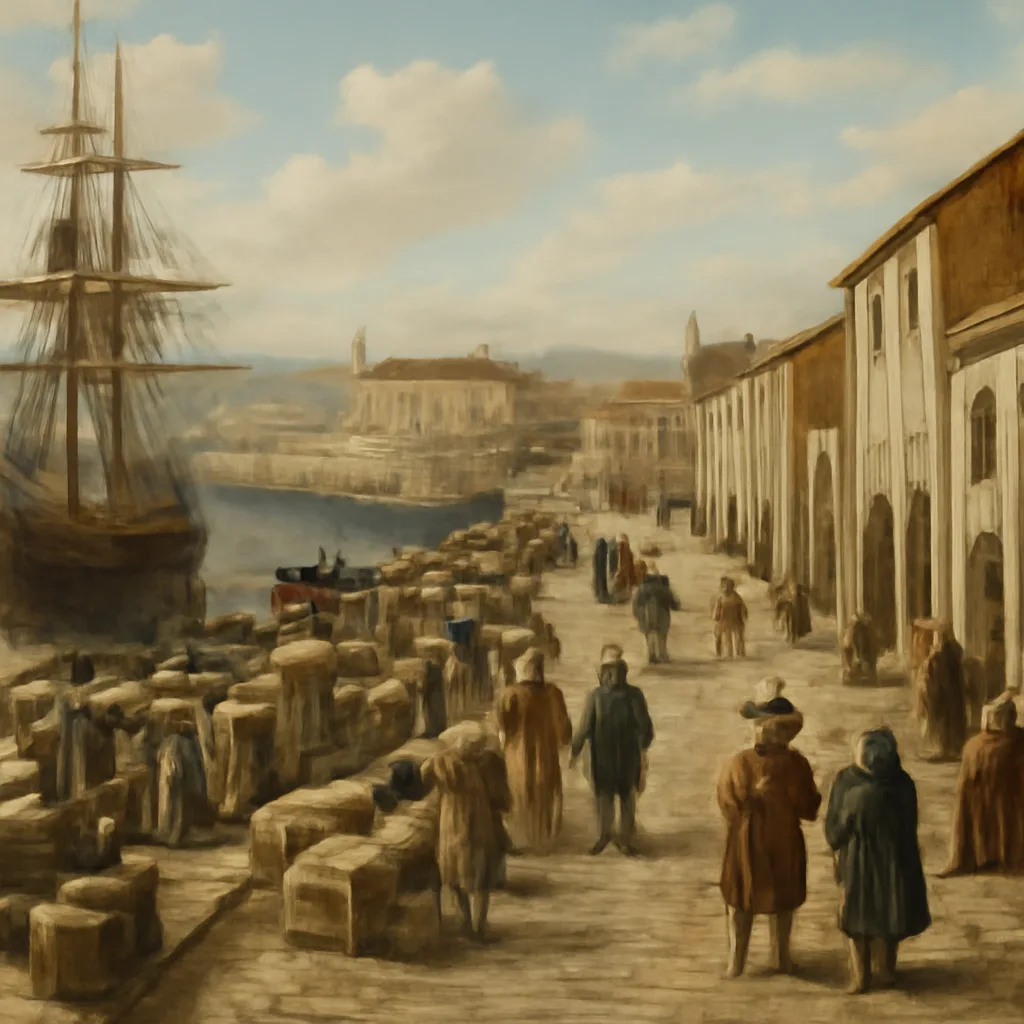
On February 3, 1720, Marseille authorities identified the first confirmed case linked to what became known as the Great Plague of Marseille. The infection is commonly traced to the merchant ship Grand-Saint-Antoine, which had arrived from the eastern Mediterranean carrying goods and, unknowingly, plague-infected cargo and possibly rats and fleas. Despite existing quarantine laws, economic pressure and political concerns led local officials and merchants to allow much of the cargo to be landed and sold, enabling the disease to spread into the city. The initial case was part of an outbreak that moved rapidly through Marseille’s dense port neighborhoods. Contemporary physicians recognized bubonic symptoms—swollen buboes, fever and rapid decline—and local surgeons and municipal health officers worked to contain the spread with measures that included house quarantines, cordons sanitaires, removal of corpses, and the establishment of lazarets (quarantine hospitals). Nevertheless, the disease propagated beyond Marseille into surrounding Provençal countryside, reaching towns and villages and causing substantial mortality. Estimates of deaths vary: contemporary records and later demographic reconstructions suggest the city lost roughly 30,000 of its estimated 90,000 inhabitants, with the wider Provence region suffering additional fatalities. The scale of mortality and social disruption made the 1720–1722 outbreak one of the last major plague epidemics in western Europe. The Great Plague of Marseille had notable political and public-health consequences. It exposed weaknesses in the enforcement of maritime quarantine and local governance, prompted renewed attention to port health regulations across Europe, and influenced the expansion and regulation of lazarets and inspection regimes in Mediterranean ports. The outbreak also left cultural traces in memorials, local records, and public memory. Historians emphasize that while 1720 is often described as the first “confirmed” modern European case, plague had recurred in Europe intermittently since the Black Death of the 14th century; what distinguishes Marseille 1720 is the combination of well-documented administrative records, medical descriptions, and demographic data that allow firm identification of the disease and its impacts in the early modern period. Some details—such as the precise chain of transmission from ship to individual patients—remain subject to scholarly debate, but the link between the Grand-Saint-Antoine’s arrival and the subsequent epidemic is widely accepted in the historiography. The Marseille epidemic also illustrates broader themes in early 18th-century public health: the tension between commerce and quarantine, the uneven capacities of municipal institutions to enforce health measures, and the reliance on containment strategies that would persist until bacteriological understandings of plague emerged in the 19th century. While later scientific advances identified Yersinia pestis as the causative agent, contemporary responses in 1720 were shaped by observation, experience, and pragmatic measures aimed at limiting contact and removing sources of contagion. In summary, the event dated February 3, 1720, marks the first clearly documented onset of the Great Plague of Marseille in the early modern period. It stands as a historically significant episode in European public-health history, notable both for its human toll and for the administrative and medical responses it prompted.