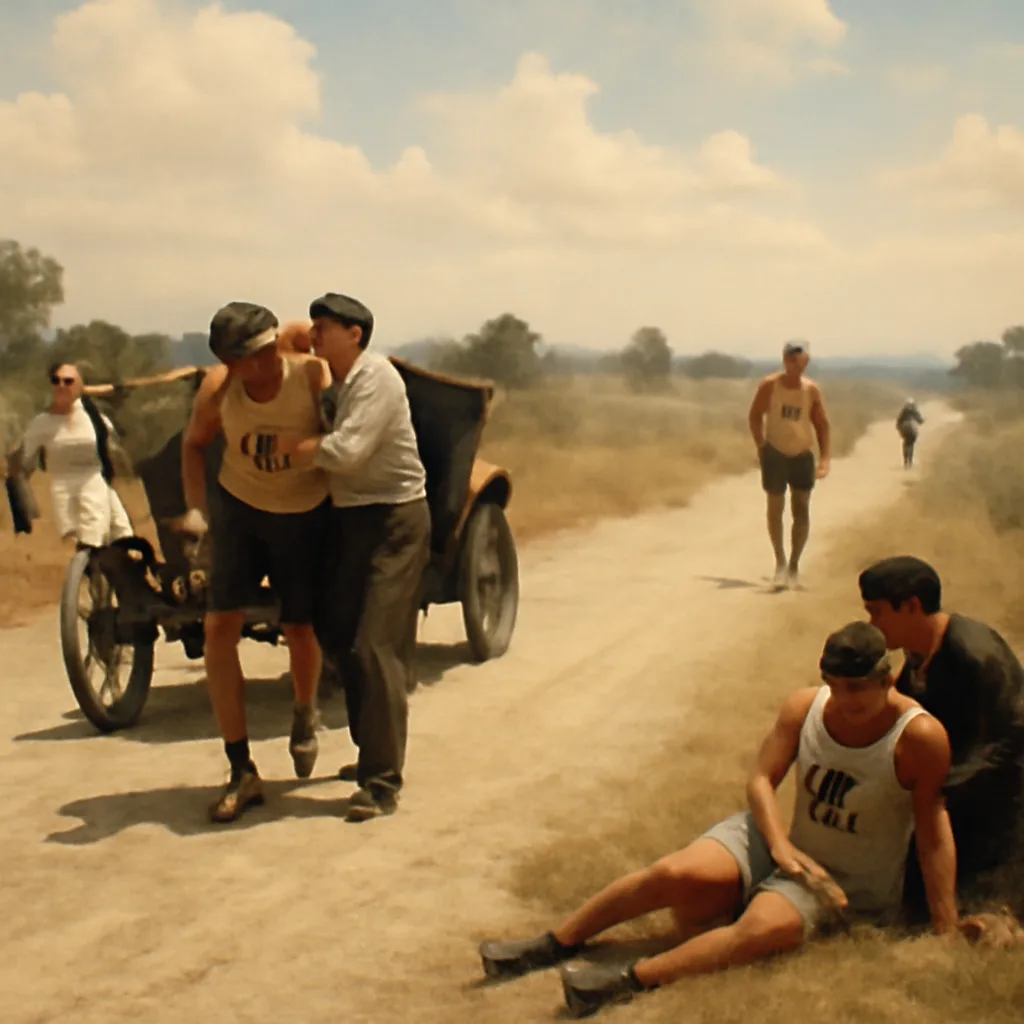
The marathon held on August 30, 1904, as part of the St. Louis Olympic program, became infamous for its extreme conditions, chaotic organization, and multiple rule violations. The race was run on dusty roads in temperatures reported near 90°F (32°C), with runners frequently choking on dust raised by accompanying vehicles. The field included a mix of Olympic competitors and local entrants; course marking, aid stations, and medical oversight were rudimentary by modern standards. Thomas Hicks of the United States is recorded as the winner after a grueling effort that nearly killed him. He completed the 24.85-mile course (records then used different distances) in about 3 hours 28 minutes, but the path to victory was mired in controversy. During the race, Hicks received repeated doses of strychnine administered by his trainers—a practice then used as a stimulant—and was supported physically when he began to collapse. Contemporary accounts and later research indicate that, after collapsing twice, Hicks was placed in a car or carriage for part of the route and driven ahead to be restarted near the front of the race. The use of a vehicle, along with the administration of stimulants and physical assistance, violated emerging expectations for fair competition even if formalized rules were inconsistent in 1904. Other runners faced equally bizarre obstacles. Fred Lorz, another American, was initially celebrated as the winner after he crossed the finish line first; it later emerged that he had ridden in a car for approximately 11 miles after collapsing, then returned to the course and jogged to the finish as a prank. Lorz was publicly disqualified when his deception came to light. South African Len Taunyane and Canadian runner Arthur Newton suffered severe dust-related problems; some reports say Taunyane was chased and struck by dogs. The chaotic environment, worn medical practices, and lax officiating combined to make the event one of the most notorious marathons in early Olympic history. Historians note that standards for equipment, medical care, and officiating were not yet established in international athletics, which helps explain why practices that would be unacceptable today occurred. The 1904 marathon influenced later reforms in race organization, athlete support, and anti-doping awareness. While Thomas Hicks is officially the Olympic champion for 1904, the circumstances of his victory—use of stimulants, physical assistance, and being moved forward by vehicle—are part of the documented record and remain a subject of historical discussion about early Olympic governance and athlete welfare. Sources for this summary include contemporary newspaper accounts from 1904 and later historical analyses of the St. Louis Games and the marathon specifically. Because reporting from the era varies in detail and terminology, some specifics (exact distances driven by vehicle, precise temperature readings, or the full medical rationale used by trainers) are reported with some uncertainty in secondary sources; the broad facts of vehicular assistance and stimulant administration are well-documented in multiple accounts.