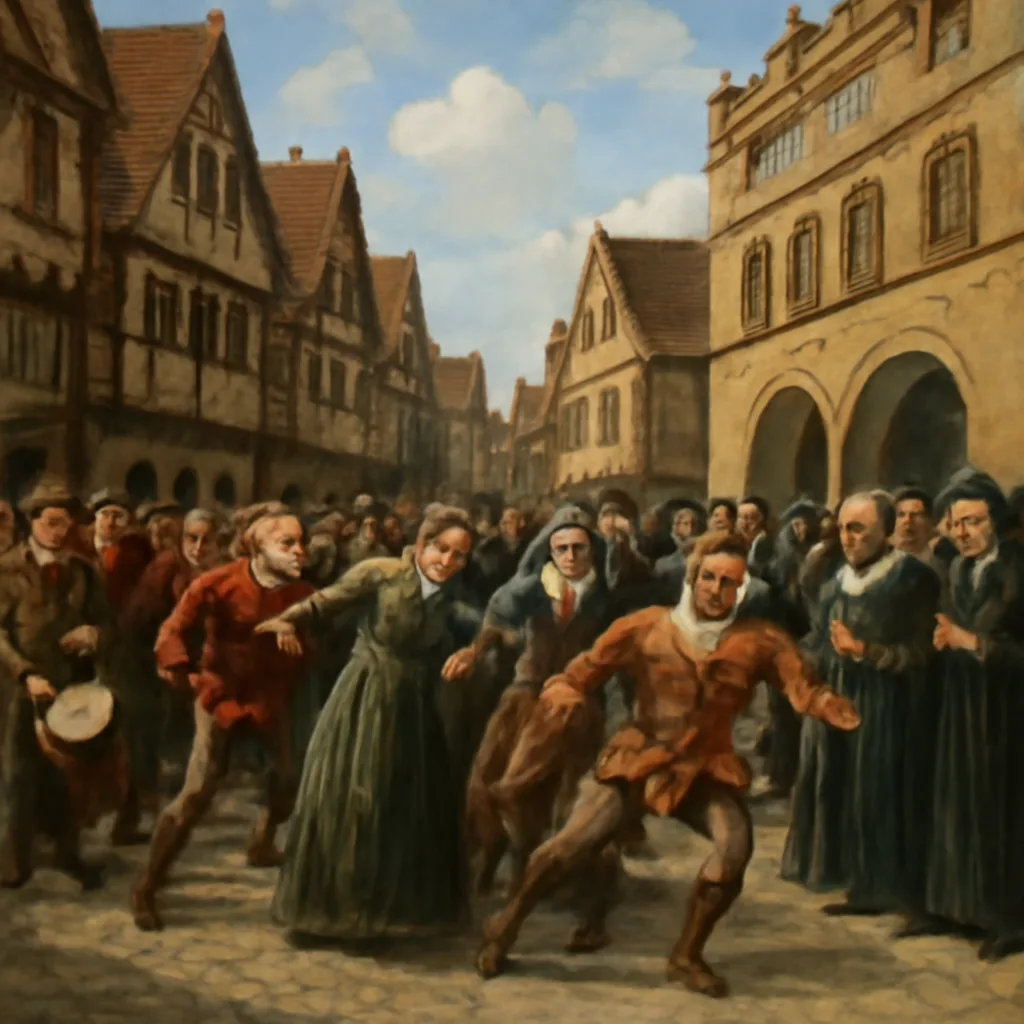
The 1518 Strasbourg Dancing Plague: a mass movement in late medieval Alsace
In July 1518, residents of Strasbourg (then in the Holy Roman Empire) experienced a weeks-long outbreak of involuntary, sustained dancing and convulsions affecting dozens to possibly hundreds; contemporaries offered varied explanations from divine wrath to natural causes.
In July 1518 a sudden and prolonged outbreak of involuntary dancing and convulsive movement occurred in Strasbourg, a city in the Alsace region of the Holy Roman Empire. Contemporary chroniclers and municipal records describe a woman—commonly named as Frau Troffea in later accounts—who stepped into the street and began to dance uncontrollably. Within days others had joined her, and the episode persisted for several weeks. Estimates of how many people participated vary by source; surviving civic records cite dozens, and some later retellings suggest numbers in the hundreds, but exact totals are uncertain.
Primary contemporary documents include municipal council records and medical notes kept by local physicians and clerics. These sources show the city authorities took the event seriously. Initial responses combined spiritual and medical remedies: clergy performed prayers and processions while physicians prescribed bloodletting and other treatments consistent with early 16th-century medical practice. At one stage, civic leaders permitted or arranged for a hall and paid musicians to allow dancers space to move, reasoning that regulated dancing might relieve whatever affliction had seized them; that policy was later reversed amid fear that the activity worsened the condition.
Explanations proposed at the time reflected prevailing worldviews. Many contemporaries interpreted the outbreak as a form of divine punishment, demonic influence, or saintly affliction requiring penance and prayer. Physicians of the era described it in humoral terms—an excess of blood or 'hot' humors producing a bodily compulsion to move. Early modern chroniclers and later historians have added other interpretations, including ergotism (poisoning from ergot-contaminated grain) and mass psychogenic illness (a social or psychological contagion triggered by stress and cultural expectations).
Modern scholarship tends to prefer psychosocial explanations while acknowledging complexity. Historians and historians of medicine point to the social context of Strasbourg in 1518: a period marked by crop failures, disease, famine, religious tensions, economic hardship, and heightened eschatological expectation. Such stresses could have made communities more susceptible to collective expressions of distress. Mass psychogenic illness—then as now—often appears in tightly connected groups under stress, spreading via observation and shared belief rather than by a biological pathogen. The ergotism hypothesis has been criticized because ergot poisoning typically produces gastrointestinal and neurological symptoms inconsistent with prolonged rhythmic dancing, and because contemporary accounts do not consistently describe the convulsions and gangrene associated with severe ergotism.
Sources vary in detail and emphasis, and later retellings have sometimes amplified numbers and sensational elements. Because surviving records are limited and filtered through the assumptions of their writers, historians caution against definitive statements about precise participant counts, causes, or how many dancers died. What is clear from the documentation is that the events were alarming enough to mobilize civic authorities, clergy, and physicians, and that the episode was remembered and recorded in local chronicles.
The 1518 Strasbourg case remains important to historians because it illustrates how medical, religious, and civic institutions responded to a puzzling communal disorder in the early modern period, and because it opens questions about how social stress and belief can produce large-scale somatic phenomena. While scholars debate particulars, the outbreak stands as one of the best-documented early instances of what later researchers classify as mass psychogenic illness or collective behavioral disturbance.