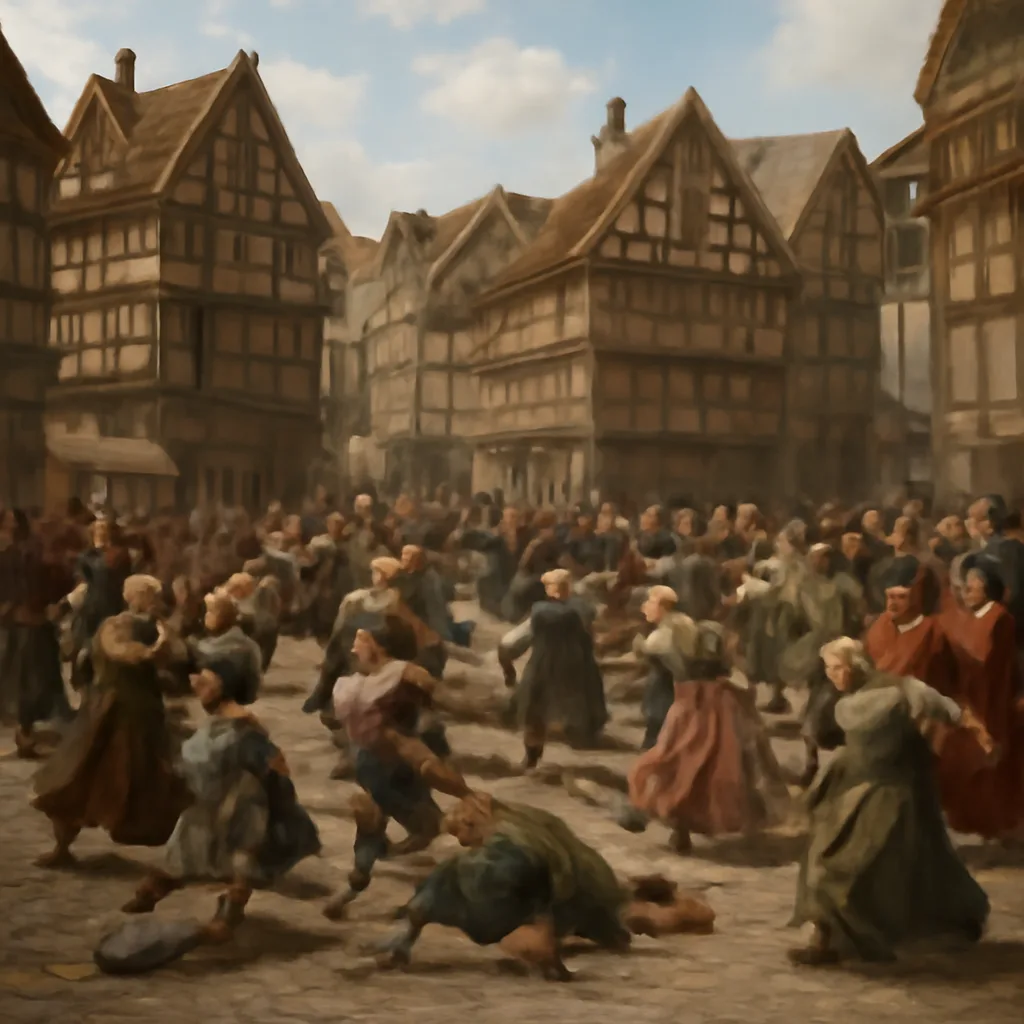
In July 1518 a month-long outbreak of compulsive dancing occurred in Strasbourg, a free city of the Holy Roman Empire (now Strasbourg, France). The episode—often called the Dancing Plague or Dancing Mania of 1518—is the earliest well-documented large-scale case in the historical record of what contemporaries described as involuntary, sustained dancing that spread among members of a community. Contemporary sources, notably civic records and a few medical and ecclesiastical accounts from 1518, describe that in mid-July a woman (often named as Frau Troffea in later retellings) began dancing in a street. Within days dozens of people had joined her, dancing for hours or days at a time. Municipal documents record that the city council and physicians were consulted; the council initially allowed and even encouraged dancing in a public space, hoping prayer and organized dancing would relieve whatever affliction had seized the townspeople. Later they restricted large gatherings and sought other remedies when the phenomenon persisted. Reports indicate that some of the afflicted collapsed from exhaustion, suffered strokes, or died, though exact casualty numbers are uncertain. Historians caution against simple explanations. Early modern observers framed the event in terms familiar to them—divine punishment, saintly intercession, or imbalances of bodily humours—while later scholars have proposed a range of possibilities including mass psychogenic illness (mass hysteria), social and economic stress, ergotism (a fungal poisoning hypothesis), and other neurological or cultural factors. Most contemporary historians of the event favor mass psychogenic illness triggered by acute social stressors: Strasbourg in 1518 faced famine, disease, and political tensions, conditions that could produce collective stress responses manifesting in physical symptoms. Primary documentation is limited and filtered through the concerns of civic and religious authorities, so details remain contested. The term “dancing plague” or “dancing mania” is a modern label that groups this outbreak with other episodic contagions of movement and convulsion reported in medieval and early modern Europe. Unlike modern clinical descriptions, 16th-century accounts lack standardized medical observation, making retrospective diagnosis speculative. The 1518 outbreak has endured in historical and popular imagination because of its dramatic character and the vividness of surviving records. It has prompted multidisciplinary inquiry—historians, anthropologists, medical historians, and neurologists have examined the event to understand how culture, stress, belief, and biology can interact. While no single explanation is universally accepted, the Strasbourg case remains a key example of how social and environmental crises can produce episodes of collective physical behavior that defy simple medical categorization. For readers seeking further verification, modern secondary treatments rely on the surviving civic records of Strasbourg and analyses in peer-reviewed history and medical history literature; those works emphasize the limits of the sources and avoid definitive medical diagnoses. The 1518 dancing plague thus stands as both a documented historical event and an open question about the interplay of stress, culture, and human physiology in premodern Europe.