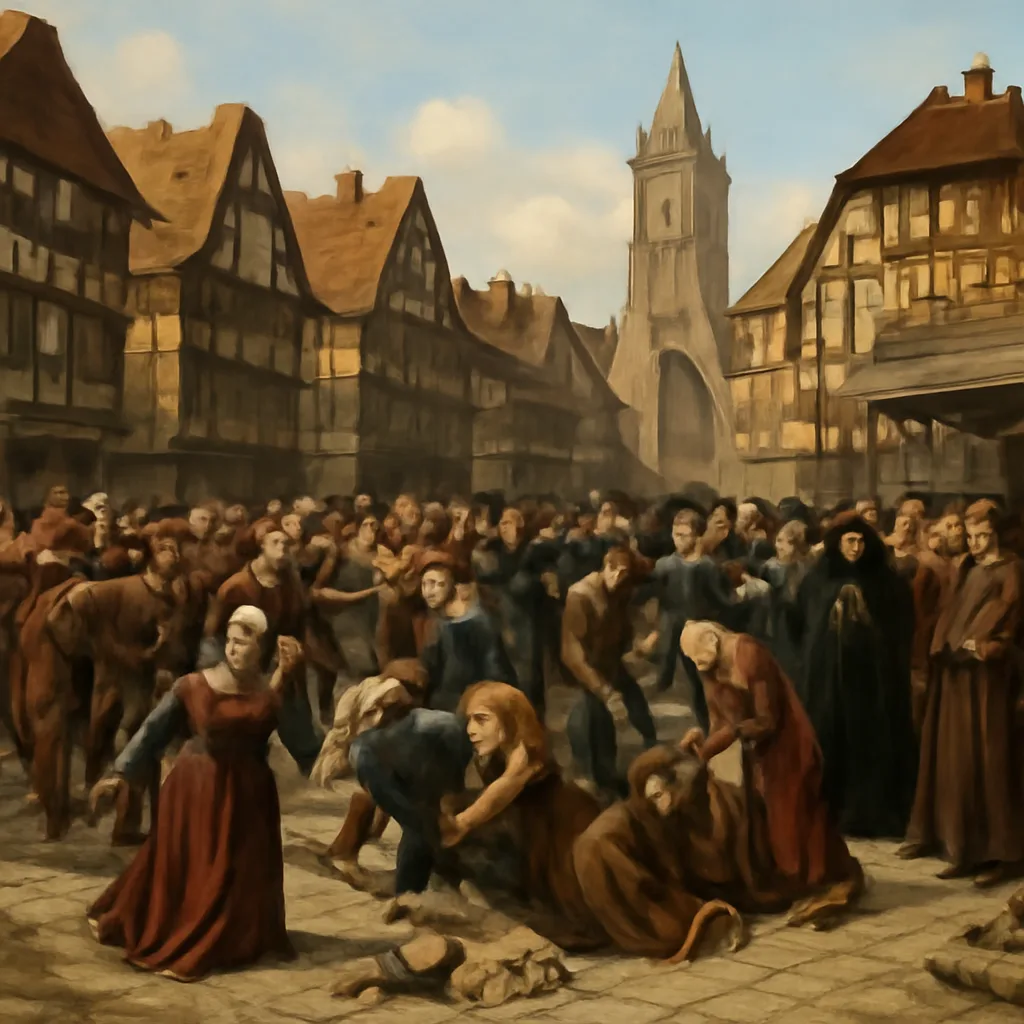
In July 1518 a remarkable and disturbing event unfolded in Strasbourg, then part of the Holy Roman Empire: groups of people began dancing in the streets and continued for days. The episode is among the earliest and best-documented instances of what later scholars called a "dancing plague" or choreomania. Surviving civic records, chronicles and notarial documents from Strasbourg describe an initial woman who started dancing in a public square and was soon joined by dozens of others. Municipal authorities were alarmed by the contagion-like spread and by reports that some dancers suffered exhaustion, injury or death. Context: Strasbourg in 1518 Strasbourg in the early 16th century was an urban center of commerce and craft within the Holy Roman Empire, coping with food shortages, disease, social tension and religious ferment on the eve of the Reformation. These stresses form the backdrop for later explanations of the dancing outbreak. Contemporary accounts—particularly city council records and physicians' notes—are the primary evidence for the event; later retellings have sometimes amplified or altered details, so historians rely on original documents where possible. What happened According to municipal records, the episode began in July when a woman (named in some original sources) began dancing fervently in a public space. Within days dozens more were observed dancing; some accounts give figures ranging from a few dozen to over a hundred participants at peak. The city took measures to control the situation: authorities initially arranged for temporary care by hiring musicians and setting up a stage, believing structured dancing and rest might relieve the afflicted. When that did not stop the phenomenon and injuries increased, officials forbade public gatherings and sought other remedies. Contemporary descriptions note that sufferers danced involuntarily, often in a trance-like state, and sometimes collapsed from exhaustion. Chroniclers record instances of injury and at least some deaths attributed to the physical toll; exact casualty figures remain uncertain because records are incomplete and phrasing varies between documents. Interpretations and debate Explanations proposed across centuries fall into two broad categories: social/psychological and physiological. Social and psychological interpretations emphasize collective stress (famine, disease, anxiety about religious and economic upheaval), social contagion, and culturally specific expressions of distress. Medical and toxicological hypotheses have included ergotism (poisoning from rye fungus causing convulsions and hallucinations) and other neurological or metabolic disorders. No single explanation has gained universal acceptance; ergotism in particular is disputed because many symptoms of ergot poisoning do not match the character of the dancing episodes described. Modern scholars treat the event as a complex phenomenon shaped by social context, belief systems, communal behavior and the limits of contemporary medical knowledge. The Strasbourg episode sits within a wider European pattern: documented outbreaks of collective dancing or rhythmic movement occurred intermittently in the late medieval and early modern periods in various regions. Sources and limitations The best evidence for the 1518 affair comes from Strasbourg civic records and contemporary chronicles; later popular accounts and modern retellings sometimes introduce hyperbole. Precise numbers of participants and causes cannot be established definitively from surviving sources. Historians therefore present multiple plausible interpretations rather than a single settled verdict. Significance The 1518 dancing outbreak remains important for historians of medicine, social history and collective behavior because it illustrates how communities interpret and respond to unexplained mass phenomena. It also shows the limits of early modern civic and medical authority when faced with events that straddle the social, cultural and bodily realms.