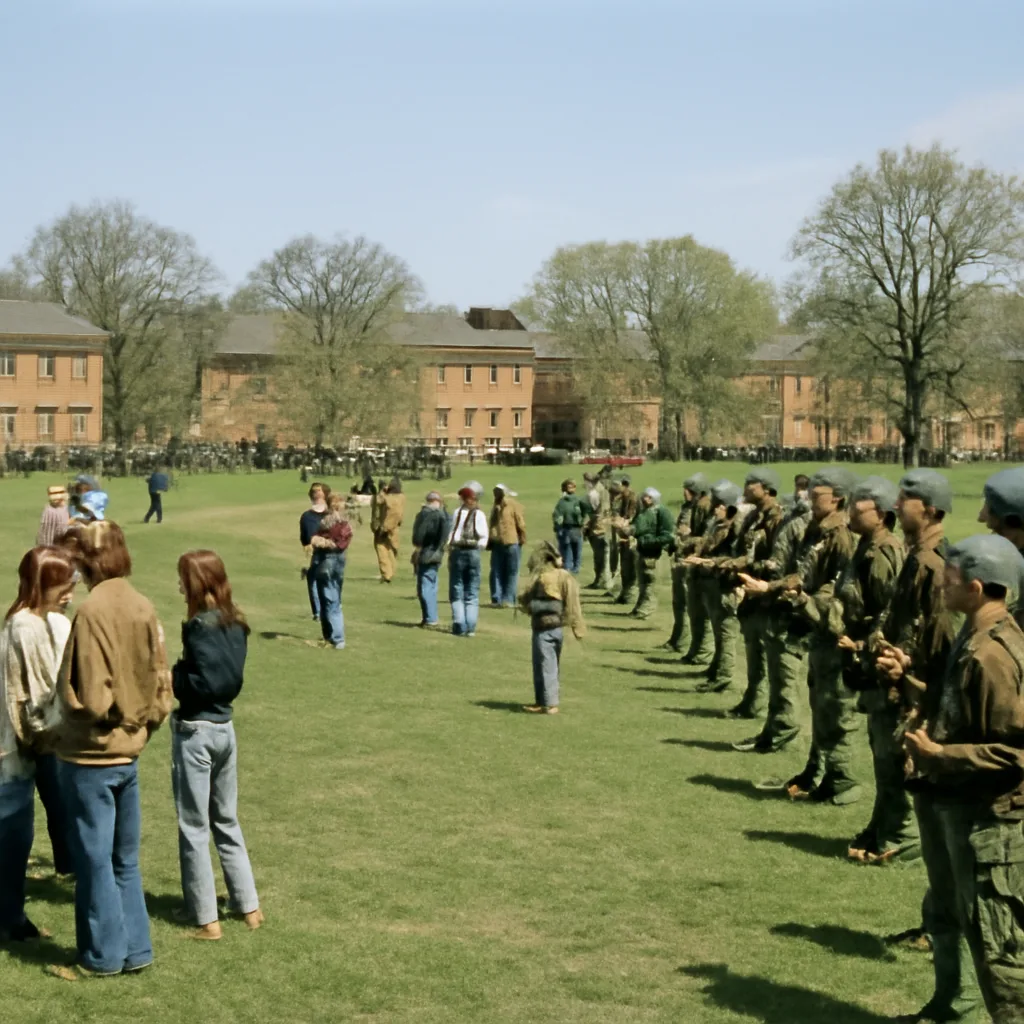
On May 4, 1970, Ohio National Guard members opened fire on students during an anti-Vietnam War protest at Kent State University in Kent, Ohio. The shootings occurred in the context of expanded U.S. military action in Cambodia announced by President Richard Nixon on April 30, 1970, which intensified nationwide campus demonstrations and unrest. Events leading up to the shootings: Following the Cambodian incursion, protests and tense confrontations between demonstrators and authorities increased across many college campuses. In Kent, demonstrations had escalated over several days. On May 1–2, local businesses and the Kent State ROTC building experienced unrest and a fire that caused property damage. In response to growing tensions and requests from local authorities, Ohio Governor James A. Rhodes called in the Ohio National Guard; guard troops arrived on campus on May 2 and remained through May 4. May 4 confrontation and shooting: On the afternoon of May 4, a group of several hundred students gathered on and around the Commons area near the main drill field. Demonstrators engaged in protests that included marches and confrontations with guardsmen, some witnesses reported shouting and taunting. Guardsmen formed lines and at times used tear gas. Shortly before 1:00 p.m., guard units advanced across the Commons; accounts differ on whether the crowd was dispersing or advancing. At about 12:24 p.m., members of the Ohio National Guard fired 67 rounds over a period of 13 seconds from standard-issue M1 and M14 rifles. Four students were killed: Allison Krause (20), William Knox Schroeder (19), Sandra Scheuer (20) and Jeffrey Miller (20). Nine other students were wounded, one permanently disabled. Immediate aftermath and reactions: The shootings shocked the nation and provoked widespread outrage, student strikes, and protests at hundreds of campuses. Public opinion was sharply divided; some supported the Guard's presence and actions as necessary to restore order, while others saw the response as an excessive use of force against unarmed students. Governor Rhodes defended the deployment and famously claimed publicly that the protesters were “worse than the Brown Shirts,” a statement that further inflamed opinion. Investigations and legal outcomes: Multiple investigations followed. A presidential commission (the Scranton Commission) concluded that the shootings were unjustified but did not assign criminal intent to the guardsmen. In a 1979 civil trial, a U.S. district judge found that the Guard had used unreasonable force and awarded damages to the wounded and the families of the dead; however, a federal appeals court reversed the decision on appeal. In 1974, eight guardsmen were indicted on criminal charges but the grand jury declined to return indictments. No guard was convicted for the shootings. In 2010, the U.S. Department of Justice announced it would not reopen a criminal investigation. Historical significance: The Kent State shootings became a defining moment for the antiwar movement and for public debate about civil dissent, the militarization of police and military forces on campuses, and the limits of state response to protest. The image of a young woman kneeling over a dead student, photographs of the scene, and the widespread campus strikes that followed cemented Kent State in national memory. The event influenced public opinion on the Vietnam War and contributed to intensified scrutiny of government responses to domestic unrest. Commemoration and legacy: Kent State University and other groups have memorialized the dead and wounded through monuments, exhibitions, and annual commemorations. The May 4 Visitor Center and the May 4 Memorial on the Kent State campus document the events and their aftermath. Debate about responsibility and the adequacy of investigations continues among historians, participants and families. Notes on sources: This summary draws on contemporaneous reporting, the Scranton Commission report, court records, and later historical studies. Specific interpretations of crowd behavior and decision-making on the day remain disputed in some details; where disagreement exists, investigations and legal rulings are cited in the historical record as noted above.