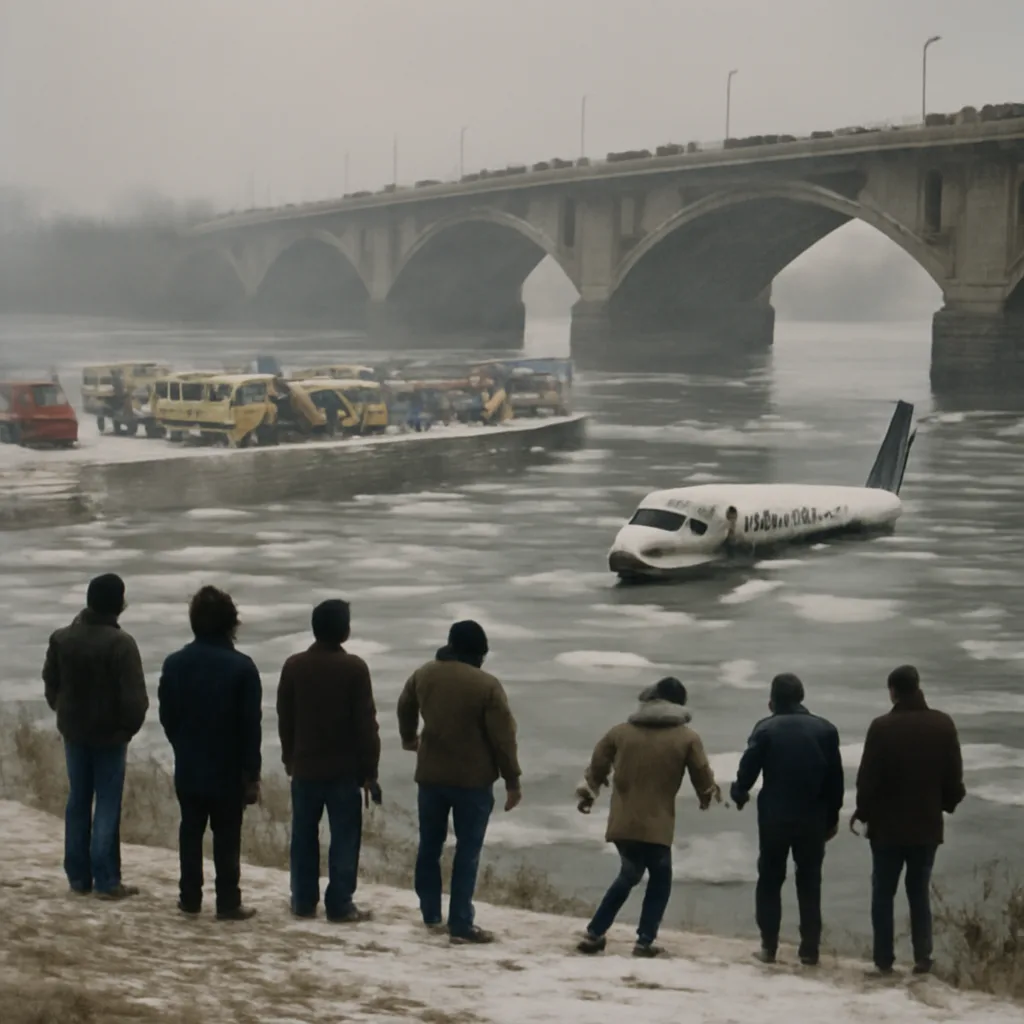
Shortly after takeoff from Washington National Airport on January 13, 1982, Air Florida Flight 90 struck the 14th Street Bridge and plunged into the frozen Potomac River during a heavy snowstorm. The crash killed most of the 79 people on board and four motorists on the bridge; some passengers were trapped among wreckage and ice in near-freezing water. Lenny Skutnik, a 25-year-old Justice Department employee working in Washington, D.C., was among the bystanders who rushed to the riverbank. Observing a woman clinging to a partially submerged plane fuselage and surrounded by floating ice, Skutnik removed his boots and coat and jumped into the icy water. He swam to the wreckage and hauled the woman to shore. Emergency crews later rescued additional survivors who had been in the water or on the wreckage. Skutnik’s spontaneous act of courage received widespread attention. He was widely praised in media accounts and by public officials for his willingness to risk hypothermia to save a stranger. Later, President Ronald Reagan singled him out during his first State of the Union address, presenting Skutnik’s action as an example of ordinary American heroism. That public recognition helped make “Skutnik” a household name and a shorthand reference for civilian bravery in the years that followed. The rescue highlighted several broader issues raised by the crash: the hazards of winter flying conditions, the need for better de-icing and pilot decision-making procedures, and emergency-response challenges on the Potomac. Investigations by the National Transportation Safety Board (NTSB) found that ice accumulation on the aircraft and errors in pilot judgment contributed to the accident. The NTSB’s findings led to renewed attention to aircraft de-icing practices and pilot training for winter operations. Skutnik himself declined to seek a public profile after the event; accounts of his rescue emphasize the spontaneous and unplanned nature of his action rather than any prior preparation. Over time, his name has been invoked in political speeches and popular culture as an example of individual initiative in a crisis. Contemporary reporting and later retrospectives treat the rescue as one dramatic human moment amid a larger tragedy that prompted technical and regulatory responses in commercial aviation. The Air Florida crash remains one of the more noted aviation accidents in the Washington, D.C., area, both for its tragic death toll and for the widely reported rescues from the icy Potomac. Skutnik’s deed is documented in contemporaneous news reports and in the public record of the crash’s aftermath; it stands as a clear example of a bystander intervention that materially aided a survivor in dire conditions.