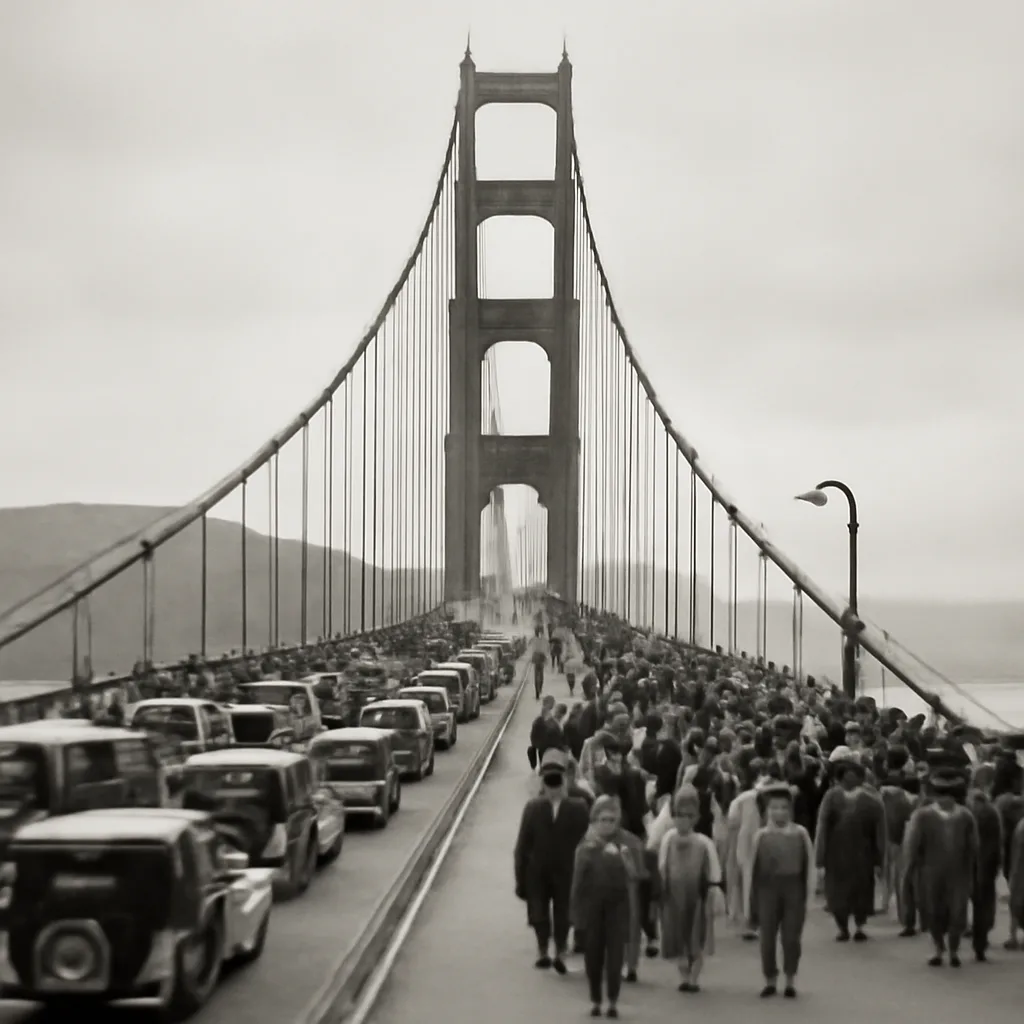
Overview On May 27, 1937, the Golden Gate Bridge officially opened to the public. The bridge, spanning the Golden Gate strait between San Francisco and Marin County, had been under construction since January 1933. The opening followed engineering innovations, economic challenges of the Great Depression, and extensive public interest in what would become an iconic American structure. The day itself Opening Day—often called “Pedestrian Day”—was organized as a public celebration. Foot traffic was allowed across the bridge before it was opened to motor vehicles the next day. Tens of thousands of people walked, strolled, and picnicked on the deck; municipal reports and contemporary newspapers documented large crowds who treated the new crossing as both a civic achievement and a recreational outing. Organizers set safety limits to avoid overloading the span, and authorities managed the flow of people throughout the day. Design and construction The bridge was designed primarily by engineer Joseph B. Strauss, with significant contributions from other engineers and designers, including Leon Moisseiff, Irving Morrow (architectural consulting on towers and color), and Charles Alton Ellis (structural calculations). The final design is a suspension bridge featuring two main towers, a central span of 4,200 feet (1,280 meters), and a total length of about 1.7 miles (2.7 kilometers). Its Art Deco tower details and the internationally recognized “International Orange” color for visibility and aesthetics were part of the collaborative design choices. Engineering and safety innovations Construction required new methods for working in deep, turbulent water and for protecting workers during high winds and fog. A safety net was installed under the deck, which saved the lives of many workers; about 19 men who fell into the net were known as the “Halfway to Hell Club.” Despite the risks, recorded worker fatalities during construction were fewer than on many large projects of the era because of those safety measures and evolving practices. Context and significance The bridge’s construction occurred during the Great Depression and was financed through bonds underwritten by local and state authorities; its completion provided jobs and represented civic optimism. At the time of opening, the Golden Gate Bridge was the longest suspension bridge main span in the world, a record it held until 1964. It rapidly became a symbol of San Francisco and an engineering landmark in the United States. Public reaction and legacy Contemporary accounts describe a celebratory atmosphere on opening day, with many residents and visitors eager to walk across the bridge and view the bay. The following day, May 28, 1937, the bridge opened to vehicular traffic. Over subsequent decades the bridge has been the subject of preservation, seismic retrofitting, and continuing debate over aesthetics, access, and safety measures, but its 1937 opening remains a foundational moment in San Francisco’s history. Notes on sources and uncertainties This summary synthesizes widely documented facts about the bridge’s construction and opening day. Specific crowd counts and some contemporaneous anecdotes vary among newspapers and municipal records; where exact figures or personal details conflict in historical sources, those differences are not asserted here as definitive.