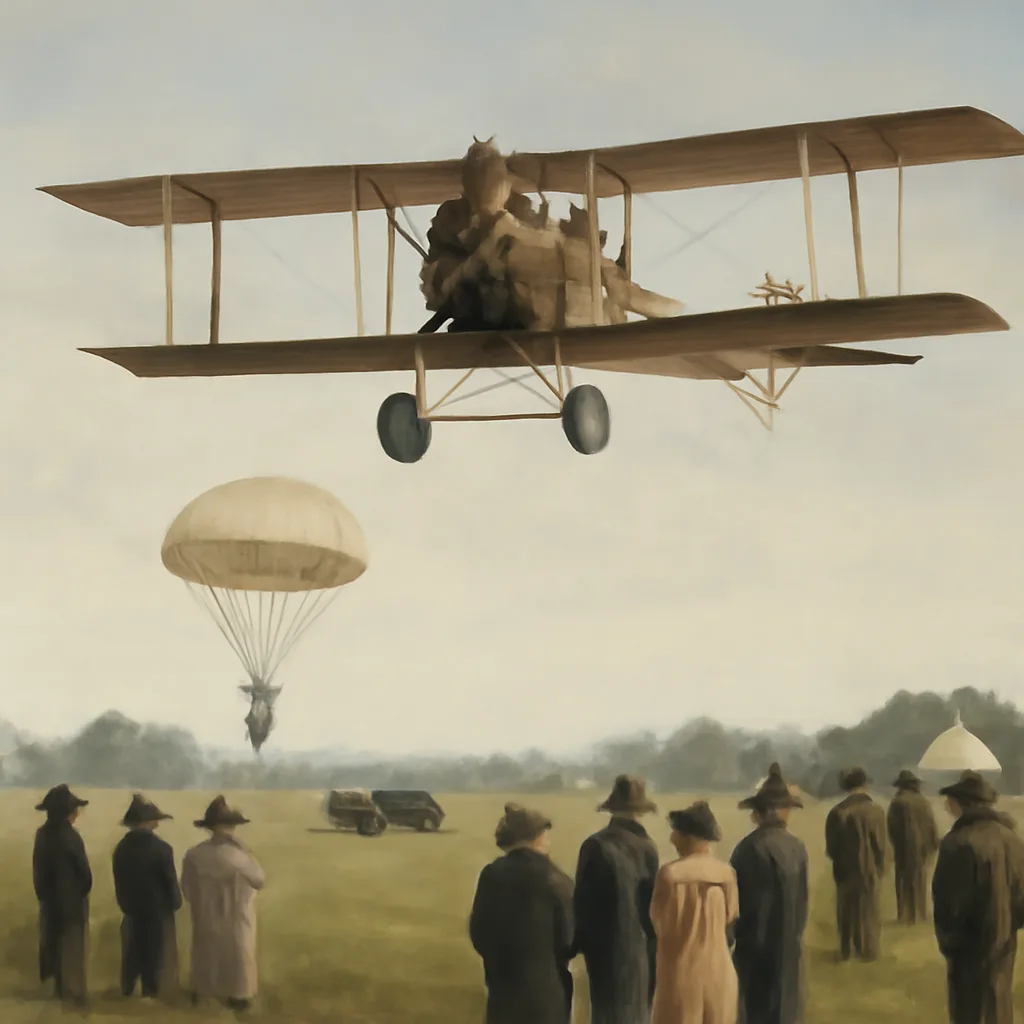
The early 1910s were a period of rapid experimentation in powered flight. As aircraft reliability remained limited, inventors and pilots explored methods to protect flyers and to deploy parachutes from heavier-than-air machines. On March 1, 1912, contemporary reports and aviation histories record a successful parachute descent from an airplane—one of the earliest documented instances of a person jumping from a powered aircraft and landing safely under a parachute. Context: By 1912, parachutes had been used from balloons for several decades, notably by balloon acrobats and some military observers. Heavier-than-air parachute jumps presented new technical challenges: platforms and harnesses had to be adapted for the slipstream and structural limitations of early airplanes, and pilots and parachutists had to coordinate exits from open cockpits and often fragile airframes. The event recorded on March 1, 1912 took place amid these experiments. Sources from the period and later aviation histories attribute the achievement to aviators and parachutists working in Europe and the United States, where demonstrations and trials were increasingly common. The jump demonstrated the practical potential of parachutes as emergency equipment for airplane crews and as a means to deploy personnel from aircraft. Technical and safety considerations at the time included the design of pack or packless parachutes suited to the lower speeds and different aerodynamic environment of airplanes versus balloons, methods to secure parachutes to harnesses without entangling the aircraft, and procedures for safe exits from open cockpits or aircraft fuselages. The successful descent on March 1, 1912 contributed to the evolving knowledge that would later standardize parachutes for military and civilian use. Significance: While not the absolute first parachute use in aviation history (balloon parachutes predate airplanes by decades), the 1912 airplane descent is significant as an early demonstration that parachute escape from powered, heavier-than-air craft was feasible. This realization influenced subsequent developments in personal parachute design and emergency procedures, and encouraged further trials that would, over the next decade, make parachute use more routine in military and experimental aviation. Limitations and historical caution: Contemporary sources from the period sometimes provide conflicting details about participants, exact locations, and technical arrangements. Early aviation reporting could be imprecise, and multiple pioneers in different countries were conducting similar experiments around the same time. Because specific names and a single universally accepted primary-source account are not consistently present in all historical summaries, some accounts cite different individuals and dates for related early airplane parachute descents. The March 1, 1912 date is recorded in several histories as one of the earliest successful airplane parachute jumps, but historians note that similar experiments occurred in nearby years and that precise attribution can be disputed. Legacy: The early experiments of 1912 and the surrounding years laid groundwork for more systematic parachute adoption. During World War I and the interwar period, parachute technology and procedures advanced rapidly, eventually becoming standard safety equipment for many aircrew. The March 1, 1912 descent remains part of the broader story of how aviators learned to manage risk and improve survivability in the new era of powered flight.