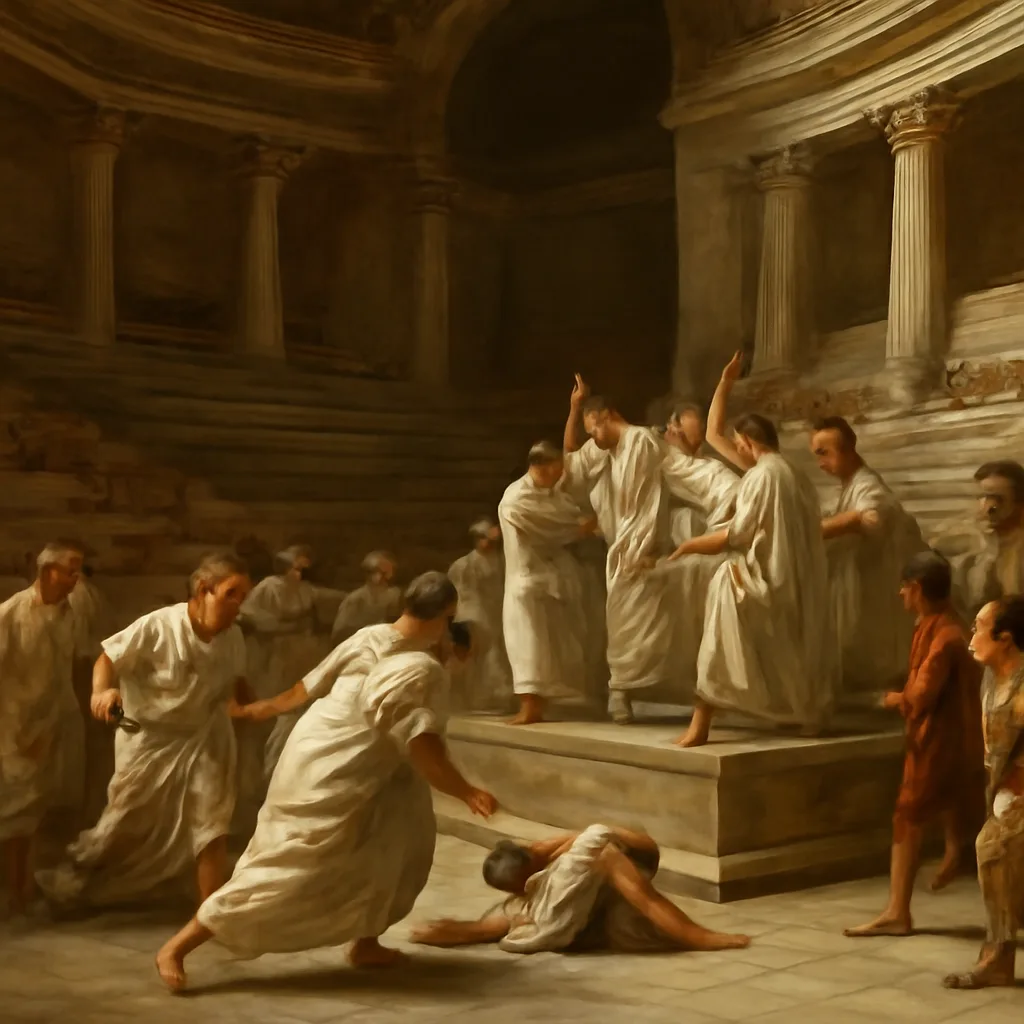
Background By 44 BCE Julius Caesar had accumulated extraordinary authority: he was dictator perpetuo (dictator in perpetuity), had reformed magistracies and the calendar, and enjoyed wide popular support and veteran loyalty. His concentration of offices and honors alarmed many senators who believed republican customs and senatorial influence were being undermined. The conspirators and motives The assassination was carried out by a coalition of senators led by figures including Gaius Cassius Longinus and Marcus Junius Brutus; other participants included Decimus Junius Brutus Albinus and several less prominent nobles. Motives varied: some conspirators framed their act as tyrannicide to restore the Republic and senatorial authority, while others were driven by personal rivalry, loss of status, or fear of Caesar’s power and the perceived end of senatorial government. The killing On 15 March 44 BCE—known in the Roman calendar as the Ides of March—Caesar attended a senate meeting scheduled to meet in the Theatre of Pompey rather than the Curia, due to renovations of the Senate House. According to near-contemporary accounts, a group of senators surrounded Caesar and stabbed him repeatedly; ancient sources report he suffered multiple wounds. The exact sequence of blows and whether any single wound was immediately fatal cannot be determined precisely from surviving sources. Ancient historians differ on some details, including whether Caesar uttered the famous phrase attributed to him in later literary tradition. Immediate aftermath The conspirators expected public approval and a restoration of the old order, but the killing produced political shock and disorder in Rome. Mark Antony, a loyal supporter and colleague of Caesar, and others rallied Caesar’s veterans and the urban populace. Antony’s actions, including a funeral oration that highlighted Caesar’s achievements and showed his wounds, helped turn public sentiment against the assassins. Political consequences Rather than restoring the Republic, the assassination unleashed a sequence of political conflicts and civil wars. Rivalries among Caesar’s supporters and the conspirators led to the formation of the Second Triumvirate (Octavian, Mark Antony, and Lepidus) and proscriptions against enemies. The ensuing decades culminated in Octavian’s (later Augustus) consolidation of power and the establishment of the Roman Empire, a political outcome fundamentally different from the conspirators’ stated aims. Sources and historiography Our knowledge comes chiefly from ancient writers such as Cicero, Plutarch, Suetonius, and Appian, as well as coins, inscriptions, and later Roman historians. These sources blend eyewitness testimony, political bias, and later literary shaping; as a result, certain details—exact words spoken, the full roster of participants, and precise motives of every individual conspirator—remain debated among scholars. Modern historians reconstruct the event by comparing texts, archaeological evidence, and the broader political context of late Republican Rome. Legacy The assassination of Julius Caesar became a defining moment in Roman history and a recurring subject in literature, political thought, and art. It is widely seen as the catalyst that ended the Roman Republic’s final phase and set the transition to imperial rule, even if that outcome was contrary to the conspirators’ intentions.