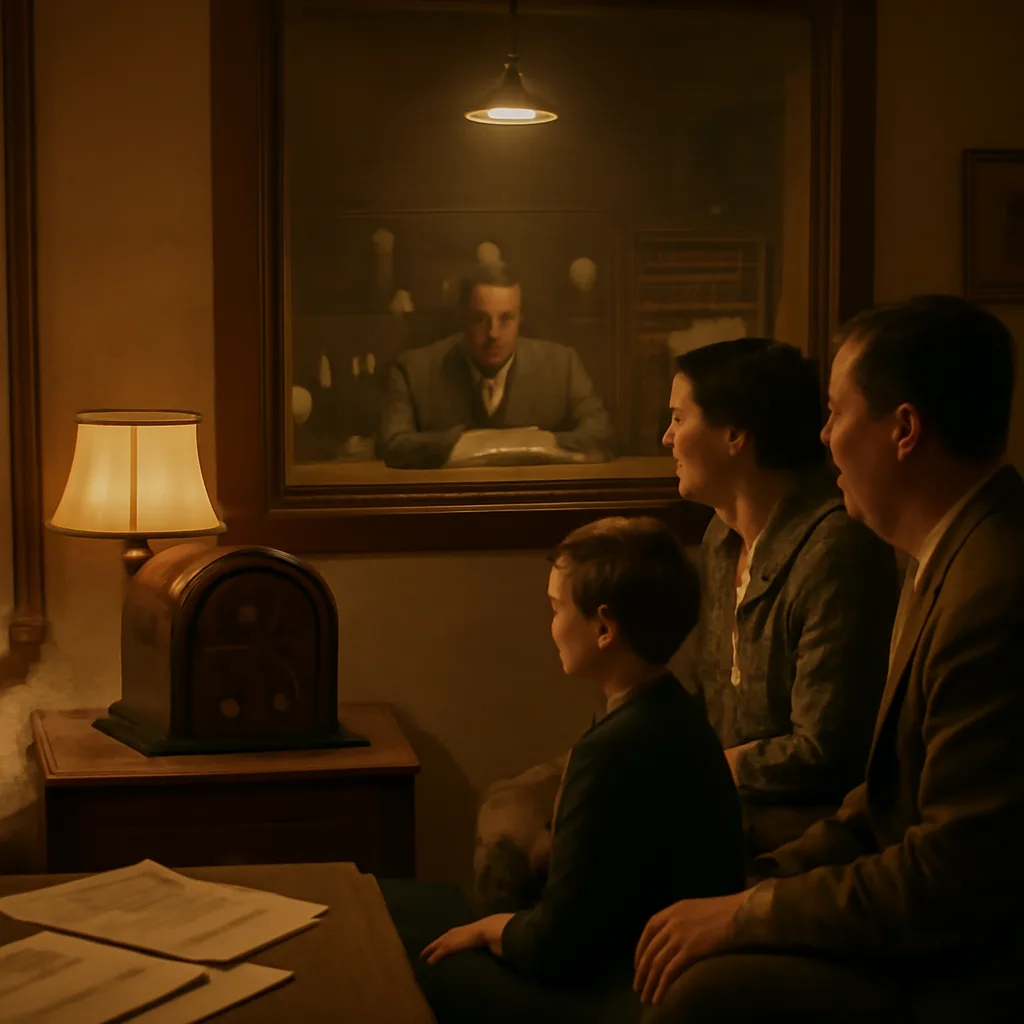
1938 Radio Drama Triggers Nationwide Panic Over Alleged 'Alien Invasion'
On the evening of October 30, 1938, Orson Welles's radio adaptation of War of the Worlds, broadcast as a series of realistic news bulletins, prompted widespread fear and confusion across parts of the United States as listeners mistook the dramatization for actual events.
On the night of October 30, 1938, the Mercury Theatre on the Air, directed and narrated by Orson Welles, aired a 60-minute radio adaptation of H.G. Wells's novel The War of the Worlds. Presented in the style of simulated news bulletins and spot reports, the program interrupted musical segments with accounts of an apparent Martian invasion in Grover's Mill, New Jersey. The broadcast's realistic format, combined with interrupted programming and a series of dramatic eyewitness-style reports, caused some listeners to believe the events were real.
Contemporary reports describe varying degrees of public alarm. In some communities people fled homes, jammed highways, or called police and newspapers seeking confirmation. Newspaper coverage in the following days amplified the story, with some editors portraying the broadcast as having induced mass hysteria. Later studies and scholarship have shown the scale and intensity of the panic were uneven and often exaggerated in the press. Researchers have documented that many listeners either recognized the program as fiction, tuned in late and missed disclaimers, or reacted with curiosity rather than panic. Nevertheless, there were genuine instances of alarm and confusion that resulted in numerous emergency calls and a handful of reported injuries linked to panic-driven actions.
The incident touched on broader anxieties of the era: recent advances in technology, geopolitical tensions in late-1930s Europe, and the growing power of mass media to blur lines between fiction and news. The broadcast prompted debates about broadcasting standards and regulation. In the immediate aftermath, the Federal Communications Commission (FCC) received complaints and conducted inquiries; Congress held hearings examining broadcasters' responsibility to avoid misleading the public. Radio stations and networks subsequently reviewed practices for disclaimers and program identification to reduce confusion in future broadcasts.
Scholars emphasize that the legend of a nationwide, uniform panic over the War of the Worlds broadcast simplifies a more complex reality. The extent of fear varied by region, demographic factors, and how audiences received the information (live versus relayed accounts via newspapers or neighbors). Retrospective accounts—by participants, journalists, and Welles himself—have sometimes conflicted, and press narratives at the time played a role in amplifying the perception of mass hysteria. Despite disputes over scale, the event remains a notable early example of how mass media can influence public perception and the social consequences when fictional content is presented in a realistic news format.
Aftermath and legacy: The War of the Worlds broadcast became a touchstone in discussions of media effects, mythmaking, and radio's cultural power. It elevated Orson Welles's public profile and contributed to ongoing conversations about ethical responsibilities in broadcasting. Historians and media scholars continue to analyze original scripts, contemporary newspaper accounts, FCC records, and listener surveys to refine understanding of what happened that night and why reactions varied. The episode is frequently cited in media literacy contexts as an early case study in audience interpretation, source evaluation, and the importance of clear labeling for dramatized news content.