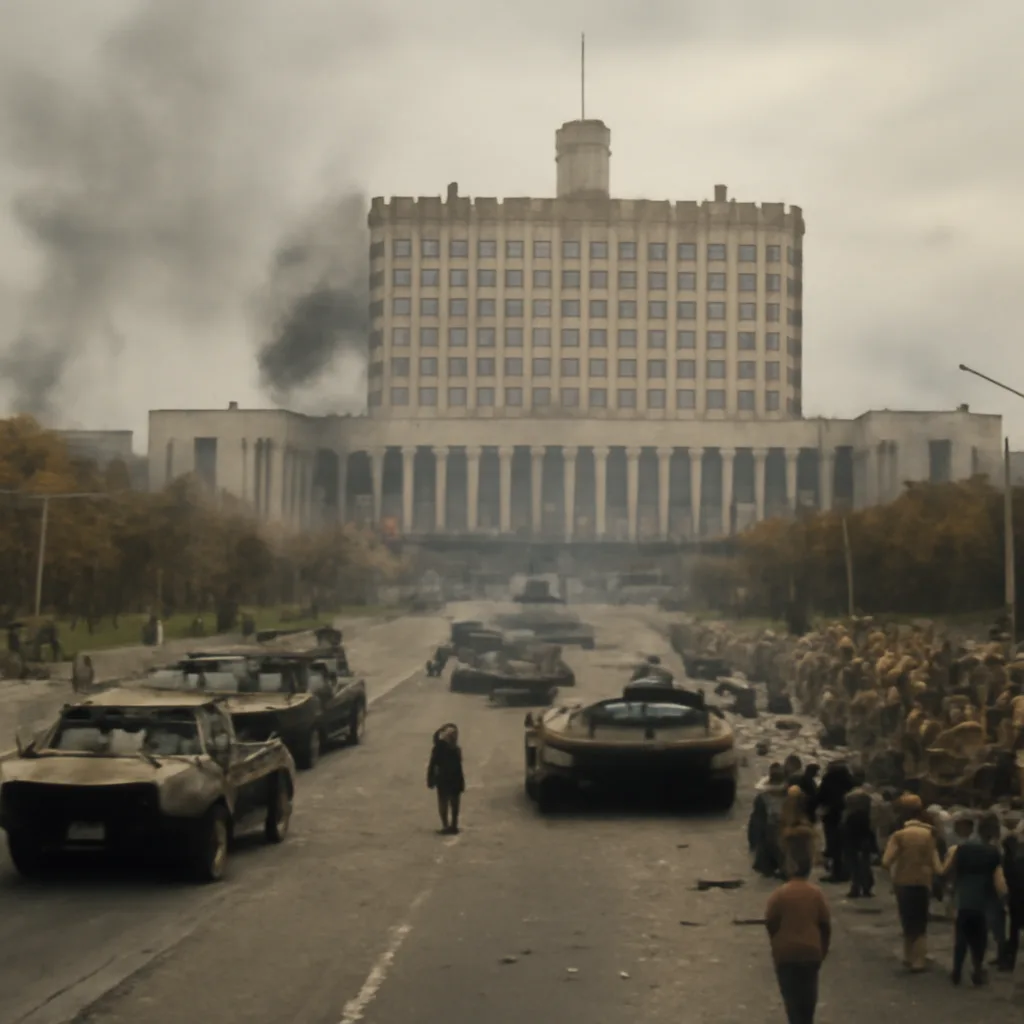
Background By 1993 Russia was engulfed in a constitutional and political struggle between President Boris Yeltsin and the parliament (the Supreme Soviet and its chairman, Ruslan Khasbulatov). Economic dislocation, rapid market reforms, and unclear constitutional arrangements following the Soviet Union’s collapse intensified clashes over the balance of power. Tensions peaked when Yeltsin sought to dissolve the legislature, which the parliament declared illegal and tried to remove Yeltsin from office. Crisis escalation In late September 1993 the standoff escalated. On September 21, a group of opposition deputies and their supporters occupied the White House (the Russian parliament building) and established barricades. Armed clashes and sporadic violence occurred across Moscow as pro- and anti-Yeltsin forces confronted each other. The city saw street fighting, checkpoints, and mobilization of both volunteer militias and regular security units. Legal and political claims Both sides claimed legality. Yeltsin asserted his authority to dissolve the parliament and called new elections and a referendum on a new constitution, arguing that the legislature was obstructing necessary reforms. The parliament countered that Yeltsin’s decree was unconstitutional and voted to impeach him and appoint an alternative acting president. International observers and foreign governments expressed alarm and urged restraint. The decision to use force After days of failed negotiations and rising violence, Yeltsin moved to reassert control. On the morning of October 4, 1993 (the widely documented date of the final assault), Yeltsin ordered military units to storm the White House. Tanks and armored personnel carriers were deployed, and artillery fire was directed at the parliament building to suppress armed resistance and shell sections of the occupied structure. The assault followed an ultimatum and preceded a ground assault by troops who cleared the building. Consequences and casualties The immediate outcome was the restoration of Yeltsin’s control over central state institutions and the arrest or dispersal of many opposition leaders, including organized detachments inside and around the White House. Estimates of casualties vary: official Soviet- and Russian-era figures and later assessments differ, with reported deaths ranging from several dozen to several hundred killed and many more wounded. The crisis left deep political scars, accelerating the adoption of a new constitution that expanded presidential powers in December 1993. Historical interpretation Scholars and commentators have disagreed over responsibility and necessity. Some argue Yeltsin’s actions prevented a broader collapse of order and enabled stabilization and reform; others view the shelling and forceful suppression as a breach of democratic norms and a decisive turn toward strong presidential authority in post-Soviet Russia. The events remain contested and are central to debates about Russia’s post-1991 political trajectory. Sources and verification The narrative above is based on widely reported historical accounts of Russia’s 1993 constitutional crisis. Exact casualty figures and legal interpretations are disputed among historians, journalists, and official records. Where dates or claims are contested, historians rely on contemporaneous reporting, government documents, and later archival work to build their assessments.