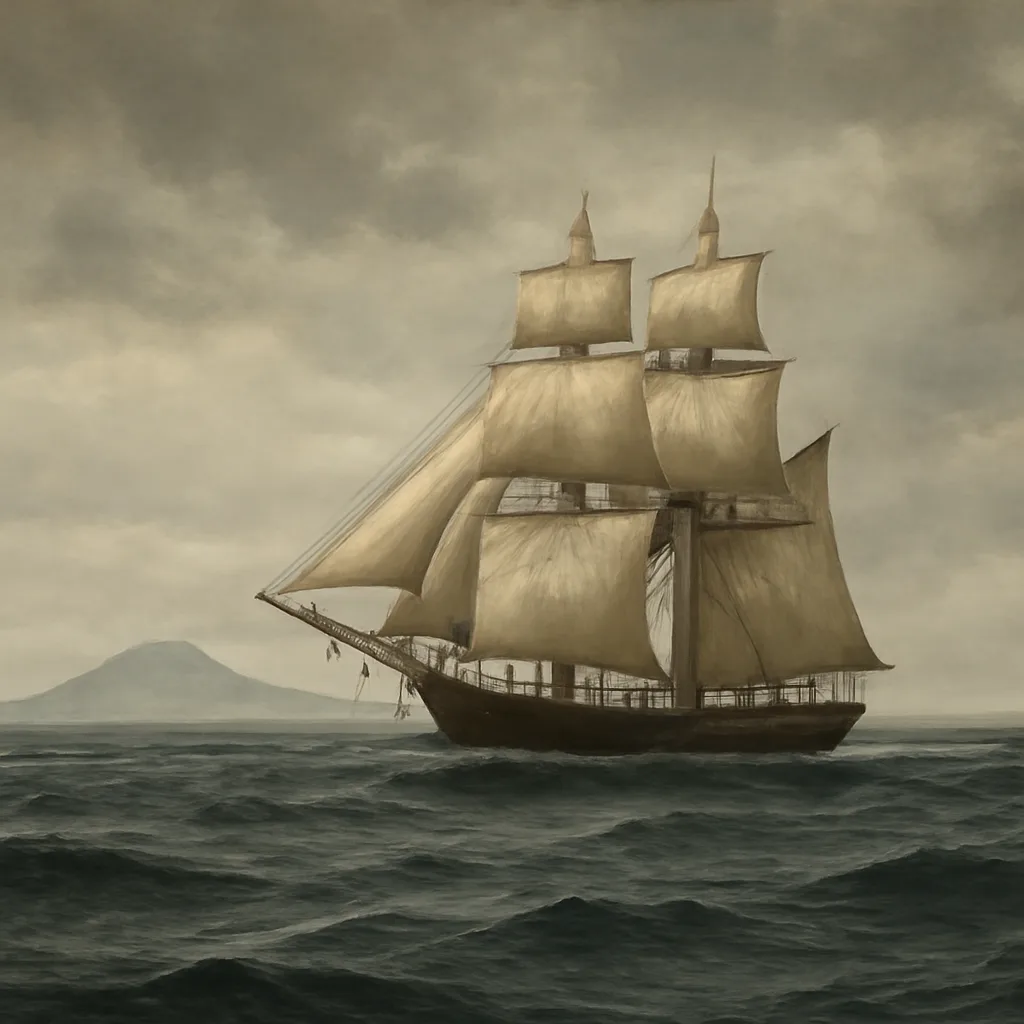
The brigantine Hawaiian Maid was a two-masted sailing vessel active in Pacific interisland and transoceanic trade in the 19th century. Contemporary newspaper notices and shipping registers record that the vessel was last seen departing Hilo, on the island of Hawai‘i, around late February 1872—commonly cited as February 25 in later summaries—bound for destinations along the Pacific trade routes. After her departure she failed to arrive at her next reported port and no wreckage, survivors, or definitive sightings were ever confirmed. Reports of the Hawaiian Maid’s loss circulated in Hawaiian and Pacific newspapers of the period. Those accounts emphasized the vessel’s unexpected disappearance and the absence of debris or bodies washing ashore, which distinguished the case from many contemporaneous losses where wreckage or survivors were ultimately found. The lack of a discovered wreck or conclusive evidence about the ship’s fate made the incident notable to contemporaries and to later chroniclers of Pacific maritime history. Several factors complicate a full factual reconstruction. Nineteenth-century shipping records and press reports occasionally conflict on exact dates and the vessel’s precise last-known course; some secondary sources cite February 25, 1872, as the approximate last sighting, while other contemporary notices give only vague timing. The Hawaiian Maid’s manifest, crew list, and ownership appear in fragmented archival sources but not in a single comprehensive file that resolves these discrepancies. Possible explanations advanced at the time and since include catastrophic weather, collision with uncharted hazards or derelict vessels, sudden structural failure, or a maritime crime such as piracy or seizure—though there is no direct evidence supporting any single cause. The Pacific in the 1870s saw frequent storms and numerous uncharted reefs, and small brigantines could founder quickly in extreme conditions, leaving little trace. Conversely, the absence of wreckage washed ashore, and the lack of subsequent credible sightings, left open the possibility of more unusual scenarios, but those remain speculative and undocumented. Historically, the Hawaiian Maid’s case is often referenced in discussions of 19th-century maritime losses notable for an absence of physical evidence. The incident illustrates limitations of contemporary communication and search capabilities: slow reporting, limited coordinated searches across widely dispersed island stations, and the difficulty of locating wreckage in vast ocean areas. It also reflects the hazards faced by vessels engaged in Pacific commerce during an era of sail, when weather, navigation errors, and poorly charted waters regularly produced unexplained losses. Because primary source material is incomplete and some details vary among period newspapers and later summaries, historians treat specifics—such as the exact day of departure and final intended destination—as uncertain. No authenticated wreck has since been tied to the Hawaiian Maid, and no definitive archaeological or documentary evidence has emerged to resolve her fate. The case therefore remains an early documented instance of a ship that disappeared without a discovered wreck, recorded in contemporary reporting and preserved in maritime registers and regional historiography as unresolved. For researchers, the Hawaiian Maid’s disappearance underscores the value and limits of period newspapers, shipping registries, and port records; further clarity would require locating extant logbooks, insurance records, correspondence from owners or agents, or corroborating archival notices that have not, to date, been assembled into a single authoritative account.