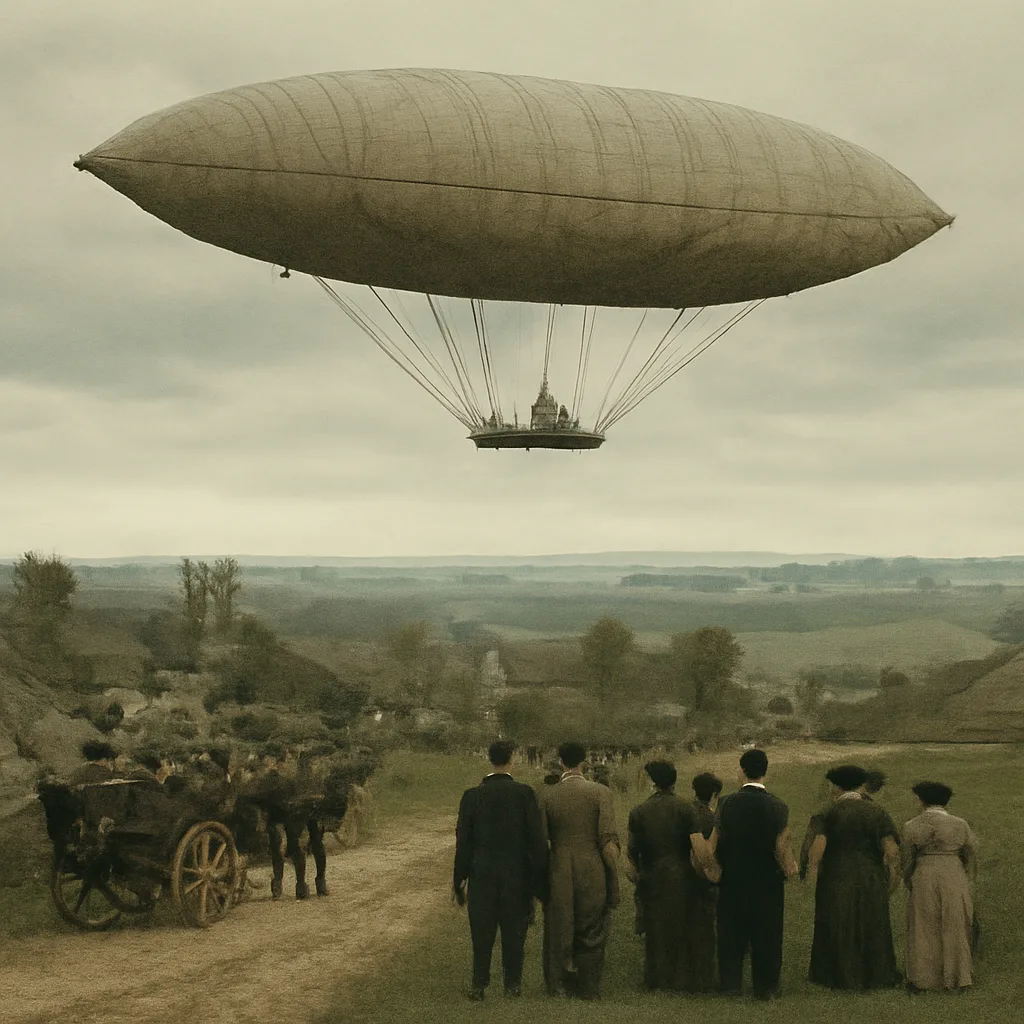
On 25 February 1872, contemporary newspapers and later aviation chronicles record an episode in which an experimental lighter-than-air craft disappeared during a public demonstration in England. The event is notable in early aeronautical history because witnesses and subsequent press coverage described a craft that seemed to vanish without leaving identifiable wreckage on land or water, making it an early instance of an airship disappearance that produced no recovered remains. Context By the 1860s and 1870s, inventors and showmen across Europe and North America were experimenting with balloons and elongated envelopes intended to provide more controlled flight. These craft—sometimes called airships or dirigibles—varied widely in design and used differing lifting gases, propulsion methods, and control surfaces. Public exhibitions were common, and press accounts often mixed technical description with sensational language, complicating later interpretation. The 25 February demonstration Available period accounts place the demonstration on 25 February in the early 1870s; several secondary sources cite 1872 specifically. The craft was reported to be an experimental elongated balloon piloted by an inventor or showman (sources differ on the individual’s identity). Witnesses in nearby towns described seeing the craft ascend on an otherwise clear day and then apparently drift away. According to contemporary newspaper dispatches, observers reported that within a relatively short time the airship was no longer visible and no pieces were found on the ground or along likely drift paths. Contemporaneous reporting and its limits Reporting from the period is fragmentary and sometimes contradictory. Local newspapers and later summaries differ on precise location, the name of the pilot or owner, and technical details of the craft (envelope material, propulsion if any, and whether ballast was jettisoned). Some accounts imply the craft rose higher than intended and was seen to diminish in size until it could not be tracked visually; others suggest it might have descended out of sight over water. No official investigation report, logbook, or authenticated wreckage catalogue from the period has survived that definitively documents cause or outcome. Why the disappearance matters Historians of aviation note the incident because it illustrates the vulnerabilities of early airship experiments: limited communications, imprecise tracking, and dependence on weather. It also highlights how 19th-century reportage could turn technical failures into mysteries when records were lost or incomplete. The lack of wreckage limits modern forensic assessment and leaves the episode subject to differing interpretations. Assessment and uncertainty Because primary-source documentation is incomplete, several possibilities remain plausible: an in-flight structural failure with debris falling into an unsearched area; a steady ascent beyond visual range followed by uncontrolled drift and later disintegration; descent into a body of water where remains were not recovered; or, less credibly, exaggeration or error in contemporary reports. No surviving, verifiable physical evidence has been linked to the flight, and names and technical specifications tied to the craft vary among secondary accounts. Legacy The episode is sometimes cited in surveys of early heavier-than-air and lighter-than-air experimentation as an early instance of an aircraft disappearance without wreckage. It serves as a reminder of the fragmentary nature of 19th-century technological records and the caution required when reconstructing early aviation events from press reports and later retellings. Researchers continue to rely on archival newspaper collections, company or inventor papers where available, and corroborating regional records to refine details of such incidents.