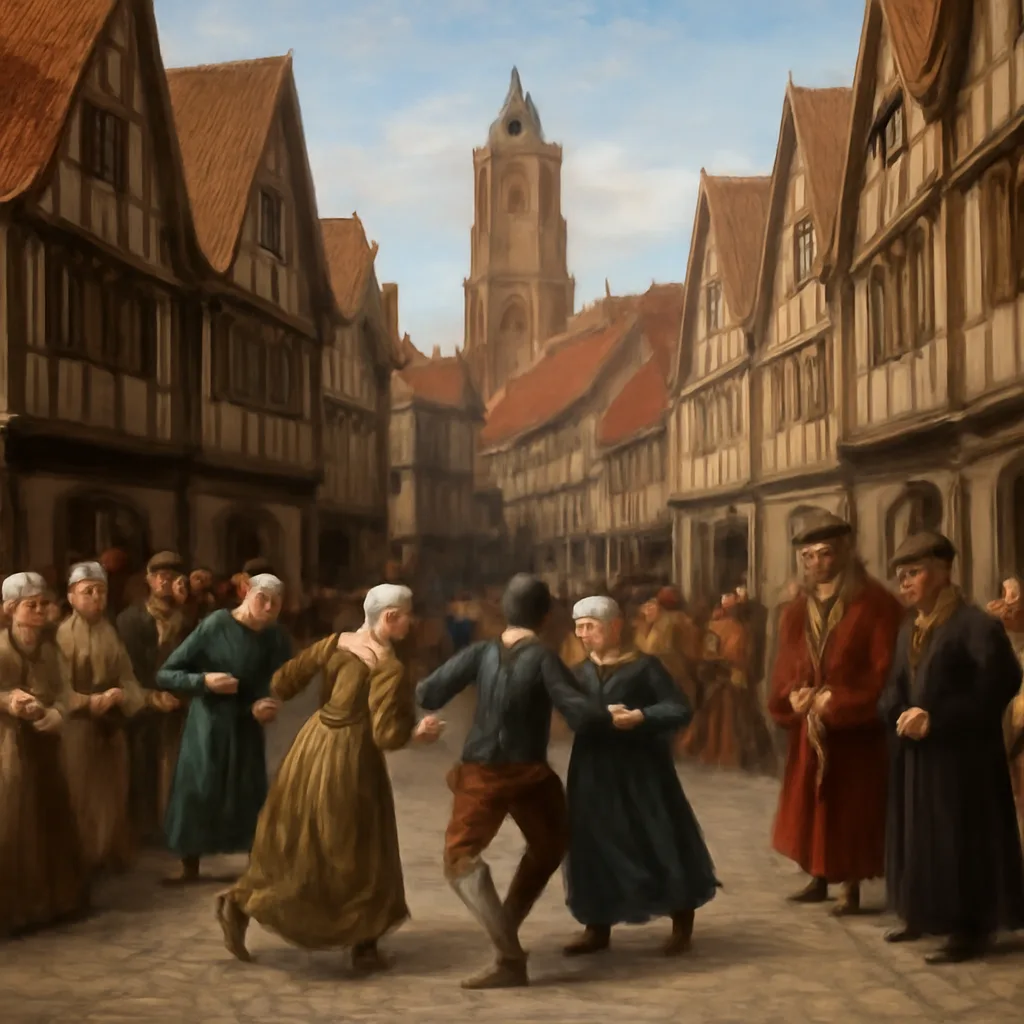
In June 1518 a sudden and alarming phenomenon struck Strasbourg (then called Strassburg) in the Holy Roman Empire: dozens of people—mostly women—began to dance, often nonstop, in the streets. Contemporary municipal records, physicians’ notes, and sermons recorded a cascading outbreak that persisted for weeks. Because these sources are relatively detailed and contemporaneous, historians and medical scholars treat the 1518 event as the earliest well-documented example of what later became known as a ‘‘dancing plague’’ or ‘‘dance mania.’’ What the records describe On or around 24–25 June 1518 multiple individuals began an apparent compulsion to dance. Local chroniclers and town council documents report that within days the number had grown—estimates in surviving records and later summaries cite dozens of participants, with some modern estimates ranging from several dozen up to a few hundred. Reports speak of exhaustion, collapse, and in some accounts deaths attributed to stroke, heart attack, or sheer physical exhaustion. Officials, clergy, and physicians responded by attempting various remedies, from processions and prayers to measures intended to cure or control the dancers. Context and contemporary responses Early-sixteenth-century Alsace was a region marked by social stress: harvest failures, disease, famine, and anxiety about religious and political change. Municipal and church authorities viewed the outbreak through moral, spiritual, and medical lenses. Some contemporaries treated the dancing as a form of possession or divine punishment; others sought secular remedies. Town leaders at times arranged for the dancers to be confined, placed under supervision, or moved to a specialized hall where music and dancing were permitted—an attempt, by some accounts, to exhaust the compulsion—though later historians debate the effectiveness and exact sequence of such measures. Interpretations and debates Modern scholars disagree about causes. Proposed explanations include mass psychogenic illness (collective stress-induced behavior), neurological conditions, ergot poisoning (from Claviceps-infected rye causing convulsions and altered behavior), and sociocultural phenomena—ritualized expression of distress in a premodern urban community. Ergotism has been widely circulated in popular accounts, but many historians and toxicologists argue it poorly fits the documented pattern: ergot typically produces gangrenous symptoms and specific neurological signs not consistently described in the Strasbourg accounts, and the social distribution and progression of the event align more readily with social contagion theories. The 1518 outbreak is important not because any single explanation is universally accepted, but because the municipal records, physicians’ notes, and later chroniclers together provide unusually rich primary documentation for a mass behavioral episode in early modern Europe. The case has since been compared with other ‘‘dance manias’’ recorded across medieval and early modern Europe—episodes that appear intermittently in the historical record and that similarly blend medical, religious, and social interpretations. Legacy The dancing plague of 1518 remains a focal case in studies of mass psychogenic illness, cultural responses to collective stress, and the history of medicine. While scholars continue to debate causes, the event is often cited as a reminder that past communities experienced sudden, communal disorders that confounded contemporary authorities and that modern investigators must interpret through careful examination of fragmentary, context-dependent sources. Sources and reliability This summary is based on surviving municipal records, contemporary chroniclers, and secondary historical and medical literature analyzing the 1518 Strasbourg episode. Many specific numeric details (such as exact counts of participants or fatalities) vary among sources; where accounts disagree, historians typically emphasize uncertainty rather than definitive figures.