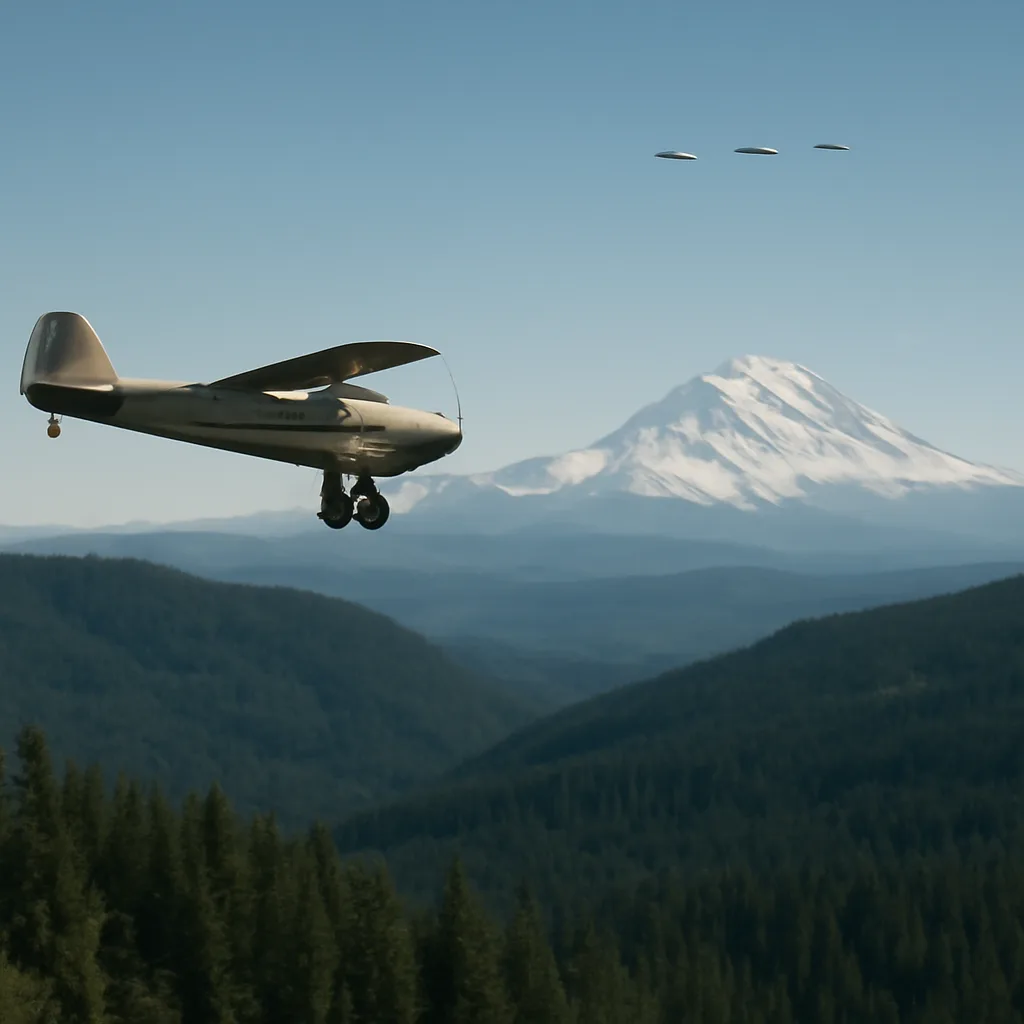
On June 24, 1947, private pilot Kenneth Arnold reported observing nine fast-moving, crescent-shaped objects while flying near Mount Rainier, Washington. Arnold said the objects moved erratically and at great speed, and he estimated distances and velocities that, if accurate, would have exceeded known aircraft performance of the time. He described their motion as “saucer-like,” a phrase later paraphrased by reporters and linked to the origin of the popular term “flying saucer.” Arnold, a businessman and experienced pilot, had been conducting a routine flight when he spotted the objects while searching for a downed military transport. He provided a relatively detailed account to local authorities and journalists soon after landing. Word of his sighting spread rapidly: newspapers picked up the story, wire services relayed it nationwide, and subsequent public interest intensified as other reports of strange aerial objects emerged. The immediate public reaction combined curiosity, excitement, and skepticism. Media coverage varied from straightforward reporting of Arnold’s statements to sensational headlines that emphasized the “flying saucer” imagery. Arnold himself expressed frustration that his original description—focused on movement and shape—was shortened and sensationalized in many accounts. Historians note that the term “flying saucer” and the intense media focus helped frame subsequent public and official discussions about unidentified aerial phenomena in the United States. Officials responded cautiously. Local law enforcement and air-traffic authorities took initial statements, and the U.S. Army Air Forces (the predecessor of the U.S. Air Force) monitored developments. In the months that followed, military and civilian agencies collected additional reports, leading to investigations and internal assessments. Some investigators concluded that a variety of factors—misidentified conventional aircraft, weather phenomena, optical illusions, or wishful interpretation—could explain some sightings. Others found certain reports, including aspects of Arnold’s account, difficult to reconcile fully with mundane explanations. Arnold’s sighting had two lasting impacts. First, it punctuated a rapid rise in public interest and media coverage of unidentified aerial phenomena, contributing to a wave of reported sightings across the United States in 1947 and beyond. Second, it prompted more systematic attention from military and government agencies tasked with assessing potential national-security implications. In subsequent years, official efforts to investigate sightings led to programs and studies aimed at cataloging reports and determining whether they posed threats or could be explained by known phenomena. Modern researchers and historians treat Arnold’s report as an important early datum in the broader mid-20th-century history of UFO reports. While some scholars emphasize the social and cultural dynamics—media amplification, Cold War anxieties, and popular imagination—that magnified interest in such accounts, others focus on the chronology and content of eyewitness reports as material for analysis. Arnold’s own testimony and subsequent interviews remain publicly available and have been scrutinized in both skeptical and sympathetic studies. Uncertainties remain. Estimates of speed and distance based on Arnold’s observations are imprecise, and retrospective analysis must account for human perceptual limits and the difficulties of estimating size and velocity without reference points. No physical evidence tied directly to Arnold’s sighting has been produced. As a result, historians present Arnold’s report as historically significant for its role in shaping public discourse and institutional responses to unidentified aerial phenomena, while acknowledging the limits of what the available evidence can conclusively demonstrate.