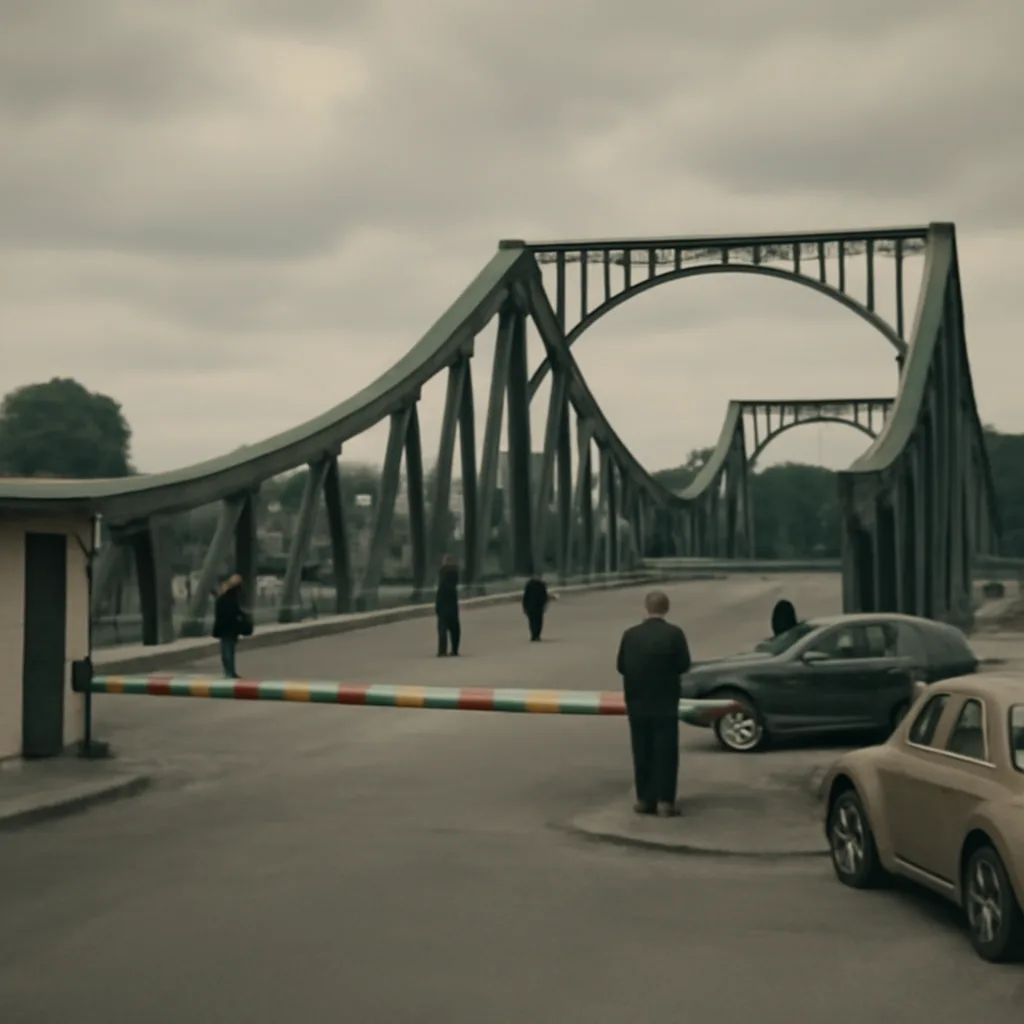
On 10 August, 1962, the Glienicke Bridge linking West Berlin and Potsdam was the site of a high-profile Cold War prisoner exchange between the United States and the Soviet bloc, trading captured intelligence personnel in a rare, negotiated swap.
On 10 August 1962, the Glienicke Bridge (often called the “Bridge of Spies”) again served as a controlled meeting point for a Cold War prisoner exchange between the United States and the Soviet bloc. The bridge, spanning the Havel River and connecting West Berlin to Potsdam in East Germany, had become a symbolic and practical venue for such transfers because of its location on the boundary between East and West and its restricted, easily secured roadway.
The exchange on this date involved intelligence personnel held by each side. Over the course of the late 1950s and early 1960s, both superpowers routinely detained foreign agents, defectors, and couriers; periodically they negotiated swaps to recover valuable operatives and to secure diplomatic face-saving outcomes. The 10 August event was one of several exchanges that underscored the pragmatic, transactional dimension of espionage during a period of intense geopolitical tension. These exchanges were typically choreographed by intermediaries, often with the knowledge or overt involvement of national governments, and were arranged to minimize the risk of incident in a highly charged environment.
Security on and around the bridge was tight for these operations. Guards, police, and intelligence officers from the relevant authorities controlled access, while vehicles and personnel met at predetermined points. Participants frequently arrived in official or unmarked cars; the transfer itself involved brief, formal handovers and swift departures to reduce vulnerability. Media attention varied: some swaps were publicized afterwards as part of government statements, while others remained discreet to protect ongoing intelligence operations and the identities of sources.
Historical accounts note that exchanges like the 10 August swap carried symbolic weight beyond the individuals exchanged. They were public demonstrations that, despite ideological hostility, the two blocs could still conduct negotiations and resolve selected disputes. For the families of those returned, the events were personal reunions; for governments, they were pragmatic recoveries of assets or prisoners who might otherwise be used for propaganda or further bargaining.
Documentation of Cold War prisoner exchanges is drawn from government records, memoirs of diplomats and intelligence officers, contemporary press coverage, and later historical research. Some details of individual swaps—such as exact lists of exchanged personnel or the full negotiation record—remain classified or contested, so historians sometimes rely on corroborating sources to reconstruct events. The Glienicke Bridge exchanges, including the 10 August 1962 transfer, remain emblematic of the era’s mixture of secrecy, diplomacy, and high-stakes intelligence work.
After the Cold War, the bridge’s history has been commemorated in books, films, and museum exhibits that explore the complex human stories behind these brief but consequential meetings. The physical site remains a tangible reminder of the divided city and of the delicate, often hidden procedures through which rival powers managed some of their most sensitive confrontations.