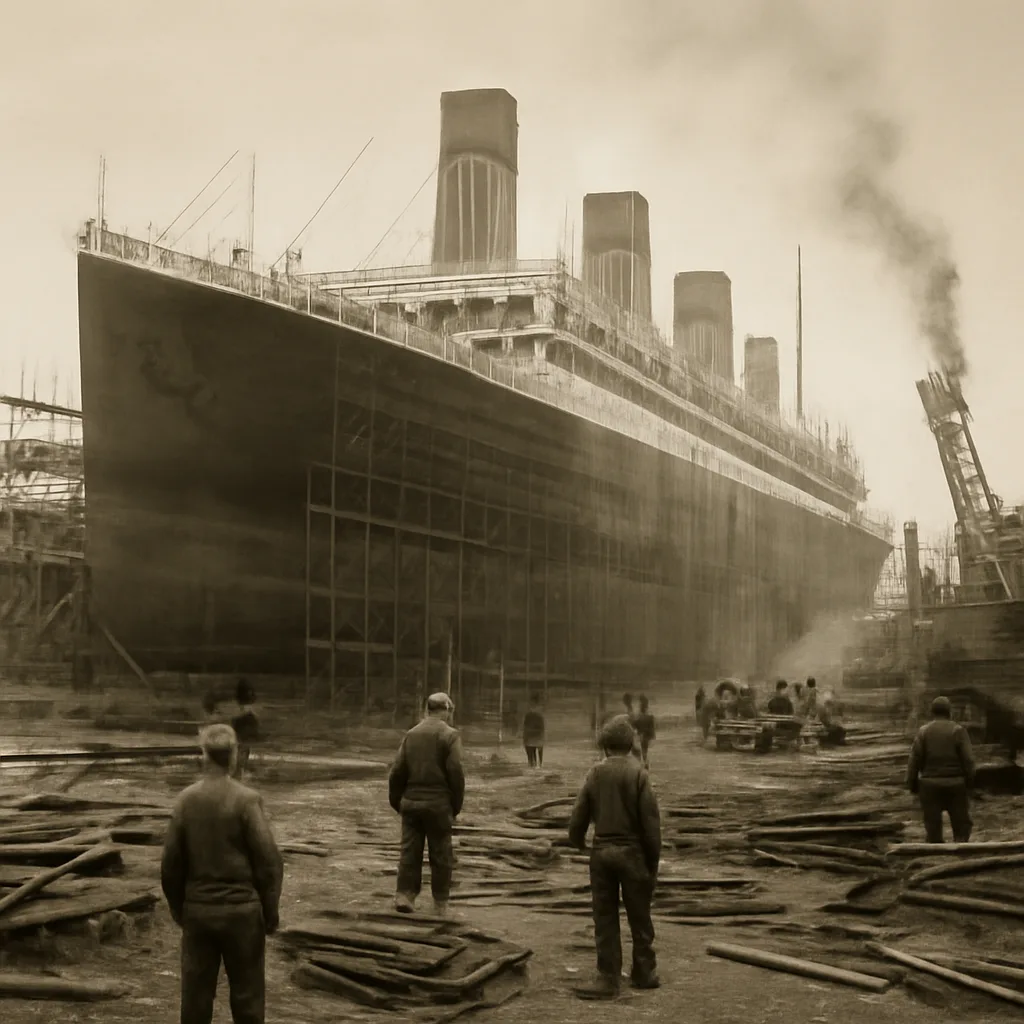
On March 31, the hull and principal outfitting of RMS Titanic were declared complete at Harland & Wolff's shipyard in Belfast, where she had been laid down and assembled as part of the White Star Line’s Olympic-class trio. Construction began in 1909 and proceeded through successive stages of steelwork, decking, interior fit-out and installation of engines, boilers and auxiliary machinery. By late March the ship’s exterior structure, funnels, lifeboat davits and much of the visible superstructure were in place, and finishing work was being carried out ahead of trials and delivery. Harland & Wolff was one of Britain’s preeminent shipbuilders, and the Belfast yard had been expanded and retooled to accommodate the unprecedented scale of the Olympic-class liners. Titanic and her sister ship Olympic were designed to offer unprecedented luxury and passenger capacity across first, second and third classes. Technological features included triple-screw propulsion driven by two reciprocating steam engines and one centrally placed turbine, heavy steel framing, and compartmentalisation intended to improve buoyancy in the event of hull damage—features that reflected contemporary naval architecture and commercial priorities of speed, comfort and safety. Completion at the yard did not mean the ship was immediately ready to carry paying passengers. After the final outfitting and inspections, Titanic underwent sea trials to test propulsion, steering and other operational systems. Those trials were scheduled and executed in the weeks following the yard completion. Once trials and the official handover to White Star Line were concluded, the liner prepared for her transatlantic maiden voyage from Southampton to New York, with stops at Cherbourg and Queenstown (now Cobh). Contemporary press coverage of the completion emphasised the scale and grandeur of the vessel, as well as the technical skill required to build her. The project involved thousands of workers at Harland & Wolff and numerous subcontractors supplying engines, boilers, fittings and interior furnishings drawn from sources across Britain and Ireland. Shipyards of the era often timed publicity around key construction milestones—steel-cutting, launching, completion and trials—to showcase industrial capability and attract investors and customers. The date of completion is significant in histories of Titanic because it marks the transition from construction to operational testing and commercial deployment. Historians note that while many features reflected best practices of the time—such as watertight bulkheads and a double bottom—some design and operational decisions, including lifeboat provision relative to passenger capacity, reflected regulatory standards and company practices then in force rather than later expectations. Primary documentary sources for Titanic’s construction and completion include Harland & Wolff yard records, White Star Line correspondence, contemporary newspaper reports and later investigative records. These materials provide detailed accounts of timelines, costs, workforce scale and the technical specifications of the ship’s structure and systems. Where specific dates and descriptions vary between sources, historians indicate such discrepancies and rely on surviving corporate and governmental records to establish the most reliable chronologies. The completion of Titanic at Harland & Wolff is therefore a well-documented industrial milestone: the conclusion of a concentrated shipbuilding effort that produced one of the largest and most luxurious transatlantic liners of its time and set the stage for the ship’s fateful voyage weeks later.