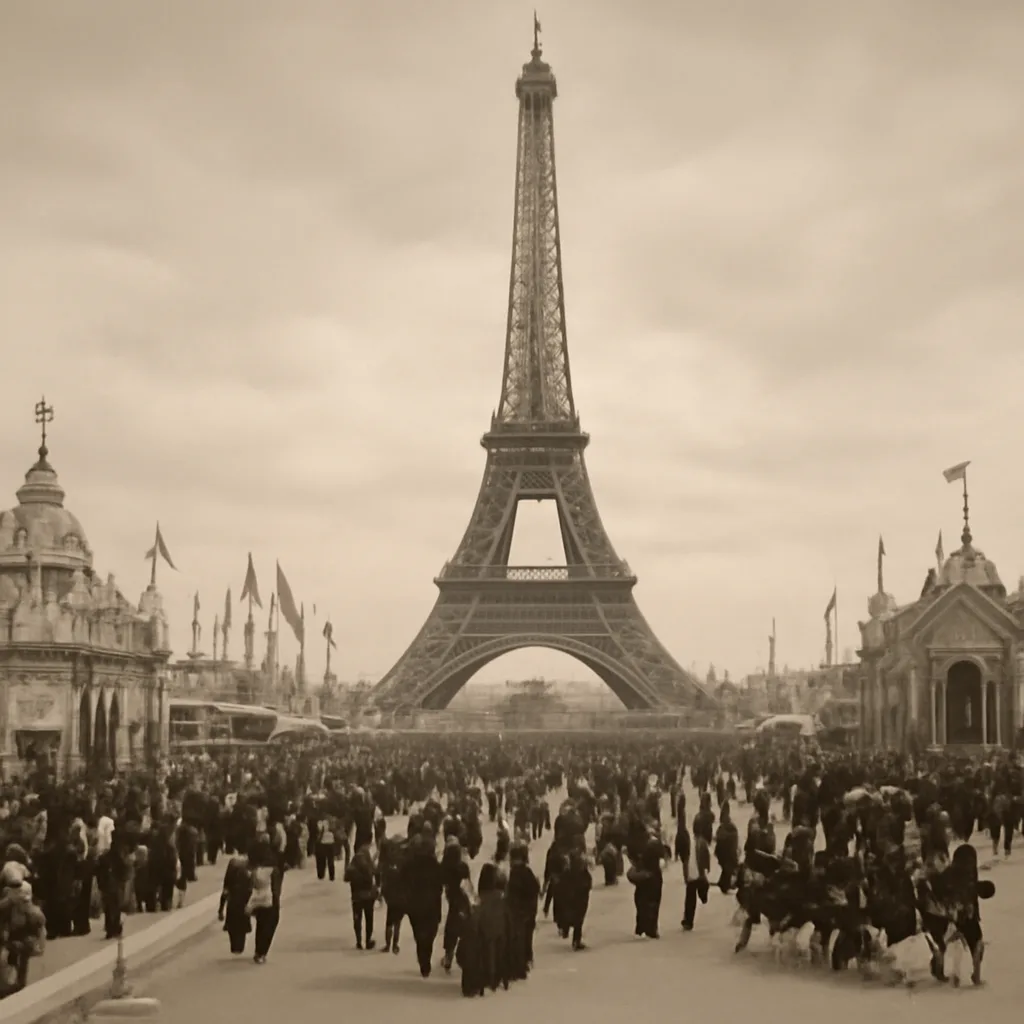
On March 31, 1889, the Eiffel Tower—designed by engineer Gustave Eiffel and completed for the 1889 Exposition Universelle (World’s Fair)—was opened to the public in Paris. Built as the entrance arch to the exposition, the 300-metre (984-foot) structure demonstrated advances in iron construction and engineering, becoming a focal point for visitors and a symbol of modernity. Construction began in January 1887 and proceeded rapidly: the tower’s wrought-iron lattice was assembled from prefabricated pieces bolted together on-site. The design grew out of a proposal by the firm of Eiffel and his chief engineers, Maurice Koechlin and Émile Nouguier, with architect Stephen Sauvestre contributing ornamentation and finishing details. The project employed hundreds of workers and used several thousand tons of iron; scaffolding and cranes of the period facilitated assembly at unprecedented heights. At the time of its unveiling, the Eiffel Tower was the tallest man-made structure in the world. Its height and exposed iron framework epitomized the industrial age and provoked a wide range of reactions. Many lauded its audacity and celebrated its role as an emblem of French engineering prowess; others—particularly some artists and writers—criticized its aesthetics and called it an eyesore that clashed with Parisian architectural traditions. A well-known petition signed by several prominent cultural figures protested the tower’s construction, arguing it would be a blight on the city’s skyline. During the Exposition Universelle, the tower drew large crowds who ascended via stairways and, later, elevators installed to carry visitors to its platforms. The tower housed restaurants and viewing platforms that offered sweeping vistas over Paris, a new experience for many visitors. Engineers also used the height of the structure for scientific experiments, including meteorological observations and early telecommunications work. Although originally intended to be dismantled after twenty years, the Eiffel Tower’s practical uses—most notably for wireless telegraphy and later radio transmission—helped secure its preservation. Over subsequent decades the tower underwent maintenance, paint cycles, and modifications (including elevator and lighting upgrades) while becoming an enduring symbol of Paris and France. Historical assessments emphasize both the tower’s technical significance and the cultural controversies it stirred at its opening. Its rapid construction, ambitious scale, and subsequent adaptation for scientific and communication uses illustrate how a single engineering project can reshape a city’s identity and the public imagination. Note: While March 31, 1889, is widely cited as the date the tower opened to the public during the exposition, sources occasionally reference other inauguration-related dates tied to the exposition’s broader ceremonies; these are distinct from the tower’s documented public opening.