Revising the Toll: How Estimates of the Great Chicago Fire’s Dead Grew Later
Initial reports of the Great Chicago Fire (October 1871) placed the dead in the dozens to low hundreds; in subsequent decades, historians and journalists raised the estimate—sometimes into the thousands—as records, definitions of disaster casualties, and civic narratives changed.
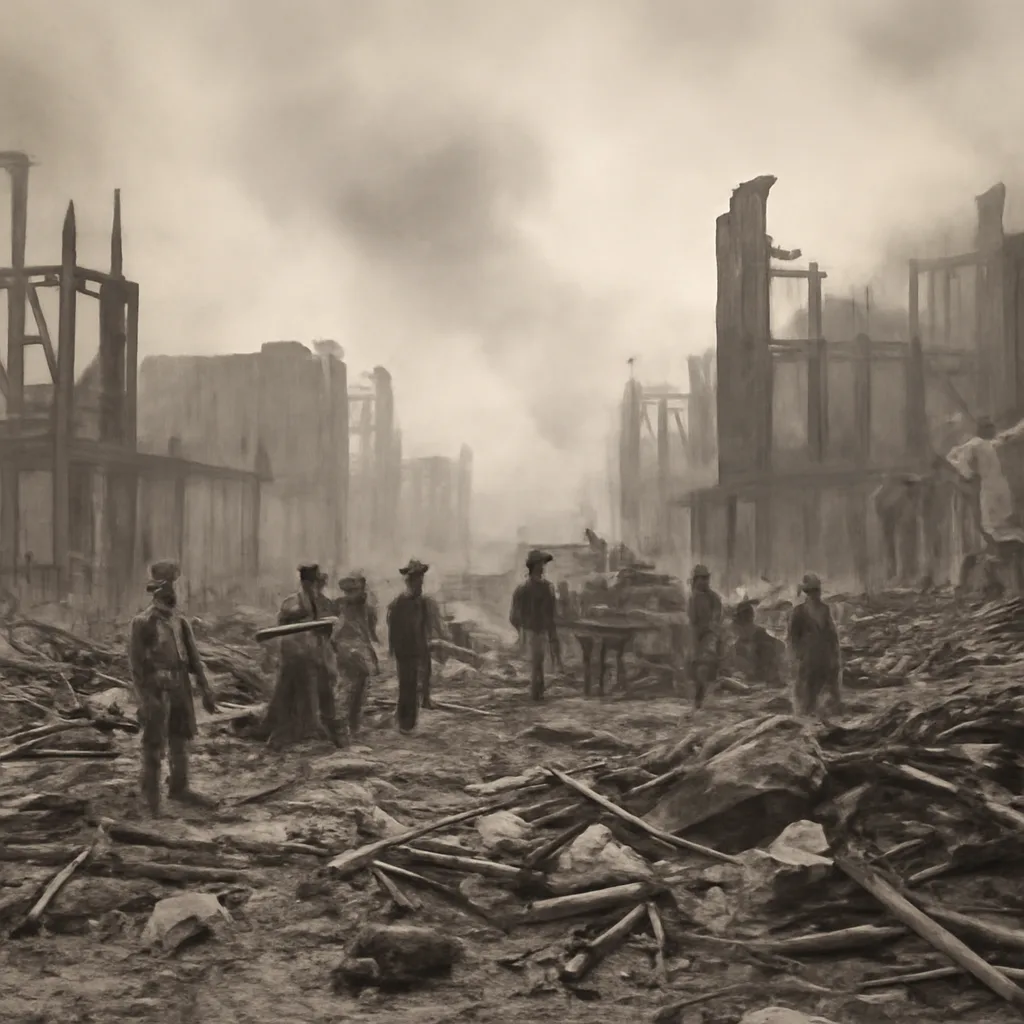
On October 8, 1871, a conflagration that began on Chicago’s Near West Side spread through tinder-dry wooden neighborhoods and destroyed much of the city. Contemporary newspaper accounts and official statements produced widely varying death counts in the immediate aftermath. Early tallies—based on bodies recovered, burials, and eyewitness reports—typically ranged from a few dozen to several hundred. A definitive, contemporaneous municipal census of fatalities was never completed.
Over the following decades, estimates of the fire’s death toll increased. Several factors help explain why later figures grew beyond early counts without necessarily contradicting them.
Incomplete contemporary records: The speed and scale of the disaster disrupted record-keeping. Many residents were transient, lodging in boardinghouses or temporary shelters, and identification practices were limited. Some bodies were burned beyond recognition, others buried quickly in mass graves, and some displaced people who died later of burn-related injuries or exposure were not always linked back to the fire in official counts.
Changing definitions of fatalities: In the 19th century, casualty reporting often focused on immediate, confirmed deaths. Over time, historians and public officials broadened the scope to include those who later died of injuries or illness attributable to the fire, people who perished during displacements, and those whose deaths were inferred from missing-person reports. This broader framing raised posthumous totals.
Civic memory and narrative shaping: As Chicago rebuilt and competed for national prominence, retellings of the fire sometimes altered numbers for rhetorical effect—emphasizing either the city’s miraculous recovery or the scale of its original sacrifice. Newspapers, commemorative histories, and guidebooks written years after 1871 sometimes cited higher figures without always documenting methodological bases.
Archival discoveries and historiography: Later researchers consulting burial registers, hospital records, insurance documents, and church logs occasionally found additional names or cross-referenced missing-person lists, incrementally increasing casualty estimates. Historians have also noted that municipal records from the era are inconsistent, meaning that any single historic number carries uncertainty.
Estimates cited in the 20th century and beyond varied: some secondary sources repeated nineteenth-century tallies of several hundred deaths, while others presented figures in the low thousands. Modern scholarly consensus does not converge on a single precise number; many contemporary historians treat the fatality count as unknown within a plausible range rather than as a fixed statistic.
What scholars agree on is qualitative: the human cost was substantial, the social effects were profound, and official record-keeping flaws mean that exact tallies are likely forever uncertain. For readers and researchers, the shifting numbers illustrate how disasters are quantified differently across time depending on available evidence, definitional choices, and the purposes of those doing the counting.
In short, increases in the reported death toll of the Great Chicago Fire arose from incomplete immediate records, broader definitions of fire-related deaths, later archival work, and the ways civic memory reframed the catastrophe. While later figures may better capture the full human impact, historians caution against treating any single revised number as definitive.