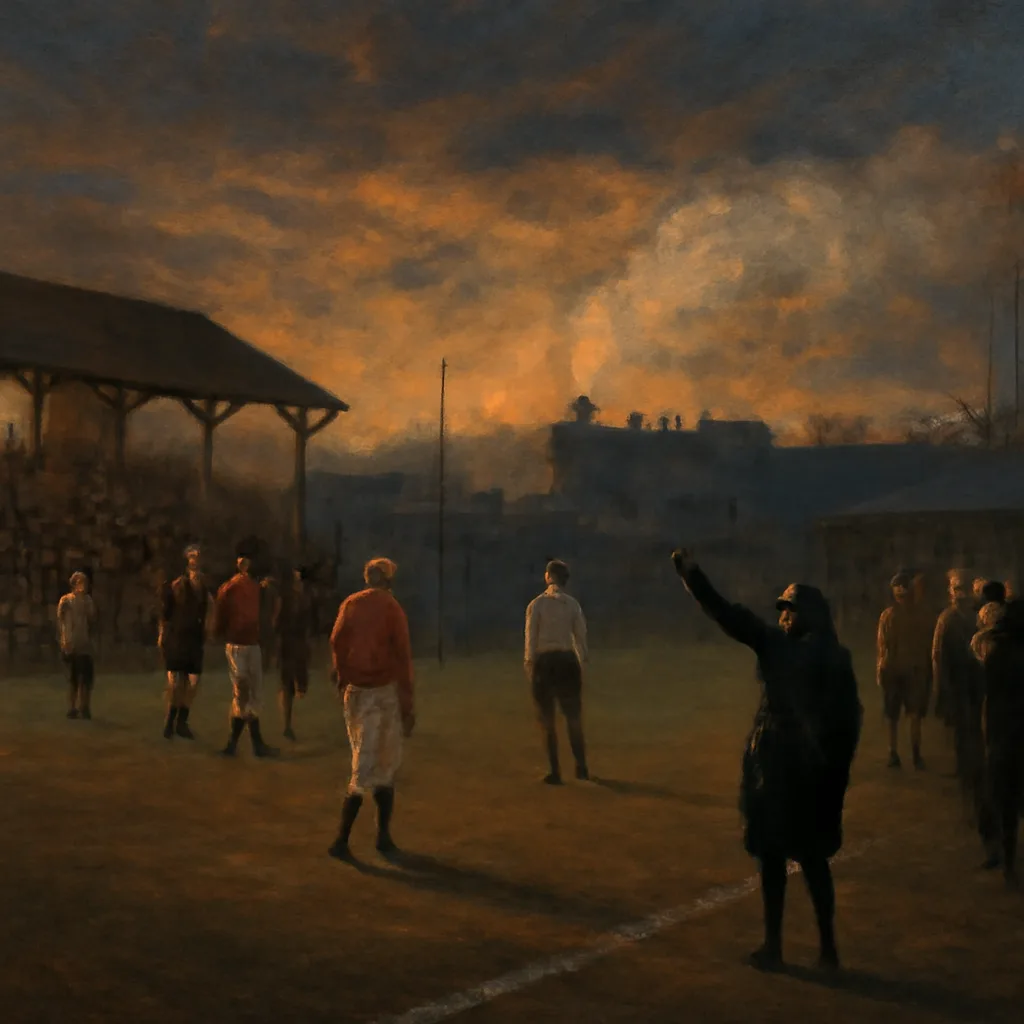
Referee Stops 1905 Football Match Early to Catch Train
On December 29, 1905, a referee reportedly ended a football match before full time so he could catch a scheduled train home, an incident that illustrates the informal, travel-dependent nature of early organized football.
On December 29, 1905, contemporary accounts record an unusual interruption of play: a referee ended a football match before the allotted time so he could make a scheduled train. The episode, reported in local newspapers of the period, provides a small but telling window into the practical realities of early 20th-century sport, when officials and players often relied on public transport and local arrangements rather than formalized professional schedules.
Context
In 1905 association football (soccer) in Britain was in a transitional era. The Football League had been established in 1888 and the FA Cup was well established, but many matches — particularly lower-division, cup replay, friendly or county fixtures — were organized with modest resources. Officials were often part-time and traveled to matches by tram, omnibus or train. Travel times and timetables could therefore shape when participants needed to leave a ground.
The Incident
Reports indicate that on the evening of December 29, 1905, a match was halted short of its scheduled finish when the referee, faced with the prospect of missing his return train, declared the contest over. Contemporary coverage treated the event as both pragmatic and mildly amusing rather than scandalous. Accounts emphasize the referee’s duty to keep to his travel arrangements and the limited recourse available to clubs and spectators when public transportation imposed hard deadlines.
Significance
This occurrence has been cited by historians and local chroniclers as emblematic of the period’s amateur ethos and logistical constraints. It underscores how the organization of sport was sometimes subordinate to the everyday necessities of its participants. Unlike modern professional referees, early officials balanced match responsibilities with other employment and personal travel plans; a missed train could mean significant hardship or inability to fulfill other commitments.
Limitations and sources
Details about the specific clubs involved, the competition level, and the precise score at stoppage vary between contemporary reports, and some accounts are brief or anecdotal. Surviving newspaper articles from December 1905 form the basis for the story, but not all contemporary papers carried extensive follow-up, and there is no single authoritative match report that preserves every detail. Where accounts differ, the consistent element is that the referee ended the match early to catch a train rather than a widely reported disciplinary or safety reason.
Legacy
The anecdote is often invoked in histories of football to illustrate how much the game’s administration and the lives of participants have changed. Over the decades that followed, the rise of full-time officials, organized fixture lists, and improved travel arrangements reduced the likelihood that transport commitments would truncate a match. Today the notion of a referee stopping play primarily to catch a train belongs to sporting folklore rather than modern practice.
The December 29, 1905 episode remains a concise historical reminder that sport operates within broader social and infrastructural constraints, and that small logistical realities could, at times, decisively shape the play on the field.