
Opening of the First Modern Olympic Games in Athens, 1896
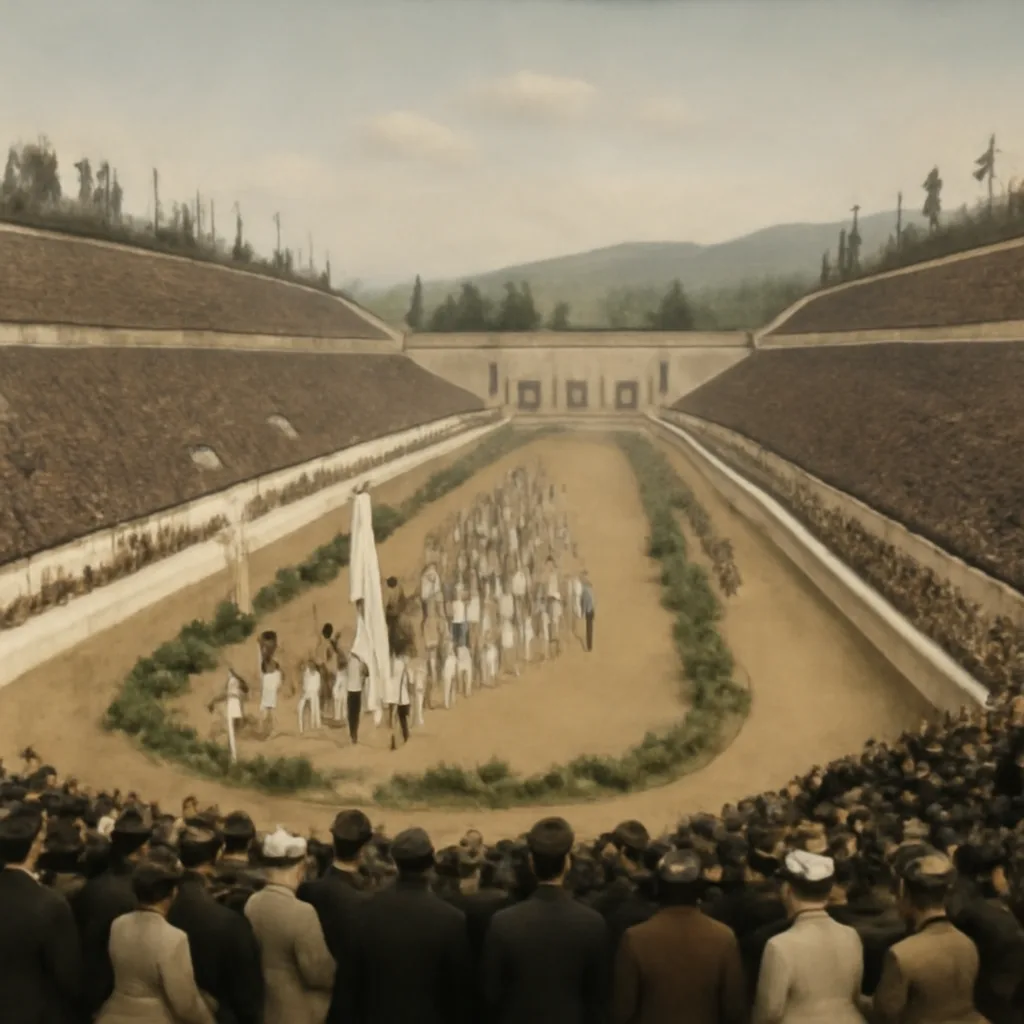
On April 6, 1896, Athens hosted the opening ceremony of the first modern Olympic Games, organized under the auspices of the International Olympic Committee and inspired by Greek classical heritage. The event marked the revival of the Olympic tradition in a modern international sporting format.
On April 6, 1896, King George I of Greece officially opened the first modern Olympic Games in Athens, an event widely recognised as the revival of the ancient Panhellenic athletic tradition in a contemporary international context. The games resulted from efforts led by French educator Pierre de Coubertin, who founded the International Olympic Committee (IOC) in 1894 and advocated for an international multi-sport competition modeled in part on ancient Greek athletics and on contemporary national and international sporting festivals.
Preparations and setting
The 1896 Games were held primarily at the Panathenaic Stadium (also called Kallimarmaro), a restored marble stadium in Athens rebuilt on the site of an ancient arena. The Greek government and private donors contributed to renovations to accommodate several thousand spectators. Events ran from April 6 to April 15 and included athletics (track and field), gymnastics, swimming, wrestling, weightlifting, fencing, cycling, shooting, and tennis. Competitors came from a range of countries, though precise national representation varied by sport and entry lists; approximately 240 athletes from 14 nations are commonly cited in contemporary and later accounts.
Ceremony and public response
The opening ceremony included military and civil processions, speeches, and religious observances reflective of the host nation's interest in linking modern competition to Greece's classical past. King George I attended and declared the games open. International press and public reaction was generally enthusiastic, though the scale and organisation were modest compared with later Olympiads. The Games drew both Greek athletes and a notable contingent of foreign competitors; among foreign participants were athletes from countries including Germany, France, Great Britain, the United States, and others.
Competitions and notable outcomes
Athletics events drew particular attention. The marathon, inspired by the ancient run from Marathon to Athens and won by Greek runner Spiridon Louis, became the symbolic highlight of the Games and helped secure popular support in Greece for the modern Olympic movement. Other events produced winners from several nations; for example, American athletes performed strongly in track and field, while cyclists and gymnasts from European countries also claimed victories. At the time, winners received silver medals and olive branches, while runners-up received copper or bronze medals; the now-standard gold–silver–bronze medal format was adopted later.
Historical significance and limitations
The 1896 Athens Olympics are significant for establishing the modern Olympic Games as a recurring international sporting event under the IOC’s guidance. They demonstrated the feasibility of organizing multi-sport international competitions and inspired subsequent Olympiads, beginning with Paris in 1900. However, the 1896 Games were limited in scope: participation was smaller and less globally representative than in later decades, and organisational practices, standards for entry and national teams, and event rules were still evolving. Contemporary records vary somewhat on exact participant numbers and national representation, and historians note that reporting from the period can be inconsistent.
Legacy
The Athens Games cemented the marathon as an enduring Olympic event and linked the modern Olympics to classical symbolism and modern nationalism. They helped establish traditions of opening ceremonies and multi-sport scheduling that were elaborated in later Games. While modest by later standards, the 1896 Olympics are widely acknowledged as the starting point of the modern Olympic movement and remain a focal point for discussions about sport, internationalism, and cultural revival at the turn of the 20th century.