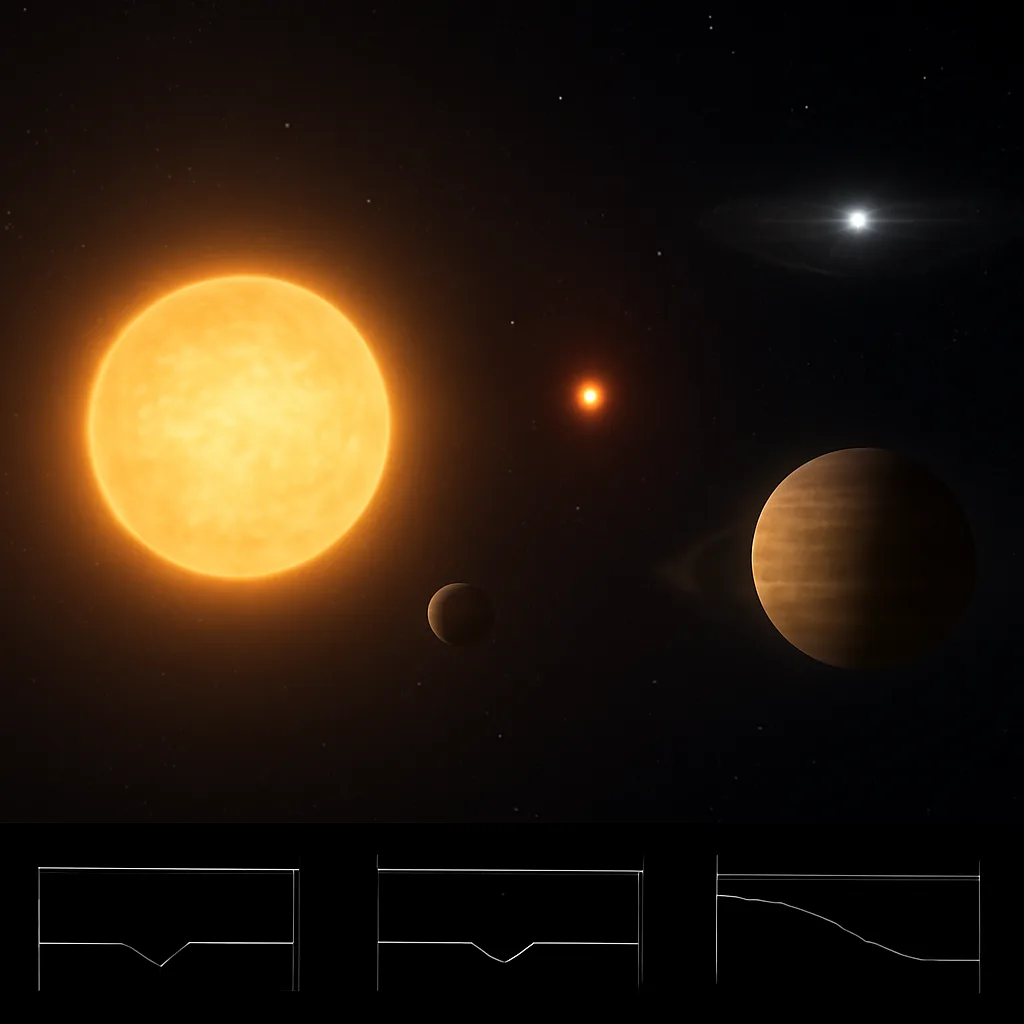
On September 4 (year unspecified by the announcement), NASA announced the identification of multiple exoplanets discovered through its most recent survey efforts and subsequent follow-up observations. The announcement adds several confirmed planets to the growing catalog of extrasolar worlds and highlights advances in detection methods, data analysis, and cooperative ground- and space-based observing campaigns. Scope of the discovery NASA’s release describes a set of newly confirmed exoplanets detected around different host stars. The discoveries come from combining time-series photometry—searching for periodic dips in starlight as planets transit their stars—with radial velocity and other follow-up measurements to confirm planetary mass and rule out false positives. Some planets were identified in data from NASA missions, while others were confirmed with observations from partner observatories. Types and orbital properties The newly confirmed planets represent a range of sizes and orbital configurations. Reports commonly note planets spanning sub-Neptune to Jupiter size regimes, with orbital periods from a few days for close-in planets to many months for wider orbits. Where available, NASA’s summary includes estimates of planetary radius, minimum or measured mass, orbital eccentricity, and equilibrium temperature. For many of the planets, host-star characterization—spectral type, radius, and luminosity—was essential to translate transit depths into planet sizes. Detection and confirmation methods NASA emphasized the importance of multiple, independent lines of evidence for confirmation. Transit detections in space-based photometry served as candidates; ground-based telescopes and spectrographs provided radial-velocity measurements to estimate mass and exclude stellar binary scenarios. In some cases, high-resolution imaging was used to detect nearby stellar companions that could dilute transit signals. Statistical validation techniques were also employed for candidates lacking full dynamical confirmation, assigning a high probability that the signals are planetary. Scientific significance Each confirmed exoplanet expands parameter space for comparative planetology—helping astronomers study how planet sizes, compositions, and atmospheres vary with host-star properties and orbital environment. Particularly valuable are planets orbiting bright, nearby stars, which are prime targets for atmospheric characterization with spectrographs on ground-based telescopes and space observatories. The announcement notes potential targets for future observation campaigns aimed at detecting atmospheric constituents, measuring precise masses and radii, and constraining formation histories. Context within ongoing missions and collaborations The discoveries reflect continuing productivity from NASA’s exoplanet-focused missions and the broader international network of observatories and researchers. Space telescopes provide precise, long-duration photometry, while coordinated follow-up—often involving university, national, and private observatories—secures the measurements needed for confirmation. NASA’s announcement underscores that growing data volumes and improved analysis pipelines are increasing the rate at which candidate signals can be vetted and confirmed. Limitations and next steps NASA’s summary is careful to distinguish between fully confirmed planets and statistically validated candidates that still require dynamical confirmation. For planets with only radius measurements, mass remains an important unknown for determining bulk composition. The agency and partner teams plan continued radial-velocity monitoring, transit-timing studies, and high-contrast imaging to refine orbital parameters and search for additional planets in the same systems. Future atmospheric follow-up will depend on target brightness, planet size and temperature, and available telescope time. Conclusion The announcement adds multiple exoplanets to the known inventory of worlds beyond the Solar System and demonstrates the ongoing refinement of detection and confirmation techniques. While technical details—such as exact masses, radii, and host-star identifiers—are provided in NASA’s full data release and accompanying literature, the headline finding is that coordinated survey and follow-up efforts continue to populate a diverse exoplanet catalog and to produce new targets for atmospheric and dynamical study.