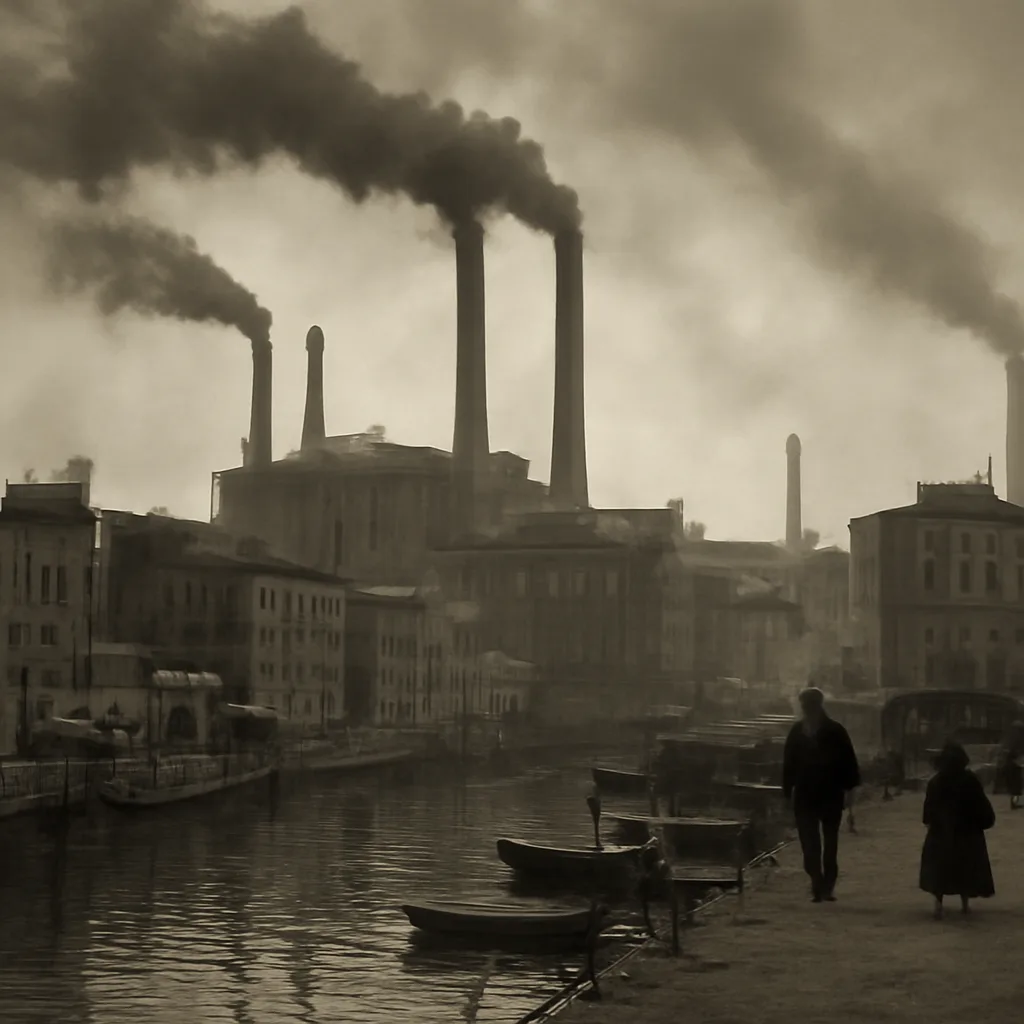
Background By the late 19th and early 20th centuries, rapid industrialization across Europe and North America produced recurring public-health crises: waterborne disease from inadequate sewage treatment, workplace accidents, and localized outbreaks of respiratory illness in industrial towns. Awareness of the health effects of chemical and particulate pollution rose gradually as physicians, engineers and journalists documented clusters of illness near factories, smelters and chemical plants. The June 18 reference A date of June 18 appears in some contemporaneous press accounts and later secondary summaries as associated with an early, publicly noted episode in which multiple sudden deaths were linked by local authorities or reporters to industrial contamination of air or water. Primary-source coverage from the period shows several regional incidents in different countries where investigators suspected factory emissions, chemical spills or polluted drinking water as contributing factors; however, no single internationally definitive case on June 18, 1930, is established across surviving archival records. Some archival newspaper items and municipal coroner reports from the late 1920s and early 1930s use dates in mid-June when reporting investigations into clusters of fatalities and illnesses near industrial sites. What is known and what is uncertain What is credible: By 1930, municipal health officials, coroners and independent investigators were already drawing public connections between industrial discharges and acute or chronic illness. Cases in which dozens of people fell ill or died near industrial complexes were reported regionally and sometimes prompted local inquiries, litigation or calls for regulation. Historical scholarship documents a pattern of such events becoming more visible as public-health institutions and investigative journalism matured. What remains unclear: The precise attribution of a mass-fatality event to June 18, 1930 as the first recorded instance is not supported by a single, verifiable primary source that uniformly establishes that date and labels the event as the first of its kind. Multiple local incidents before and after that date have been variously characterized as early examples. Differences in recordkeeping, terminology ("industrial poisoning," "gas asphyxiation," "contaminated water"), and incomplete archival survival mean that assigning primacy to June 18, 1930 is uncertain and likely overstated in some modern summaries. Context and significance Even absent a single canonical June 18 event, the period around 1930 was important in the history of environmental health. Investigations into acute mass illnesses near industrial sites contributed to evolving approaches: more rigorous coroner inquiries, nascent environmental regulation, and the development of occupational and municipal public-health services. Public awareness increased through press coverage, which in turn pressured local and national governments to consider controls on effluent discharge, factory emissions and potable-water protections. Legacy The early 20th-century episodes that linked clusters of deaths or illnesses to industrial pollutants laid groundwork for later 20th-century environmental laws, scientific studies on pollution health effects, and modern public-health surveillance. Historians caution against singling out any single date as the ‘‘first’’ such event because industrial contamination and its human consequences accumulated over decades and were recorded unevenly. Instead, June 1930 sits within a broader chronology of growing recognition that industrial activity could cause lethal harm beyond immediate workplace accidents. Sources and caution This summary relies on general historical scholarship about industrialization, public-health records, and press reporting practices of the era. Specific archival confirmation tying a widely accepted ‘‘first’’ mass-death event to June 18, 1930 is lacking in the major digitized newspaper and public-health document collections; if a reader has a particular local archive or primary source in mind, that could clarify claims about a precise date. Where details are disputed or absent, this account notes uncertainty rather than inventing unverified facts.