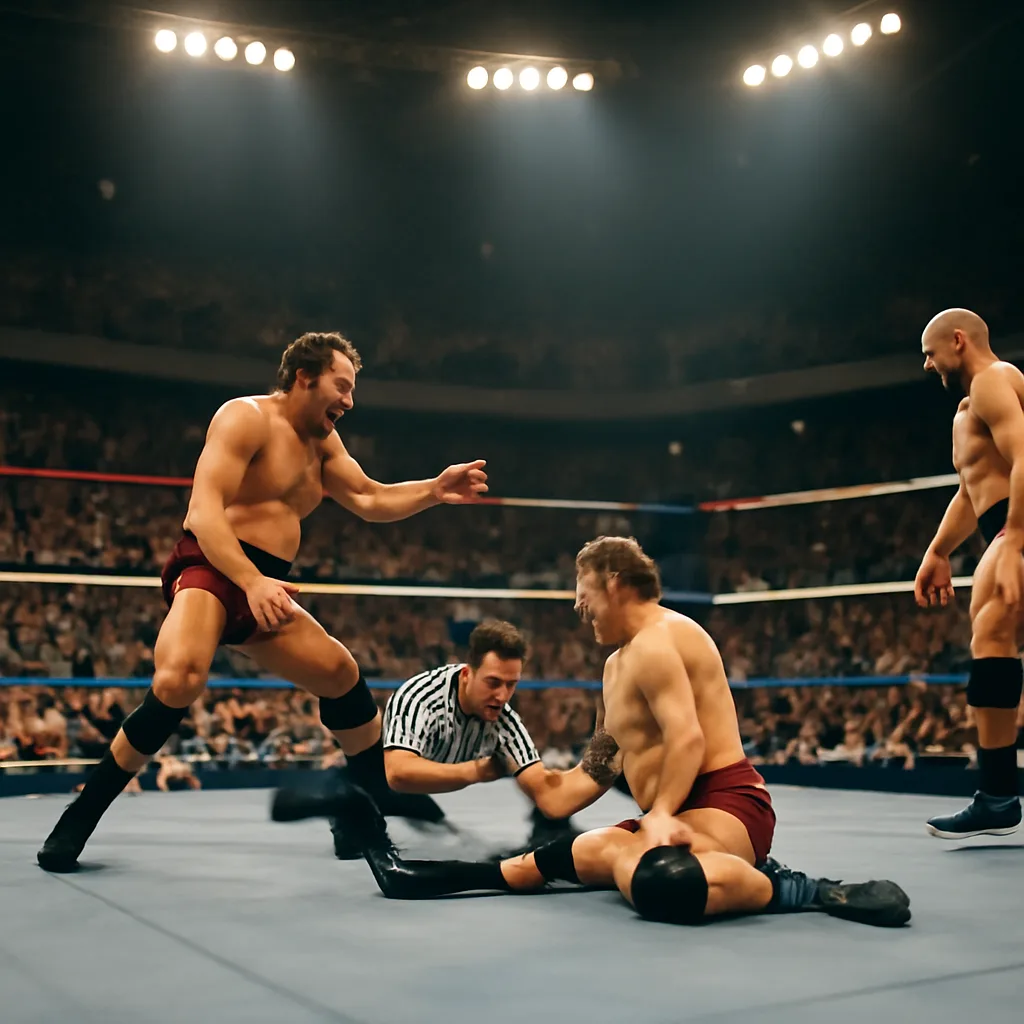
On the January 4, 1999 episode of World Championship Wrestling's flagship show Monday Nitro, a brief in-ring sequence became one of the most infamous moments in modern professional wrestling. The match was presented as a clash between Hulk Hogan and Kevin Nash for the WCW World Heavyweight Championship. After a few moments of feuding, Hogan approached Nash, poked him lightly in the chest with his finger, and Nash theatrically fell, allowing referee Scott Dickinson to count the pin and declare Nash the winner. Immediately after, other performers—most notably Scott Hall—entered the ring and, in a planned twist, Nash handed the title to Hall, who claimed to be the champion by virtue of being a member of their faction. Promoters and talent had used plot twists and controversial referee calls for decades to maintain audience interest, but this particular spot struck many viewers and industry observers as a betrayal of the audience’s suspension of disbelief. The sequence suggested that marquee matches and championship outcomes could be resolved by contrived gimmicks rather than competitive storytelling. That perception was especially damaging because WCW was then competing head-to-head with the World Wrestling Federation (WWF, now WWE) in what had been a ratings war and a battle for mainstream credibility. The incident earned the derisive nickname the "Finger Poke of Doom" and became shorthand for creative decisions that prioritized short-term shock over coherent booking. Critics argued the spot undercut the value of the world title, diminished both performers’ legitimacy in the eyes of fans, and reflected broader problems within WCW's creative leadership—chiefly, inconsistent long-term storytelling, backstage politics, and reliance on recycled star power. Many fans who had been tuning in to see competitive, meaningful payoffs felt cheated, and some defected to competing programming. In context, the angle was part of a long-running storyline involving the nWo (New World Order), a heel faction that had dominated WCW storylines earlier in the decade. By 1999 the nWo had splintered into subgroups and suffered from diminishing returns; the finger poke spot was an attempt to revive interest by reuniting or reshuffling members in an unexpected way. Instead, it highlighted creative stagnation. Television ratings for Nitro continued to decline in subsequent months; the company’s financial and management troubles compounded, and WCW was sold to the WWF in 2001. Wrestling historians view the Finger Poke of Doom not as the sole cause of WCW’s collapse but as a symbolic turning point. It crystallized fan frustration and is frequently cited alongside other examples of questionable booking, backstage dysfunction, and missed opportunities to develop new stars. The episode has been widely discussed in retrospectives, documentaries, and commentaries by wrestlers and industry observers, who generally treat it as an illustrative misstep in how to handle major championship storytelling. Because professional wrestling blends scripted performance with real-world business pressures, single moments rarely explain organizational failure on their own. Yet the January 4, 1999 segment endures as a clear, widely remembered instance of creative decision-making that eroded viewer trust at a critical time for WCW.