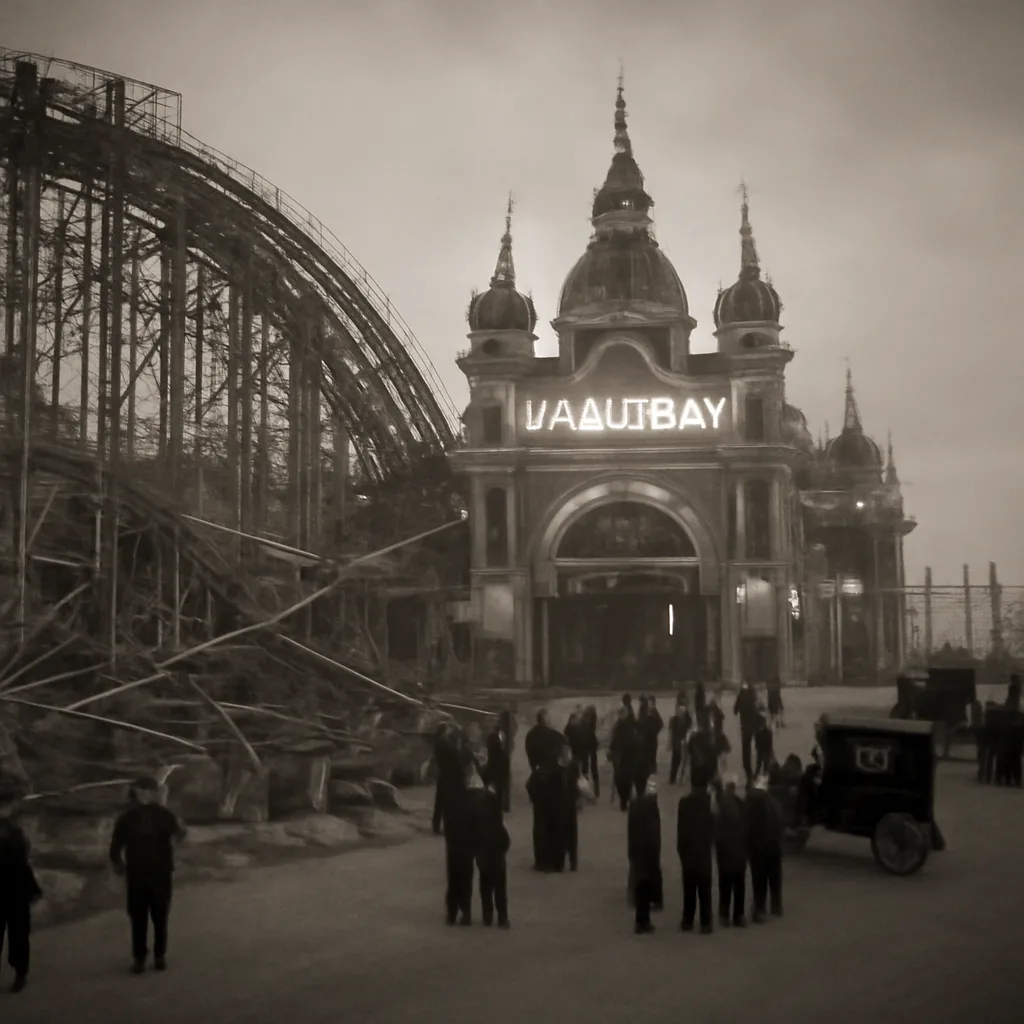
On the evening of late May 1912, newspapers reported a deadly accident at Luna Park, one of Coney Island’s major amusement parks. Accounts from the period describe a collapse or derailment on a roller coaster that sent cars from the track and caused multiple fatalities and injuries among riders. Coverage appeared in several New York papers, but details—including the precise date, the number of dead and wounded, and the mechanical cause—vary between sources, and some modern summaries conflate this incident with other early-20th-century coaster accidents at Coney Island. Luna Park opened in 1903 and quickly became known for elaborate electric lighting, scenic attractions, and large mechanical rides. Roller coasters of that era were wooden structures built quickly to meet public demand; they were popular but less regulated and less standardized than later coasters. Newspaper dispatches describe frantic rescue scenes, with onlookers and attendants assisting the injured, and hospitals treating victims brought in from the park. Some reports cite a failure of track support or a structural tie that led to a section of the coaster giving way beneath loaded cars. Conflicting contemporary reports leave key facts uncertain. Some period accounts place the accident on May 23, 1912; others give nearby dates in late May or early June 1912. The published death tolls range in different versions—from a handful of fatalities to higher numbers reported amid the chaos of early reporting. Coroner’s inquests and municipal investigations were sometimes reported later but with varying conclusions about responsibility—blaming either wear and tear on the wooden structure, faulty maintenance, or operator error. Archival research shows multiple coaster incidents at Coney Island in the 1900s–1910s, and later retellings have at times merged details from different accidents. For context, roller coaster safety standards in the United States were rudimentary in the 1910s. Municipal oversight, engineering inspection protocols, and standardized restraint systems that are common today were largely absent. Builders relied on timbers and basic fastenings; regular inspection often depended on the park proprietors’ discretion. Rapid construction and the high public appetite for novel thrills contributed to risk. After high-profile accidents, public outcry occasionally spurred legal and regulatory responses, but implementation was inconsistent across jurisdictions. Because primary-source accounts conflict, modern summaries should treat specifics cautiously. Available newspaper archives are the main contemporaneous sources: they document an alarming accident at Luna Park in late May 1912 involving a roller coaster and report deaths and injuries, but they do not present a consistent, corroborated record of the exact date or precise casualty figures. Coroner’s reports and municipal records from Brooklyn or New York City from that period may provide further detail for researchers, but those items are not uniformly digitized or widely cited in later secondary works. This incident is part of a broader pattern of amusement-ride accidents during the early era of mass entertainment in the United States. It illustrates the period’s technical limits and the evolving relationship between public leisure, private enterprise, and public safety regulation. When citing this event, historians and writers should note the discrepancy in dates and numbers across sources and avoid presenting a single definitive casualty count or an unqualified date unless supported by primary documentation from municipal records or contemporaneous official inquiries.