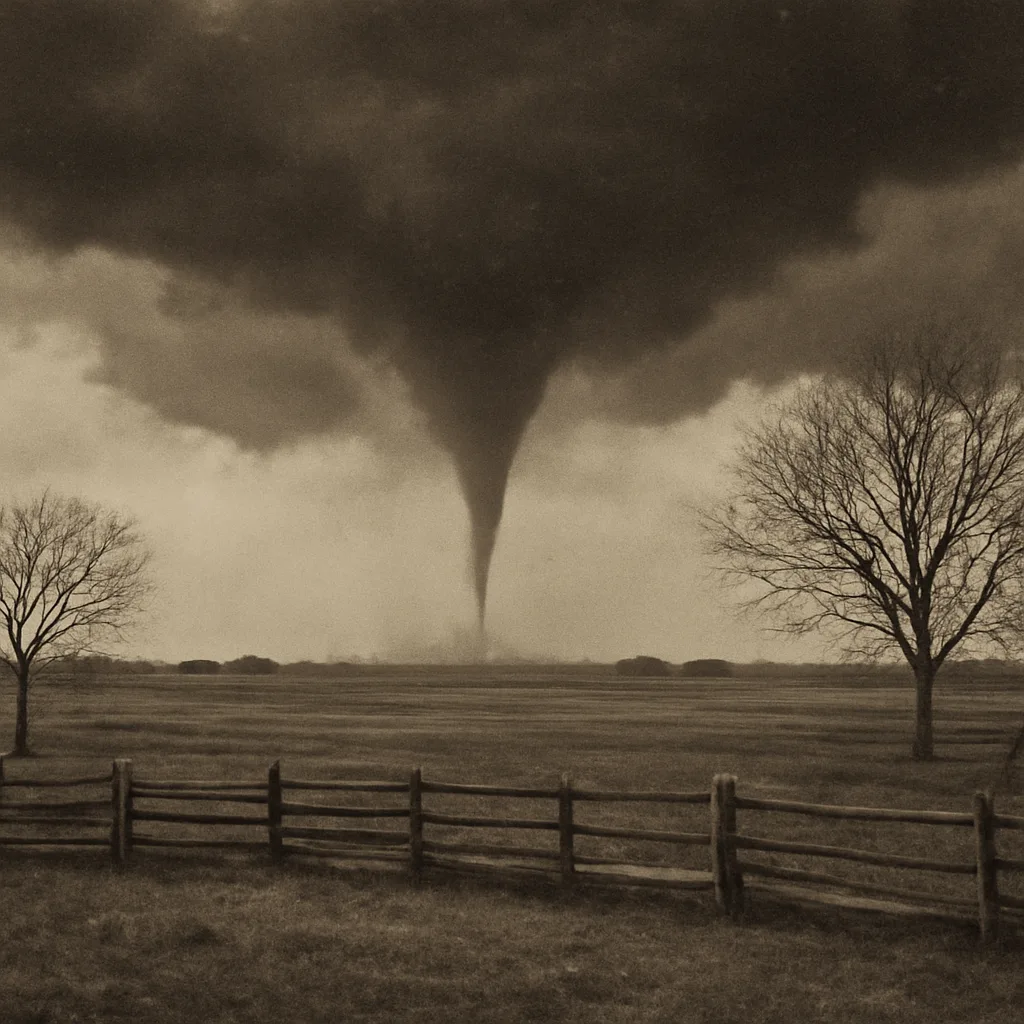
On April 26, 1884, photographers working in the United States produced what is widely regarded as the earliest reliably dated photograph of a tornado. The image shows a funnel-shaped cloud descending from a storm system over a relatively flat landscape—an event that, when captured on glass-plate or early film technology, provided scientists and the public with one of the first visual records of a tornadic vortex. Photography in the late 19th century was increasingly used to document natural phenomena. By the 1880s photographers employed wet-plate collodion and albumen prints; glass negatives and contact prints conveyed details that earlier illustration-based records could not. The 1884 photograph stands out in contemporary meteorological and photographic histories because it ties a specific date to an image and depicts the characteristic structure of a tornado: a narrow, rotating column extending from cloud base toward the ground. Context and significance Before reliable photographic records, tornadoes were recorded by written accounts, sketches, and post-event damage surveys. A dated photograph allowed observers to compare visual morphology with eyewitness reports and damage patterns, improving understanding of tornado form and behavior. Though this single photograph could not by itself resolve questions about tornado genesis or dynamics, it joined a growing body of empirical evidence that would later support systematic storm study and the development of severe-weather forecasting. Limitations and caution Contemporary sources and later historians note that early photographic technology had constraints: long exposures, sensitivity to lighting, and difficulties in quickly capturing rapidly changing weather. Some images once claimed as early tornado photographs have ambiguous dating or uncertain provenance. Scholars therefore distinguish between the earliest purported photographs and those with verifiable dates and context; the April 26, 1884 image is cited in histories as a reliably dated example rather than an absolute first instance of any tornado image worldwide. Legacy The 1884 photograph occupies a niche in both meteorological and photographic history. It exemplifies how late-19th-century visual technology began to intersect with scientific interest in extreme weather. Over subsequent decades, improvements in film speed, camera portability, and telecommunications would enable far more frequent and immediate photographic documentation of severe storms, ultimately contributing to modern storm-spotting, research, and forecasting practices. Sources and verification The account above relies on contemporary photographic records and secondary historical analyses that identify and discuss dated 19th-century tornado images. Where claims are disputed or provenance is uncertain, historians note such qualifiers; the April 26, 1884 image is repeatedly referenced in secondary literature as a verifiable early photograph rather than an unqualified global first.