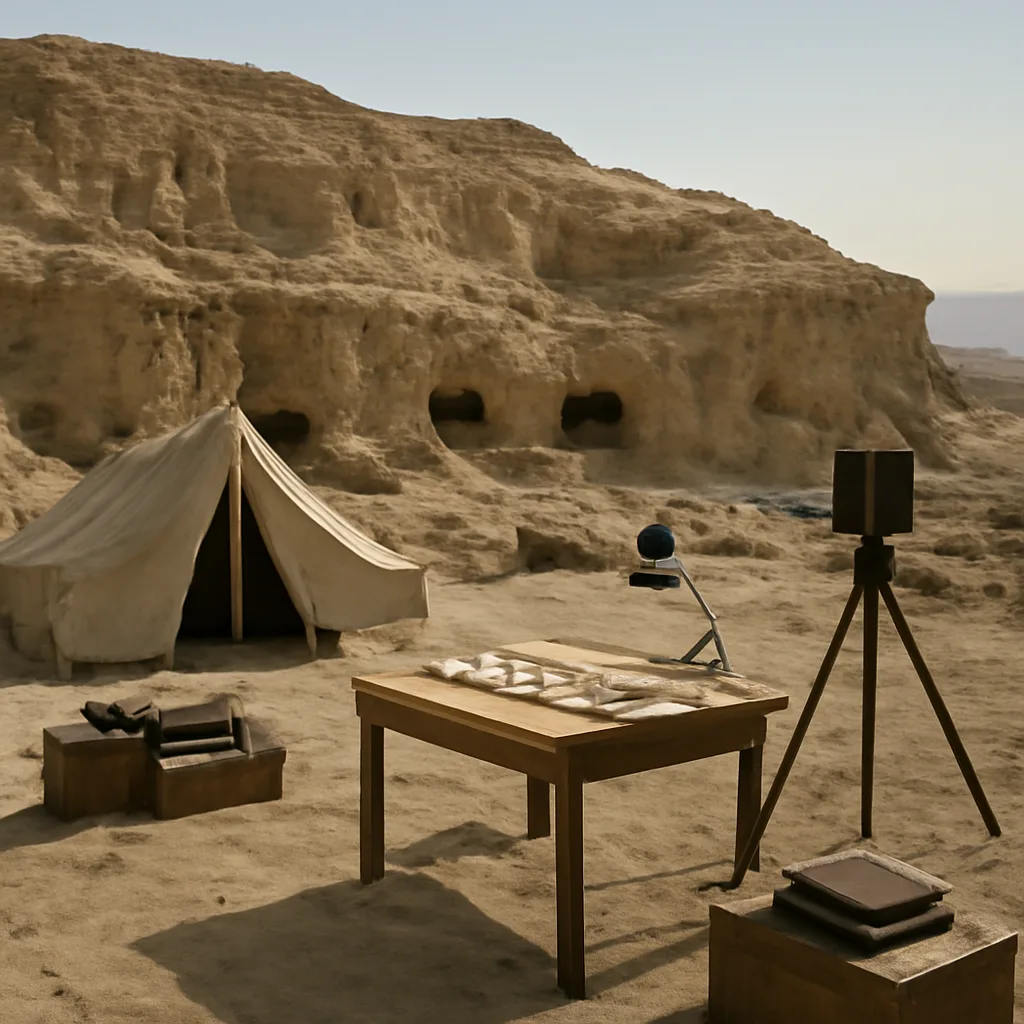
Background The Dead Sea Scrolls are a collection of Jewish manuscripts discovered between 1947 and 1956 in caves near Qumran, on the northwest shore of the Dead Sea. The corpus includes biblical texts, sectarian writings, and other religious and legal documents dating mainly from the third century BCE to the first century CE. After their discovery, the scrolls were subject to archaeological conservation, transcription, and editing before public release. Events Leading to Publication Scholarly access to the scrolls in the years immediately after their discovery was limited. A small international team, centered in Jerusalem and including scholars such as Eleazar Sukenik, John C. Trever, Roland de Vaux (archaeologist at Qumran), and paleographers and philologists from Europe and the United States, undertook the work of conservation, photography, transcription, and commentary. Progress was slow in part because of the fragmentary condition of many manuscripts, the complexity of the ancient scripts and languages (Hebrew, Aramaic, and Greek), and disputes over access and editorial control among institutions and scholars. The 1955 Publication On March 15, 1955, an initial set of the Dead Sea Scrolls was officially published. This early publication made available edited transcriptions and photographic plates of several key manuscripts, including important biblical books and sectarian documents. The release represented the culmination of collaborative work to stabilize, read, and annotate texts that had profound implications for the history of the Hebrew Bible, the study of Second Temple Judaism, and the textual history of biblical books. Scholarly and Public Impact The publications allowed broader scholarly scrutiny of text variants and of previously unknown religious writings associated with the Qumran community (or communities). Comparative study between scroll texts and later Masoretic and Septuagint textual witnesses illuminated textual plurality in the early centuries of the common era. The scrolls also provided context for understanding sectarian beliefs, liturgy, law, and scriptural interpretation in a period that shaped early Judaism and the milieu into which Christianity emerged. Controversies and Limitations The initial publication did not resolve all disputes. Access to some scrolls remained restricted for years, and debates continued over provenance, the precise nature of the Qumran community, editorial decisions in the published editions, and the dating and interpretation of specific texts. Later scholarly efforts, wider photographic publication (including microfilm and, much later, high-resolution images), and new editions have expanded and sometimes revised early readings. Legacy The 1955 official publication was a pivotal step that moved the Dead Sea Scrolls from a small circle of specialists into wider scholarly circulation. Over subsequent decades, the corpus has been the subject of sustained philological, historical, and theological study. While debates persist about particular readings and historical reconstructions, the scrolls remain central primary sources for the study of ancient Judaism and the textual history of the Bible. Sources and Caution This summary synthesizes established historical facts about the discovery, scholarship, and early publication of the Dead Sea Scrolls. Specific editorial histories, dates of individual volumes, and the sequence of releases involve detailed bibliographic records produced by the primary editors and later scholars; those details are not exhaustively recounted here and can be consulted in specialized bibliographies and institutional archives. No fictional quotes or invented sources are included.