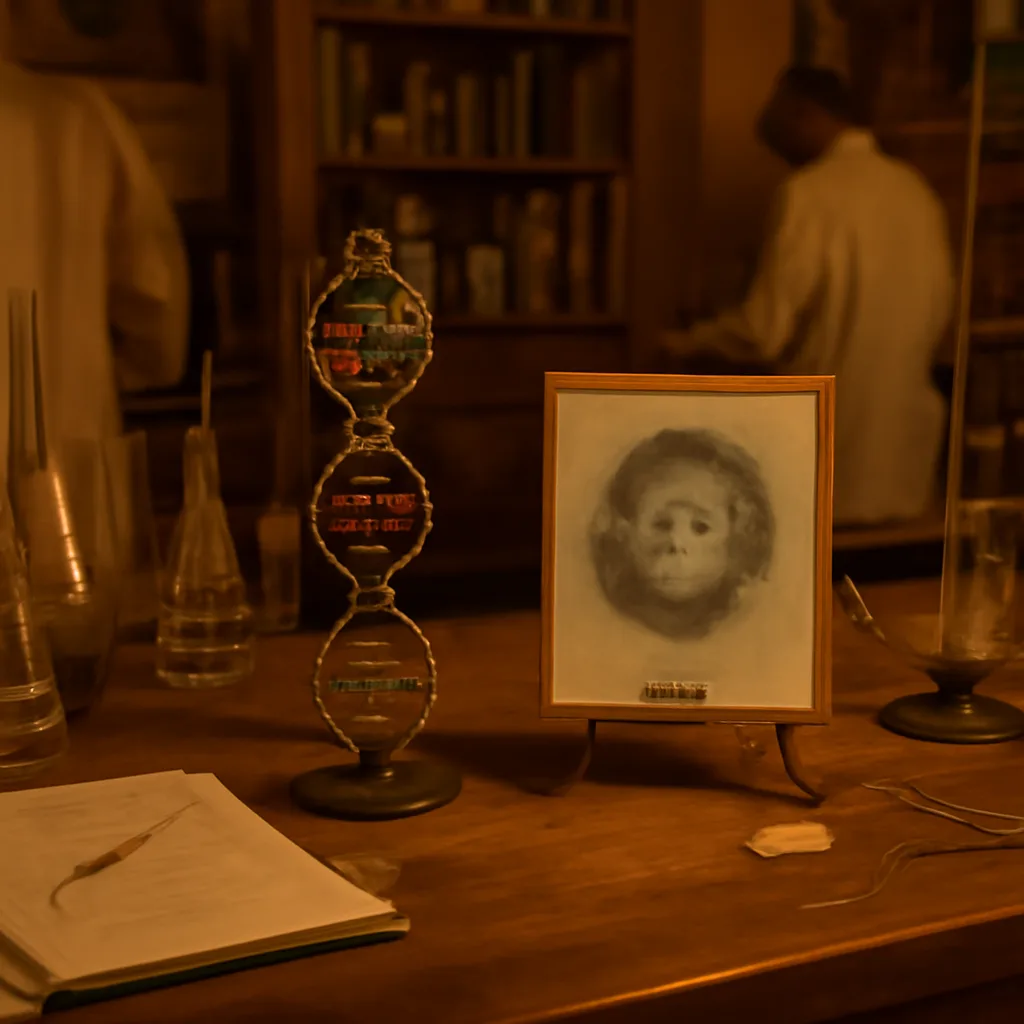
On 28 February 1953 James Watson and Francis Crick disclosed that they had arrived at a model for the molecular structure of deoxyribonucleic acid (DNA) capable of explaining how genetic information is encoded and copied. Their proposal — a right-handed double helix with complementary base pairing between adenine and thymine, and cytosine and guanine — rapidly reoriented biological research by offering a clear, physical basis for heredity. Watson, an American molecular biologist, and Crick, a British physicist turned molecular biologist, worked at the Cavendish Laboratory in Cambridge. Their 1953 model built on multiple lines of evidence from contemporaries: Rosalind Franklin and Maurice Wilkins at King’s College London had produced X-ray diffraction images of DNA that indicated a helical form; Erwin Chargaff had shown that in DNA the amounts of adenine and thymine are approximately equal, as are cytosine and guanine; and earlier chemical and structural studies had constrained possible configurations. Watson and Crick combined these empirical constraints with model-building to propose a specific arrangement of two polynucleotide strands wound around a common axis, held together by hydrogen bonds between paired bases. The immediate mode of announcement was modest: in late February 1953 Watson wrote in his diary that they had “discovered the secret of life,” and their initial public disclosure occurred in informal conversations and a brief note in the scientific journal Nature that appeared in April 1953. The Nature paper (coauthored by Watson and Crick) presented the double-helix model concisely, while separate papers by Franklin and Wilkins with colleagues provided supporting experimental data. Over the ensuing months and years, the double-helix model was tested, elaborated, and integrated into the emerging field of molecular biology. The discovery’s impact quickly became apparent. The complementary base-pairing mechanism explained how DNA could be replicated: each strand serves as a template for the synthesis of its complement, enabling accurate transmission of genetic information to daughter cells. This conceptual breakthrough set the stage for later advances, including the decoding of the genetic code, recombinant DNA technologies, DNA sequencing, and modern genetics and biotechnology. Historical assessments of credit and contribution have been the subject of continued discussion. Rosalind Franklin’s X-ray diffraction work provided crucial empirical constraints, and some historians and scientists have debated whether her role received adequate recognition at the time. Watson and Crick’s model-building was decisive in synthesizing available data into a coherent structural hypothesis; other researchers’ measurements and biochemical findings were essential corroboration. By the 1960s the double helix had become a foundational concept in biology and medicine. Watson, Crick, and Maurice Wilkins were awarded the Nobel Prize in Physiology or Medicine in 1962 for discoveries concerning the molecular structure of nucleic acids and its significance for information transfer in living material. Nobel Prizes are not awarded posthumously; Rosalind Franklin had died in 1958 and was therefore not eligible for the prize. Today the announcement of the double helix is remembered as a pivotal moment in 20th-century science: a synthesis of experimental data and conceptual insight that transformed understanding of heredity and enabled vast downstream technological and biomedical developments. While historical debates about contribution and attribution continue among scholars, the scientific significance of the double-helix model in explaining genetic information storage and replication remains central to modern biology.