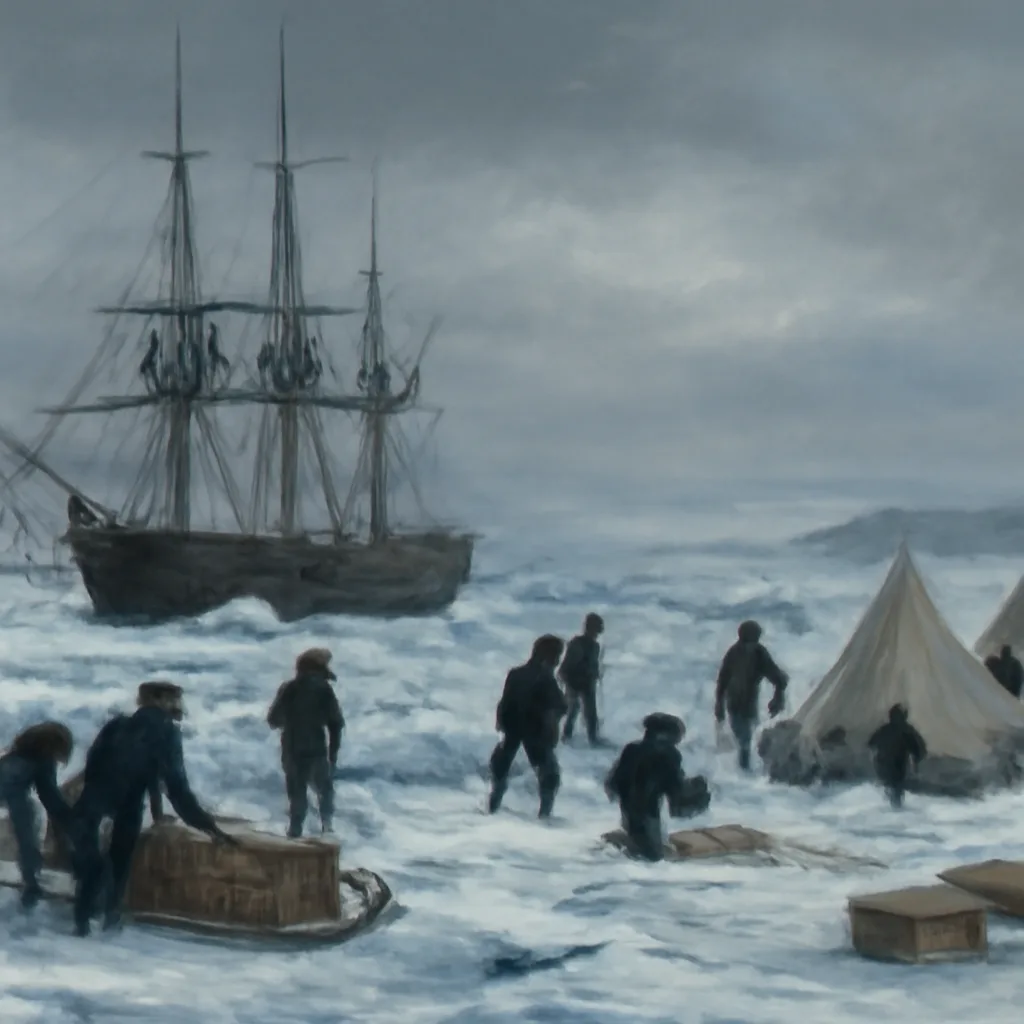
In 1845 the British Royal Navy launched an expedition under Sir John Franklin to chart and navigate the Northwest Passage through the Canadian Arctic. Franklin commanded two steam-assisted ships, HMS Erebus and HMS Terror, carrying 129 officers and men. The voyage departed England with high confidence in Victorian seamanship and naval resources, but it soon became clear that the challenge of Arctic ice and isolation could overwhelm even well-provisioned crews. Initial plans and public expectations The expedition was intended as both a scientific and navigational venture: charting uncharted channels, collecting natural-history specimens, and demonstrating Britain’s maritime reach. At the time, the Northwest Passage was a sought-after commercial route and a matter of national prestige. Franklin, a seasoned polar commander, and his ships were provisioned for several years, and the mission enjoyed enthusiastic public support and official backing. Early progress and loss of contact After leaving England in May 1845, Erebus and Terror were last seen by European whalers and ships in July 1845 near Baffin Bay. Routine scheduled reports and expected returns did not materialize, and by 1848 concern had grown into alarm. On March 5 (the date associated with this phase of the story in some contemporary accounts and later inquiries), search efforts intensified as relatives, government officials, and the Admiralty confronted the reality that an entire expedition could be missing. The lack of reliable communication from Arctic expeditions meant that months of silence could be normal—but not in this case, where multiple seasons passed without word. Searches and speculation From 1848 onward Britain mounted a series of increasingly extensive search missions, privately and officially funded, that explored vast stretches of the Canadian Arctic coast, islands, and ice lanes. Reports and Inuit testimony collected by searchers suggested that the ships had become icebound and that survivors attempted to trek southward on foot. Over time, evidence emerged—scattered graves, abandoned camps, and later artifacts—that confirmed the expedition had failed, but the precise sequence of events, causes of death, and fate of many individuals remained unclear for decades. Causes and later discoveries Investigators proposed multiple and sometimes competing explanations: scurvy, starvation, lead poisoning from tinned food or ship water systems, tuberculosis, trauma from exposure, and conflict. Many of these hypotheses reflected the limitations of 19th-century medicine, nutrition, and Arctic survival knowledge. In the late 20th and early 21st centuries, archaeological finds and forensic analysis added clarity: Inuit testimony, recovered artifacts, and human remains showed evidence of prolonged hardship, physical trauma, and attempts to move inland from the trapped ships. Key breakthroughs occurred in 2014 and 2016, when the wrecks of Erebus and Terror were located on the seabed—Erebus in 2014 in the eastern Queen Maud Gulf and Terror in 2016 in Terror Bay—providing material context that continues to inform study. Why March 5 matters Dates such as March 5 mark stages in public realization and the ramping up of search efforts rather than a single decisive event aboard the ships. The early spring of years after departure is when authorities and families moved from hope to organized action, launching missions into the Arctic winter and spring with mounting urgency. The Franklin story thus moves from an ambitious imperial voyage to a long, painful inquiry into loss and the limits of exploration. Legacy The disappearance of Franklin’s expedition became a cultural touchstone in Britain and Canada, shaping Arctic policy, indigenous–European relations, and naval procedures. It spurred exploration that mapped previously unknown regions and prompted reforms in polar provisioning and ship design. Although many questions about individual fates remain, a century and a half of research—archival, archaeological, and oral-history—has transformed what was once pure mystery into a complex, better-documented tragedy of Arctic exploration.