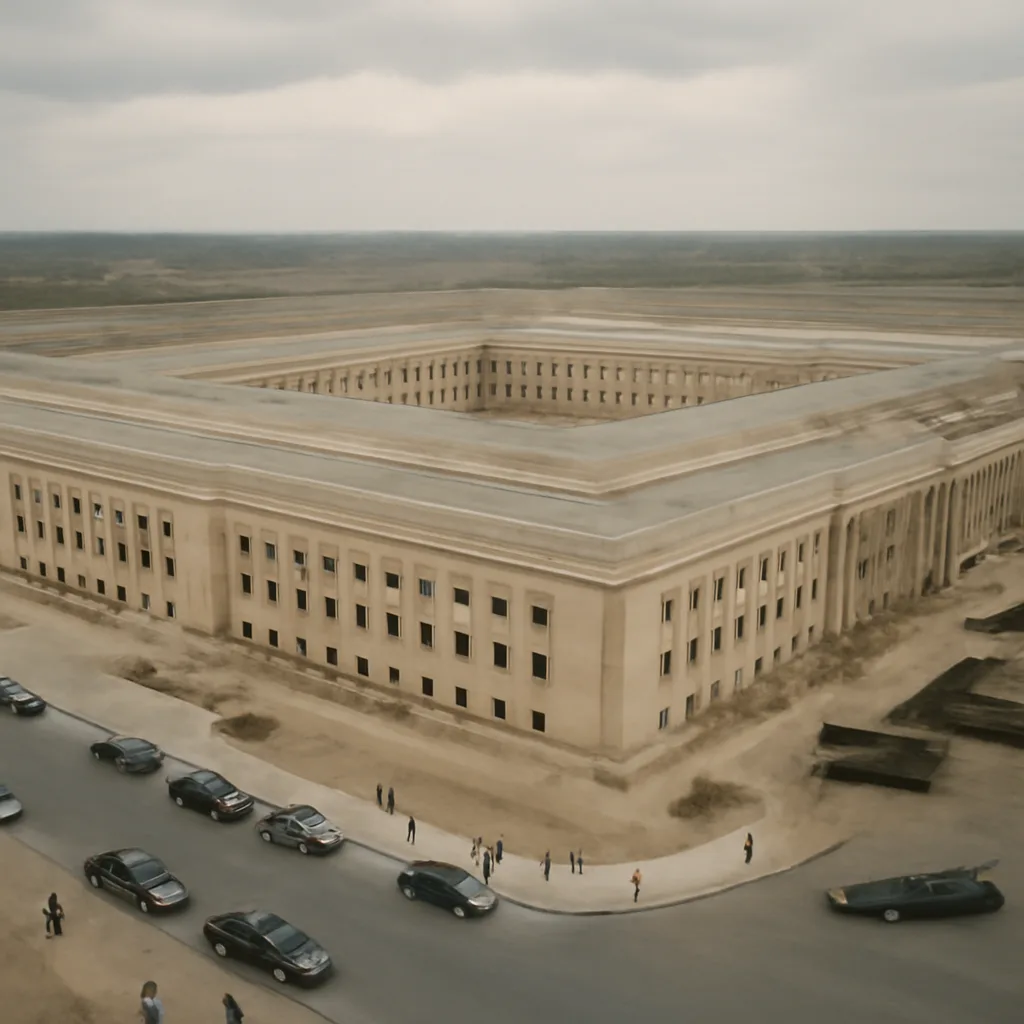
The Pentagon’s official dedication took place on March 20, a milestone in the rapid wartime construction that produced one of the world’s largest office buildings. Groundbreaking for the project occurred on September 11, 1941, and construction proceeded through 1942 amid urgent wartime needs for centralized military administration. Designed by architect George Bergstrom with engineering by John McShain’s firm, the five-sided building was intended to consolidate the War Department’s widely scattered offices in the Washington, D.C., area. The building’s distinctive geometry—five concentric pentagonal rings surrounding an open central courtyard—and its substantial floor area were practical responses to the necessity of providing office space for tens of thousands of military and civilian personnel. The use of reinforced concrete and load-bearing exterior walls, along with an emphasis on speed and economy, reflected wartime constraints on materials and labor. Much of the labor force included local workers and tradesmen; some materials and craftsmen were redirected from civilian projects due to wartime priorities. Although construction began before the United States formally entered World War II, the project accelerated after the December 1941 attack on Pearl Harbor. The Pentagon was intended to streamline command and control by bringing together the War Department’s fragmented bureaus and commands. Offices were outfitted rapidly; many agencies moved in as sections were completed rather than waiting for the entire structure to be finished. The building thus began serving its operational purpose even as finishing work continued. The March 20 dedication marked the formal recognition of the building’s role as the central administrative hub for the nation’s defense establishment. Over the following decades the Pentagon remained the headquarters of the Army and, after 1947 reorganization, the Department of Defense. Its enormous size and centralization of military functions made it a symbol of U.S. military organization and bureaucracy, as well as a focal point for public attention during later conflicts and political debates. Historians note that the Pentagon’s rapid construction, centralized planning, and monumental scale are emblematic of the broader mobilization of American industry and government during World War II. The building’s design choices balanced functionality—efficient circulation, proximity of offices, and security considerations—with the pressing need to complete the project quickly and within the constraints of wartime resource allocation. While the March 20 dedication is a fixed date associated with the building’s formal opening, the Pentagon’s history continued to evolve: postwar reorganizations, expansions in communications and technology, and later renovations have altered the building’s internal workings without changing its basic footprint. Its role as a locus of American defense policy and administration endures, and the building remains a prominent feature of the Washington area’s federal architecture. Note: Some sources emphasize different milestones (such as when particular office rings were occupied) as more operationally significant than the ceremonial dedication; accounts vary on which moves and dates different agencies regard as their effective start within the building.