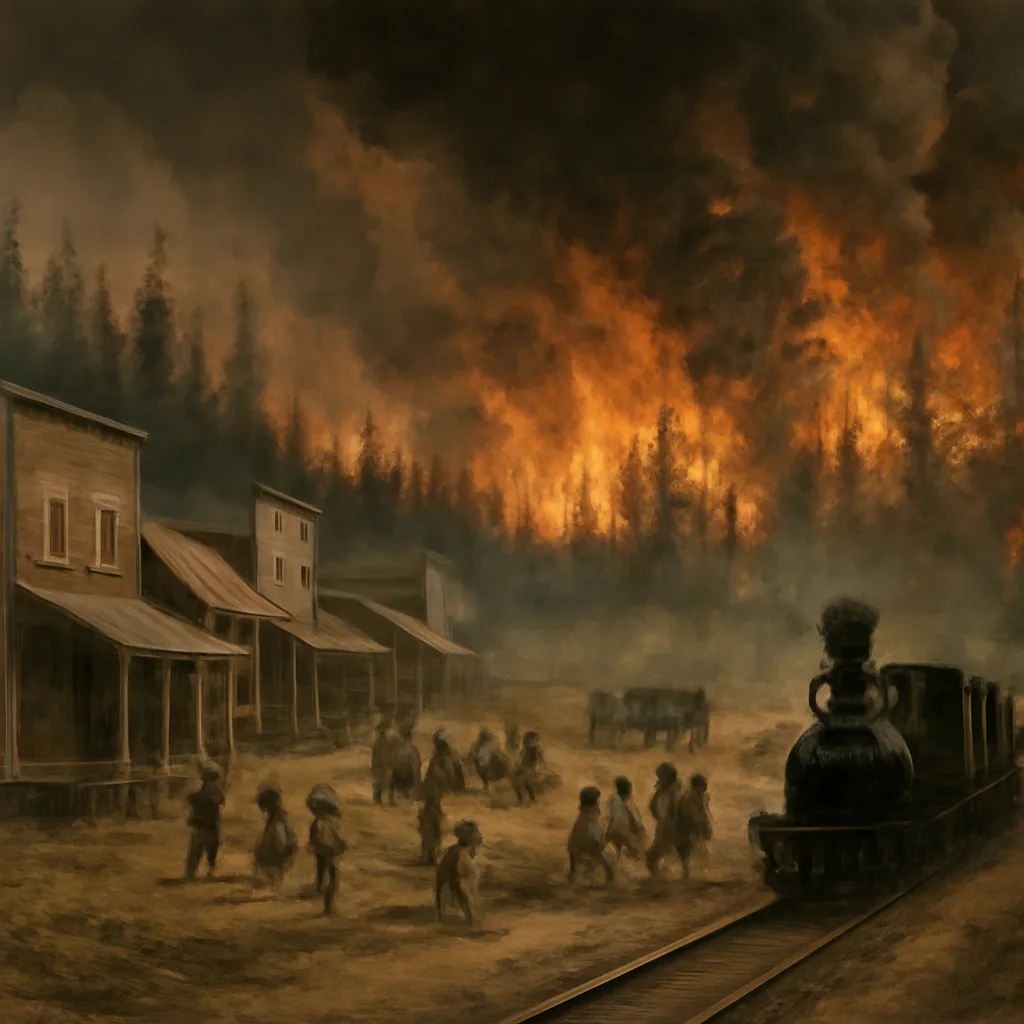
The Great Hinckley Fire of 1894: Hundreds Perish in Minnesota Blaze
On September 1, 1894, a catastrophic wildfire swept through Hinckley and surrounding Pine County, Minnesota, killing at least several hundred people, destroying the town, and leaving thousands homeless in one of the deadliest fires in U.S. history.
On the afternoon of September 1, 1894, a fast-moving wildfire, later known as the Great Hinckley Fire, raced across the pine forests of eastern Minnesota and into the town of Hinckley and nearby communities in Pine County. Fueled by prolonged drought, abundant dry logging slash, and strong winds, separate fires merged into a conflagration that advanced with terrifying speed through timber, brush, and settlements.
Background
In the 1890s northeastern Minnesota was a center of logging and railroad activity. Heavy logging left large quantities of slash—branches, treetops and other debris—on the forest floor. That summer had been unusually dry, creating conditions favorable to ignition and rapid spread. Local railroads and other activities created sparks that could ignite the dry material.
Advance and impact
Multiple fires ignited in the surrounding countryside; under gale-force winds they coalesced into a massive firestorm. Eyewitness accounts recorded flames and dense smoke moving so swiftly that residents had little time to respond. The fire destroyed Hinckley, the nearby settlements of Mission Creek and Cloverdale, and extensive sections of the surrounding countryside. Many victims were overcome by flames or dense smoke; others sought refuge in wells, ponds, or along railroad tracks.
Casualties and displacement
Precise death tolls have varied in contemporary and later reports. Official and newspaper tallies at the time cited at least several hundred fatalities; modern summaries commonly report that at least 400 people died, with some estimates higher. Thousands of residents were left homeless; the town of Hinckley was largely leveled and required extensive rebuilding. Many of those killed were lumber workers, railroad laborers, and their families.
Response and aftermath
Relief efforts were launched from nearby towns and cities; survivors received medical care, shelter, food, and clothing. The disaster prompted scrutiny of logging practices, particularly the hazards posed by slash left after timber cutting, and led to calls for improved fire prevention and firefighting organization in the region. Over ensuing years, changes in forest management, firefighting coordination, and regulations around logging debris were among the long-term responses aimed at reducing the risk of similarly catastrophic fires.
Historical significance
The Great Hinckley Fire remains one of the deadliest wildfires in U.S. history and a defining event in Minnesota’s environmental and social history. It exposed the dangers of extensive logging without adequate attention to fire risk, and it influenced both local rebuilding and broader conversations about forest stewardship and public safety. Memorials and historical accounts have preserved the memory of those who perished and the communities that were rebuilt.
Notes on sources and uncertainty
Contemporary newspaper reports, government records, and later historical studies form the basis of knowledge about the event. Exact casualty figures vary between sources, and some specifics of individual experiences are known only through survivor accounts recorded at the time. This summary adheres to the broad consensus on date, location, causes, and general scale of the disaster without asserting disputed particulars.