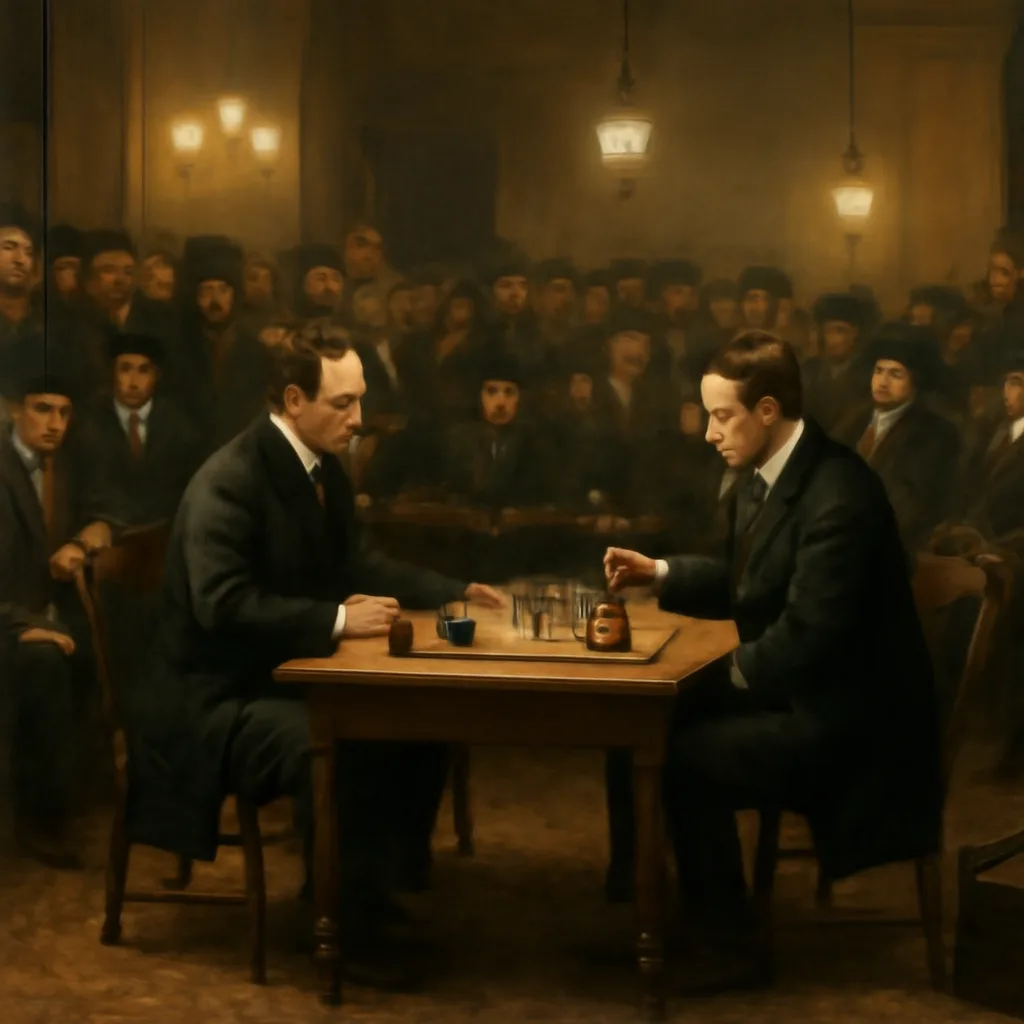
In 1886 the chess world held what is widely regarded as the first modern World Chess Championship match: Wilhelm Steinitz, the leading theorist and de facto world’s best player, challenged Johannes Zukertort, a popular and formidable opponent. The match ran from January to March of 1886 and was organized as a first-to-ten-wins contest (draws not counting), played in New York, St. Louis and New Orleans. Steinitz won the match by a score of 12½–7½ (10 wins, 5 losses, and 5 draws in some contemporary tallies), thereby establishing himself as the inaugural official World Champion in the sense recognized by later historical consensus. Context: By the mid-1880s international chess had developed regular tournaments and public interest, especially in the English-speaking world and central Europe. Zukertort had recently achieved major successes—most notably winning the 1883 London tournament—while Steinitz had been mounting a programmatic case for a scientific, positional approach to the game and had been recognized as the leading player by many peers. The 1886 match formalized a champion-versus-challenger format and drew considerable attention in newspapers and chess circles. Format and locations: The match was arranged with a first-to-ten-wins stipulation. Play moved among three American cities: New York (where several games were played), St. Louis (an important chess center then), and New Orleans. Travel and logistics of the period meant that match conditions varied; long journeys and changing venues affected both players. Time control and match adjudication reflected contemporary practice rather than later standardized rules. Key features and significance: The match highlighted contrasting styles. Zukertort was celebrated for dynamic tactical play and opening preparation; Steinitz emphasized positional principles—accumulating small advantages and exploiting structural weaknesses. Steinitz’s victory is often seen as vindication of his theoretical approach and as the beginning of modern positional chess at the highest level. The match also contributed to the idea of a formal world championship cycle and to expectations that top players would contest the title by arranged matches rather than solely in tournaments. Contested details: Some numerical details and contemporary reports differ in how they count draws and report intermediate scores; historical sources sometimes list slightly different totals depending on whether exhibitions and non-standard games are included. The exact month and day given in some modern summaries may vary; the commonly cited dates are January–March 1886. The user-provided date (April 17) does not correspond to the commonly documented span of the match. Aftermath: Steinitz defended his title in subsequent matches and remained World Champion until 1894, when he was defeated by Emanuel Lasker. Zukertort’s performance in 1886 marked the high point of his career; he died in 1888. The 1886 contest left a lasting institutional legacy by helping to cement the concept of a recognized world title and by influencing public and press interest in chess as a spectator and intellectual sport. Sources and reliability: This summary follows mainstream chess historiography and primary contemporary reports; where accounts differ (notably exact game tallies and peripheral exhibition games), I have noted that such details are sometimes disputed in the record.