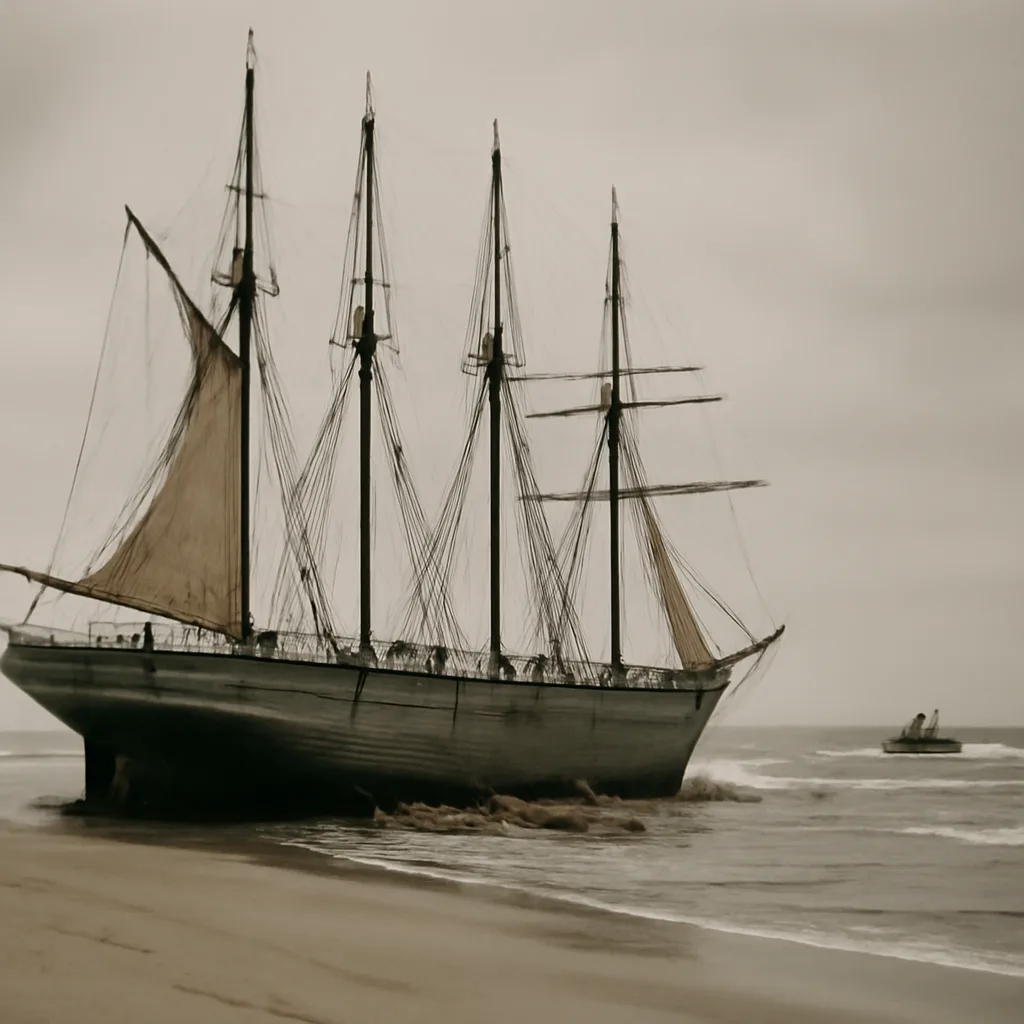
On the morning of January 31, 1921, the five-masted schooner Carroll A. Deering was sighted aground on Diamond Shoals off Cape Hatteras, North Carolina. Built in 1919 for coastal trade and named for a New England merchant, the Deering had departed Hampton Roads, Virginia, on January 28 bound for Rio de Janeiro with a cargo of coal. When a pilot boat reached the vessel on January 31, the deck was cluttered and the helm lashed, but there was no sign of the crew. Personal effects, papers and the ship’s log were left behind. Lifeboats were gone, and some damage to the rigging and a disorganized galley suggested a hurried abandonment rather than a planned evacuation. The U.S. government launched a wide-ranging investigation: interviews with the last known pilot, Coast Guard inspections, and inquiries into the crew’s identities. The Deering’s captain, William H. Merritt, and the crew of ten were never found. Various physical clues were recorded: the ship’s wheel was smashed, the binnacle glass broken, and the anchor was down but not fully set. The galley showed signs of an interrupted meal. The ship’s log was incomplete; many pages were missing or torn out. These details fueled speculation but provided no conclusive narrative. Several explanations have been proposed over the decades. One theory posits that severe weather and navigational error led the vessel onto the shoals and that the crew abandoned ship in panic; however, contemporaneous weather reports did not show a storm sufficient to explain the crew’s disappearance. Another line of conjecture involves piracy or foul play by local criminals or mutiny among the crew. Yet there was little forensic evidence of a struggle or theft beyond missing lifeboats. Some have suggested involvement by foreign agents or secret government operations related to Prohibition-era smuggling or post–World War I tensions, but investigators found no documentary support for such claims. The Deering case also entered local folklore and speculative literature. Writers and amateur sleuths pointed to the nearby Outer Banks’ history of wrecks, and to the region’s treacherous shoals and shifting sands, as context for why a vessel might be found hard aground and deserted. Other proponents leaned into more sensational hypotheses—such as paranormal explanations or sea monsters—but these are not supported by archival evidence. Modern assessments emphasize the limitations of the 1921 investigation: incomplete records, loss of the original logbook pages, and the era’s limited forensic techniques make it difficult to draw firm conclusions. The identities and backgrounds of the crew were sometimes confused in early reports, and some witness statements conflict. Historians and maritime researchers generally regard the fate of the Deering’s crew as unresolved; available primary-source documents—Coast Guard and Bureau of Navigation reports from 1921, contemporary newspaper accounts, and the surviving ship papers—offer important facts but no definitive answer. The Carroll A. Deering endures as a well-documented maritime mystery rather than a solved crime. Its significance lies in the tangible evidence aboard the vessel—intact shipboard equipment, missing crew, and an incomplete log—which invites careful historical inquiry while resisting easy explanation. The case continues to interest historians, maritime archaeologists and the public because it combines verifiable archival records with enduring uncertainty about what happened to the people who sailed her.