
The 1518 Dancing Plague of Strasbourg: When a City Kept Moving
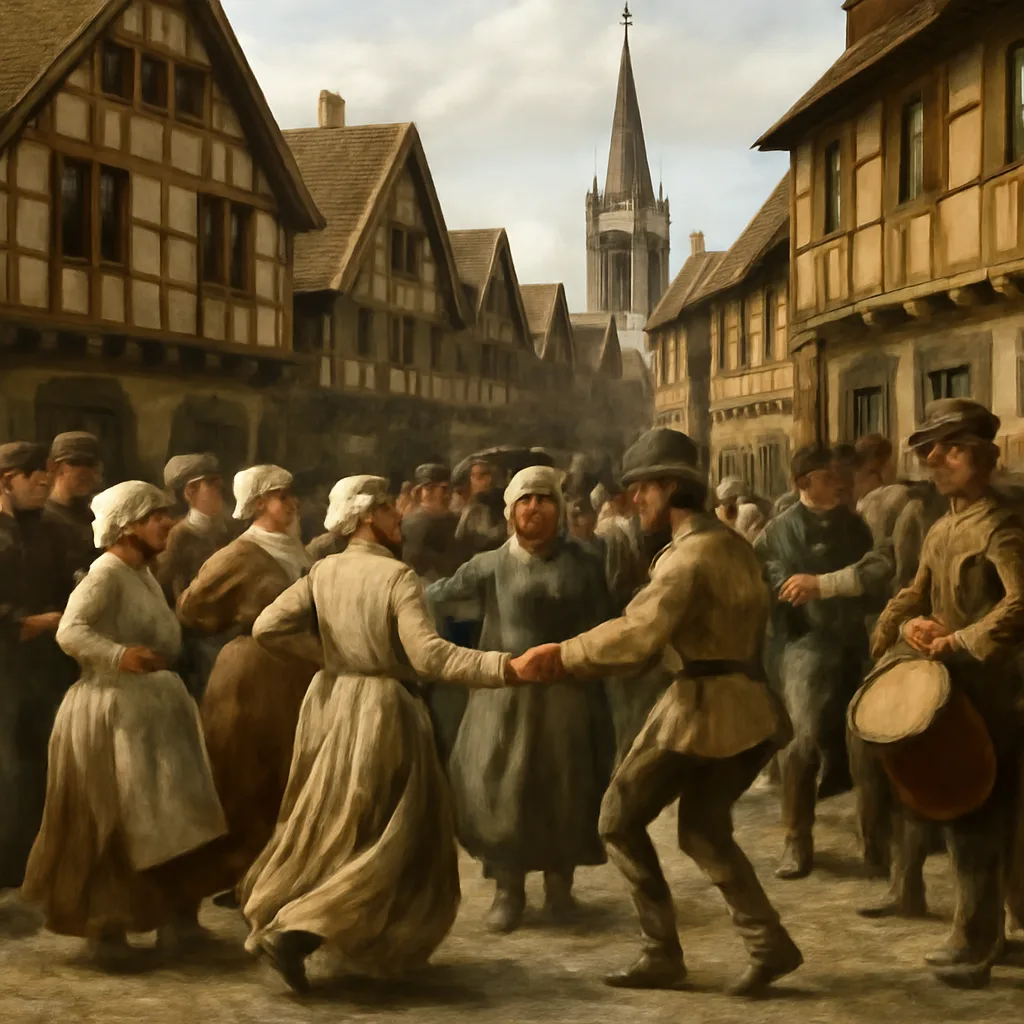
In July 1518, dozens of residents of Strasbourg (then in the Holy Roman Empire) began an uncontrollable compulsion to dance in the streets for days; contemporary records describe exhaustion, injury and deaths, though causes remain debated by historians and medical researchers.
In mid-July 1518 a sudden outbreak of prolonged, involuntary dancing swept through Strasbourg, a city then part of the Holy Roman Empire (now in France’s Alsace region). Contemporary municipal and ecclesiastical records, including a physician’s notes and city council memoranda, report that the episode began with one woman and within days involved dozens of people who danced for hours or days in public, some until they collapsed from exhaustion or died.
What happened: On 14 July 1518, according to surviving sources, a woman known in records as Frau Troffea began dancing in the street. Over the next week the number of dancers rose to dozens. City authorities reacted by arranging for musicians and a stage so dancers could be moved to a choreographed setting, believing that providing a place to dance would allow them to recover. When the behavior persisted, officials redirected dancers to a shrine to St. Vitus and employed other measures. Reports from the period describe severe fatigue, injuries and several deaths attributed to stroke, heart attack or exhaustion, though exact counts are uncertain.
Contemporary context: The outbreak took place during a period of crop failure, famine and disease in the region; harsh winters, poor harvests and outbreaks of disease had strained urban populations. Religious devotion, popular cults and beliefs about saints’ intercession were prominent in daily life. Municipal and church authorities treated the event as both a medical and moral problem, invoking religious remedies while also attempting civic management and public health measures available at the time.
Explanations and debate: Modern scholars and clinicians propose several nonexclusive explanations. Mass psychogenic illness (a form of collective stress response) is a widely cited interpretation: in unstable, anxious communities, strongly emotive behaviors can spread socially and be sustained by attention and communal reinforcement. Other hypotheses include ergotism (poisoning from Claviceps-infected rye) producing convulsions and hallucinations, epileptic or neurological disorders, and cultural or ritual practices misread by later observers. Ergotism remains debated because many characteristic symptoms (e.g., gangrene) are not consistently reported, and the pattern of social spread fits better with psychogenic models. No single explanation is universally accepted.
Sources and limits: The primary evidence comes from municipal records and chronicles written soon after the event; these sources provide contemporary descriptions but reflect the perspectives and medical theories of the period. The episode’s scale, precise timeline and casualty figures are uncertain because records are incomplete and sometimes ambiguous. Modern reconstructions rely on interdisciplinary analysis—historical documents, social psychology, epidemiology and toxicology—and scholars caution against definitive judgments.
Legacy: The 1518 event has endured as a striking historical case of mass unusual behavior. It appears in studies of mass psychogenic illness and in discussions about how societies respond to stress and medical uncertainty. While it is often portrayed dramatically, careful scholarship emphasizes uncertainty, the social and material stresses of early modern Europe, and the limits of retrospective diagnosis.
The dancing plague remains a subject of scholarly interest because it sits at the intersection of culture, health and community response: an episode that highlights how social, environmental and psychological factors can combine to produce extraordinary collective behavior, even when the precise mechanisms are not fully known.