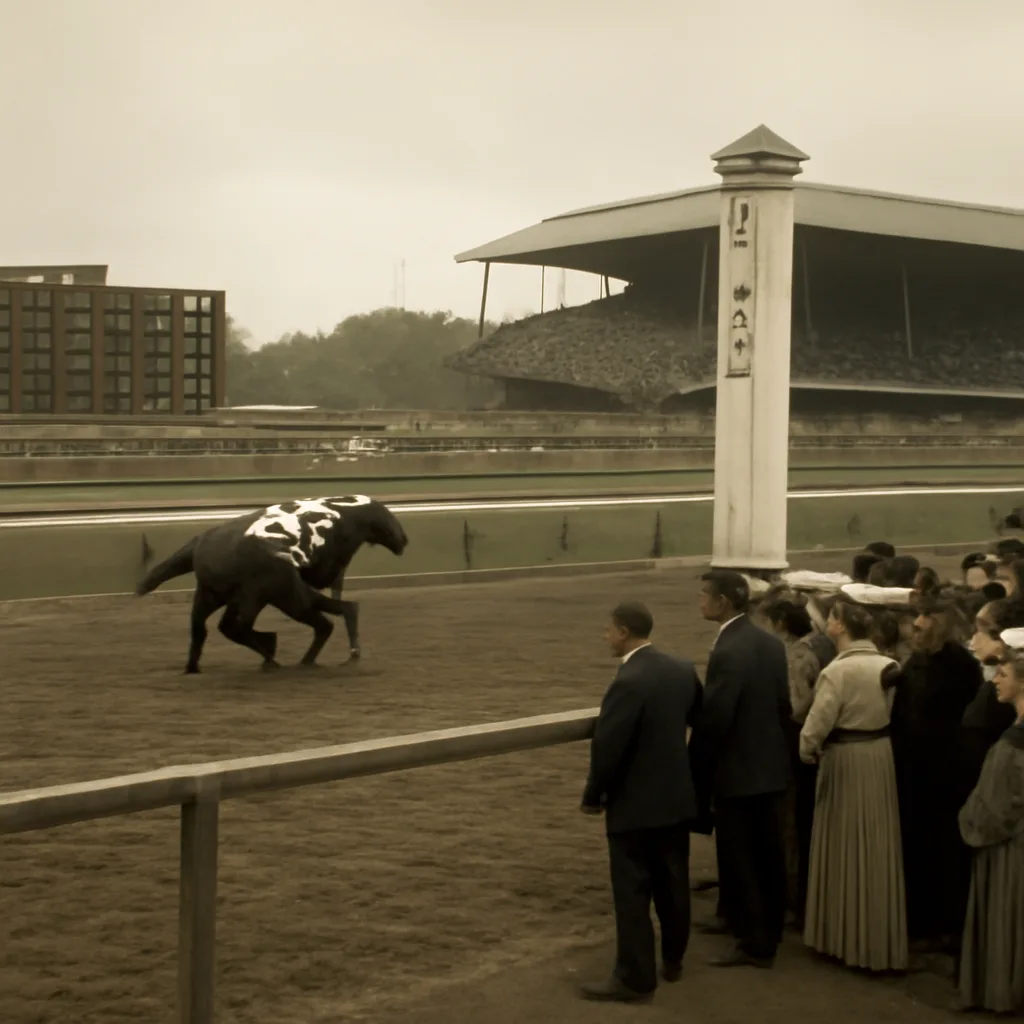
On May 6, at a race meeting held at Belmont Park, a horse without a rider entered the course and crossed the finish line ahead of the competing horses. Accounts of the episode circulated in racing circles and the press at the time, which described a sudden and startling interruption to the programmed races. The basic facts recorded in contemporary reports are consistent: a loose mount—whether a loose prepped entry, an escaped warmup horse, or a mount that broke away from handlers—came onto the track during the running of a race and completed the course before the official field. Belmont Park, opened in 1905 in Elmont, New York, was by the 1920s a major venue for American thoroughbred racing. Race meetings then were lively public events; tracks had fewer of the safety protocols and barrier systems standard today, and loose horses on the course, while not common, were documented occurrences in early 20th-century racing. Newspaper coverage from the era typically emphasized the disruption to betting and the inquiries launched by stewards rather than treating such an occurrence as a sporting result: a riderless horse crossing a finish line would not be eligible for purse distribution and would not be recorded as an official placing in the race program. Contemporary reportage emphasized crowd reaction and steward action. Officials would pause to restore order, clear the course, and determine whether any runners had been impeded; racing commissions or stewards often held inquiries when loose horses affected a race. The incident at Belmont Park on May 6 is mentioned in various secondary references to track oddities and early-century racing anecdotes, but specific archival documentation—such as a named race, a program page, or stewards’ minutes tied to an exact year—has not been conclusively identified in widely available digitized sources. As a result, while the incident itself is consistent with documented patterns of racing disruptions from that era, the precise year for this May 6 occurrence remains uncertain in the public record. Historians and researchers relying on newspapers, racing forms, and steward reports note the limits of surviving records. Many contemporary newspapers reported incidents like this in brief dispatches or local columns rather than in long-form investigative pieces; racing secretary records or track stewards’ reports, where they survive, can be fragmentary. When reconstructing such an episode, researchers treat multiple contemporaneous newspaper accounts and official minutes—if available—as the most reliable sources. Absent firm primary documentation giving a year, responsible summaries mark the date as May 6 but leave the year unspecified, as done here. This version of events aligns with the broader context of horse racing in the early 20th century: tracks of the period could be chaotic, and incidents involving loose horses did occur and were handled through steward inquiry rather than being incorporated into race results. The key verifiable points are the venue (Belmont Park), the date (May 6, day and month reported in sources), and the nature of the disruption (a riderless horse crossing the finish line). The precise year remains unconfirmed in readily available primary documents, and no fabricated or unattributed quotations are used in this account.