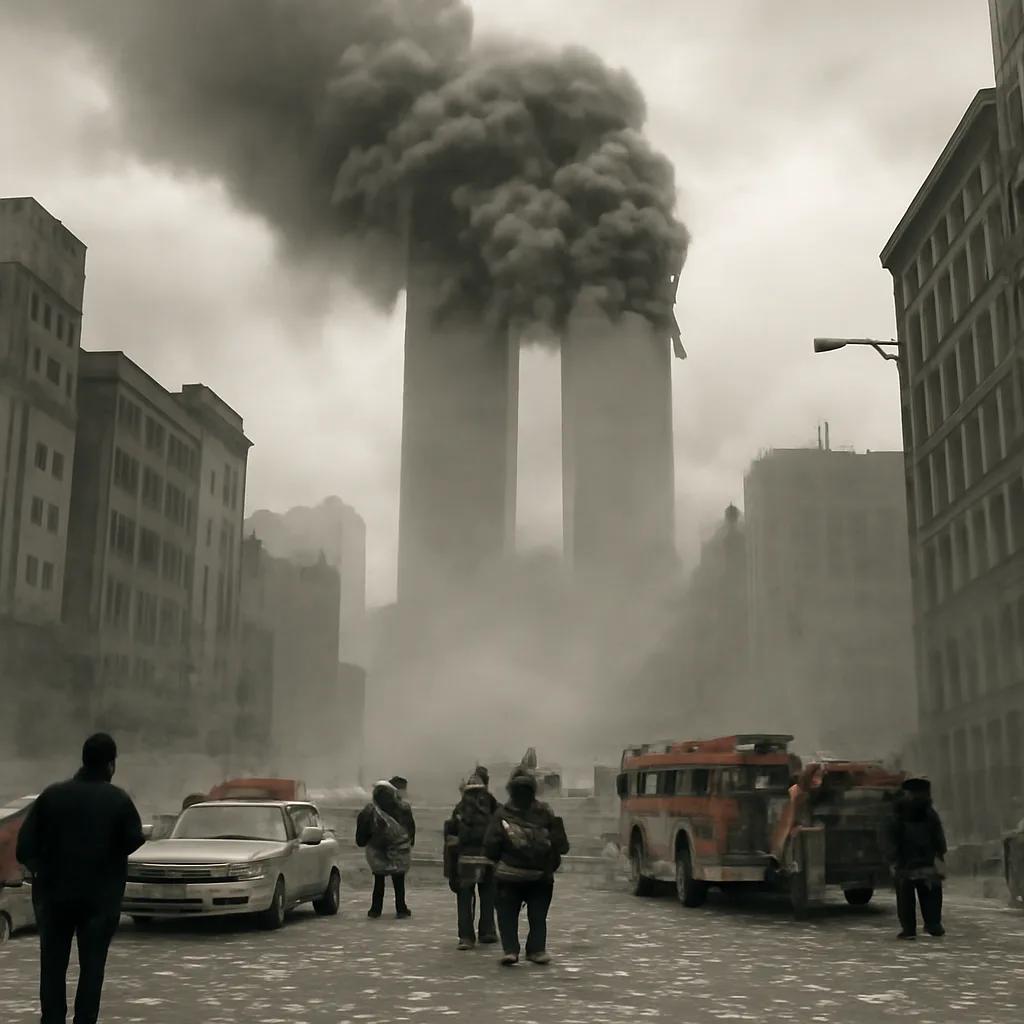
On the morning of September 11, 2001, a coordinated series of terrorist attacks struck the United States. Four commercial airliners were hijacked by 19 militants affiliated with the extremist group al-Qaeda. Two of those aircraft—American Airlines Flight 11 and United Airlines Flight 175—were deliberately flown into the North and South Towers of the World Trade Center complex in Lower Manhattan. The impacts and ensuing fires caused catastrophic structural damage; both towers collapsed within hours, producing massive debris, fires, and a toxic dust cloud that spread across parts of Manhattan. A third hijacked airliner, American Airlines Flight 77, was flown into the Pentagon, the headquarters of the U.S. Department of Defense, in Arlington, Virginia, causing significant structural damage and additional casualties. Passengers on the fourth plane, United Airlines Flight 93, fought back against the hijackers; that aircraft crashed in a field near Shanksville, Pennsylvania, before reaching the hijackers' apparent target in Washington, D.C. The attacks killed nearly 3,000 people from more than 90 countries, including airline passengers and crew, workers in the buildings, first responders, and bystanders. Thousands more were injured. The death toll and the scale of destruction overwhelmed local and federal responders and prompted a massive rescue, recovery and identification effort at Ground Zero that continued for months. The attacks also produced extensive long-term health consequences: first responders, cleanup workers, and survivors experienced respiratory conditions, cancers, and other illnesses linked to exposure to dust, smoke and hazardous materials at the site. The economic and political aftermath was immediate and profound. U.S. airspace was closed temporarily; commercial aviation saw sweeping security changes, including new screening procedures, reinforced cockpit doors, and creation of the Transportation Security Administration. The U.S. government launched a “War on Terror,” beginning with the invasion of Afghanistan in October 2001 aiming to dismantle al-Qaeda and remove the Taliban government that had sheltered it. Domestically, the attacks led to major intelligence and law-enforcement reorganizations, most notably the creation of the Department of Homeland Security and the passage of the USA PATRIOT Act. The destruction of the World Trade Center also prompted debates over foreign policy, civil liberties, counterterrorism strategy, and how best to care for survivors and responders. Memorials and commemorations were established, including the National September 11 Memorial & Museum at the World Trade Center site in Lower Manhattan, which opened in 2011. The anniversary of the attacks is observed annually in the United States and internationally, marked by ceremonies honoring victims and first responders. Historical assessments of the attacks examine failures in intelligence sharing and preparedness, the capacities of extremist networks, and the broader geopolitical consequences of the U.S. and coalition responses. While many aspects of the events of that day are well-documented through government reports, media coverage, and eyewitness testimony, inquiry and review have continued into specific operational and intelligence questions. The scale of loss—nearly 3,000 dead—and the visible destruction in New York, Washington and Pennsylvania made September 11 a watershed moment in 21st-century history.