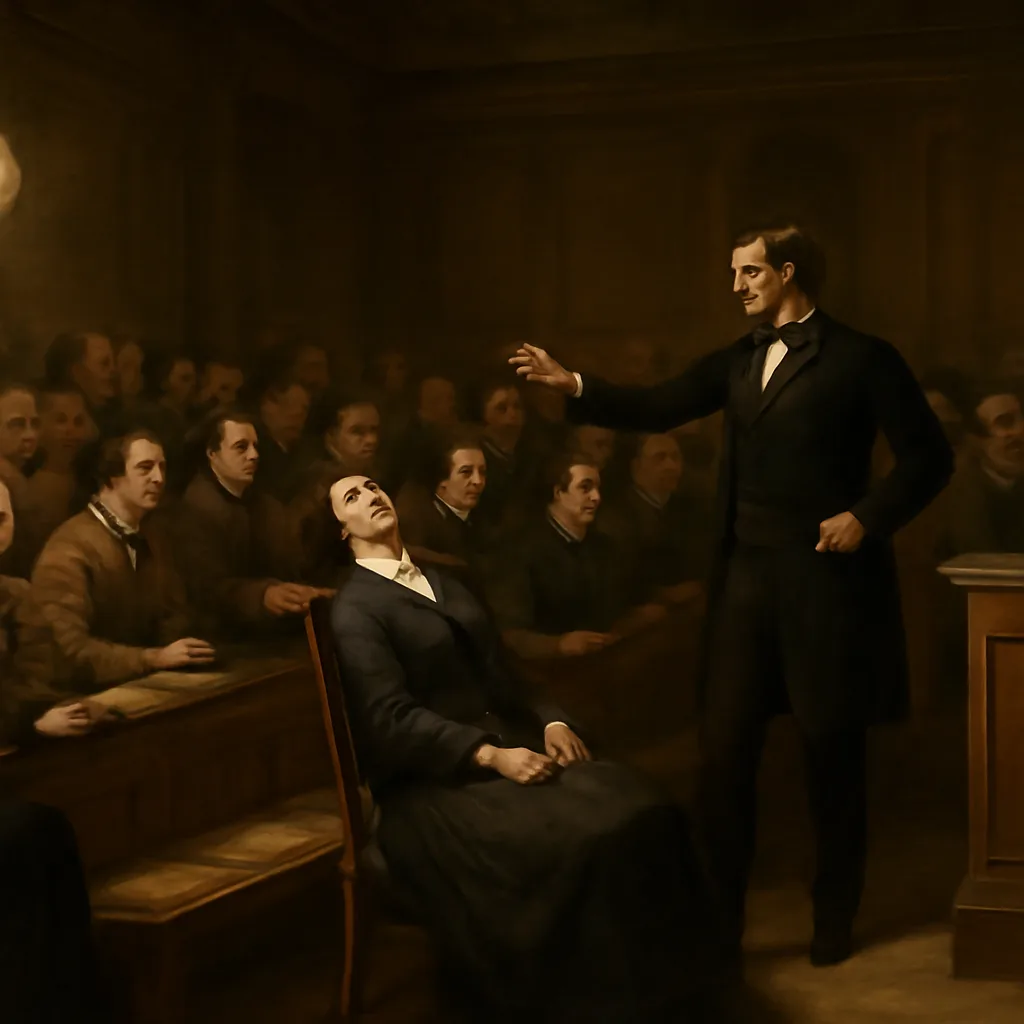
On 12 February 1846 a public demonstration of mesmerism — a practice that would later be called hypnotism — was staged in front of an audience, marking a notable moment in the gradual shift of such practices from private curiosity to subject of wider public scrutiny. Mesmerism originated with Franz Anton Mesmer in the late 18th century, who proposed that a universal “animal magnetism” could be manipulated to affect health. By the mid-19th century the techniques had evolved and diversified, and public demonstrations were becoming a common way for practitioners to attract patients, patrons and press attention. The 1846 demonstration sits within a broader continental and British context in which medical reform, popular fascination with the occult, and expanding print culture intersected. Earlier decades had seen itinerant magnetizers, medical doctors experimenting with suggestive techniques, and theatrical displays in salons and lecture halls. By the 1840s, prominent physicians and showmen alike organized public séances to exhibit dramatic somatic and psychological responses — fainting, analgesia, altered responsiveness — that mesmerists attributed to magnetic influence or heightened suggestibility. Contemporary reports of public demonstrations emphasized spectacle and empirical claims in equal measure. Audiences typically included lay spectators, journalists, members of the medical profession and clergy. Demonstrators often used volunteers from the audience to show immediate, repeatable effects: a subject who would seemingly fall into a trance, resist pain, or obey commands. These displays were framed by advocates as evidence of therapeutic potential and by skeptics as theatrical trickery or charlatanry. Scientific and medical responses were mixed. Some physicians took mesmerism seriously as a therapeutic tool worth controlled study; others dismissed it as superstition or fraud. Investigations by learned bodies — most famously the French Academy of Sciences at the end of the 18th century — had already concluded that Mesmer’s notion of a physical magnetic fluid lacked demonstrable basis, while acknowledging that the reported phenomena warranted psychological explanation. By 1846, the language was shifting: clinicians and researchers increasingly explored suggestion, expectancy and the psychological dimensions of the trance state rather than a literal magnetic fluid. The public demonstration of 12 February 1846 thus contributed to evolving public and professional conversations. It exemplified how spectacle and scientific inquiry were entwined in 19th-century culture: demonstrations drew public interest that pressured medical authorities to investigate and, in some cases, to adopt or adapt techniques for clinical use. Hypnotic methods later influenced fields as diverse as psychotherapy, anesthesia research, and experimental psychology, though these disciplinary developments took decades and rigorous study to unfold. It is important to note that accounts of specific demonstrations can vary in detail across contemporary newspapers, pamphlets and memoirs; some descriptions were prone to exaggeration, and witnesses often disagreed about what they saw and how to interpret it. The 12 February 1846 event should therefore be understood as representative of a class of public spectacles that played a significant role in bringing mesmeric practices into public and professional debate, rather than as a single decisive discovery that instantaneously transformed medical practice. In short, the demonstration of 12 February 1846 reflects a transitional moment: a practice rooted in 18th-century mesmerism was being tested, staged and reinterpreted in an era increasingly committed to empirical inquiry and professional medical standards. The ensuing decades would see the refinement of hypnotic concepts, greater scientific scrutiny, and gradual incorporation of suggestion-based techniques into therapeutic contexts, even as controversy and skepticism persisted.