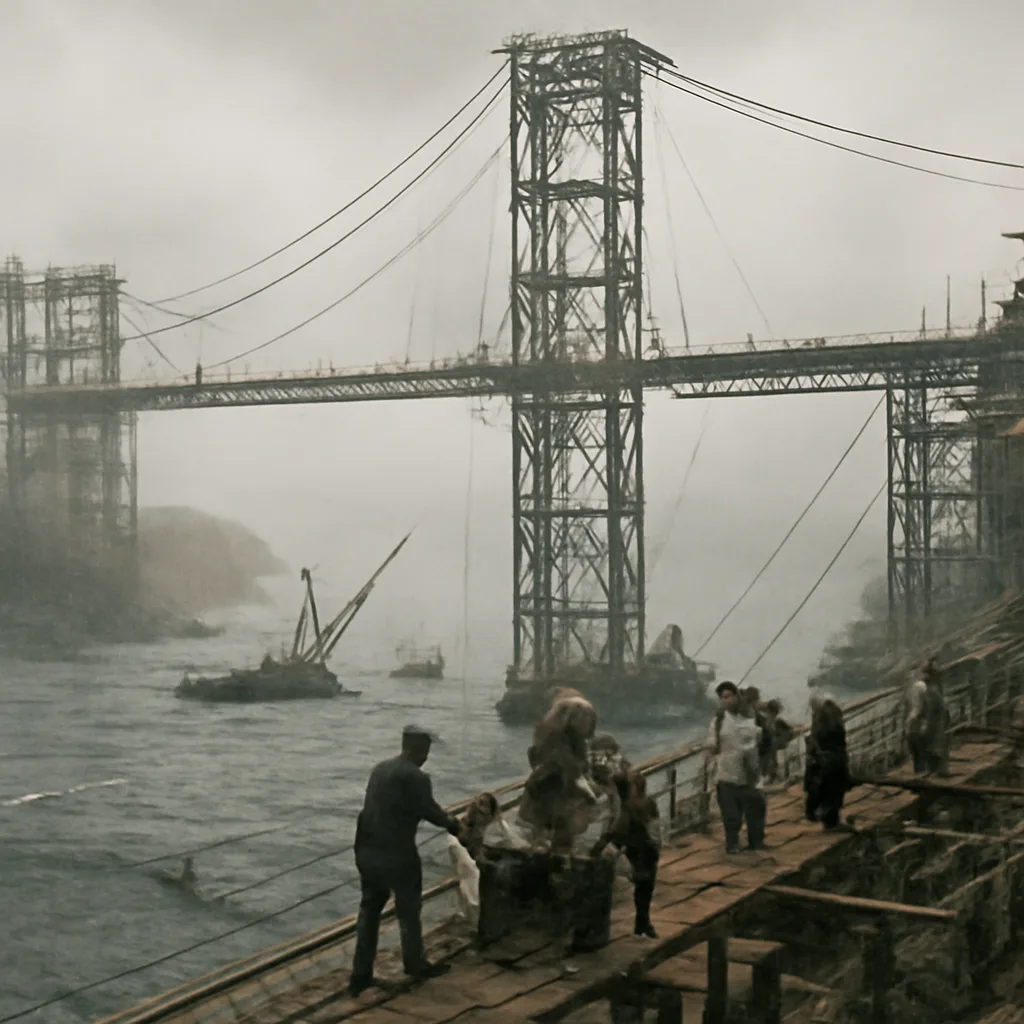
Construction Begins on the Golden Gate Bridge Amid Daring, Deadly Predictions
On January 5 (year unspecified), construction began on the Golden Gate Bridge — an audacious engineering project launched amid forecasts that many workers would die from falls, weather, and dense fog. The bridge’s early work combined novel safety measures with high risk.
On January 5 (year unspecified), work commenced on what would become the Golden Gate Bridge, a bold effort to span the strait between San Francisco Bay and the Pacific Ocean. The project confronted severe natural challenges: swift tides, deep water, frequent fog, and fierce winds. Early public commentary and some contemporary accounts expressed grim expectations that many laborers would be killed in the attempt, reflecting both the genuine hazards of the site and prevailing attitudes toward industrial risk in large-scale civil projects of the era.
Site selection and design
Engineers and civic leaders chose a suspension bridge design to cover the roughly 1.6-mile (about 2.6 km) distance of the Golden Gate. Suspension bridges were then the proven means for long spans; the site’s combination of deep water and wide channel made alternatives such as tunnels or multiple shorter spans impractical or prohibitively costly. The chief engineer, whose role was typical for such projects, had to reconcile aesthetic ambitions with technical necessities: anchorage points in steep headlands, towers tall enough to provide the required clearance for shipping, and approaches that connected to San Francisco and Marin County.
Engineering challenges
Constructing the bridge required pioneering solutions. Foundations for the towers demanded work in turbulent currents and, for the southern tower, construction from a caisson or other deep-water method. The bridge’s main cables were spun from thousands of wires overhead — a complex, dangerous procedure requiring precise coordination. Wind loads, seismic risk, and corrosive salt air obliged engineers to incorporate robust structural allowances and protective measures.
Workforce and danger
The labor force included ironworkers, riveters, divers, and many other skilled trades. At that time, large construction projects routinely accepted a high risk of injury and death; safety standards were less strict and enforcement less consistent than today. The Golden Gate effort became notable in part because it introduced and emphasized several safety measures that were atypical for the period, such as requiring hard hats and providing a safety net beneath the work area. Those measures likely saved lives, though they did not eliminate danger from falling, drowning, hypothermia, equipment failure, or accidents aboard barges and scaffolding.
Public reaction and moral debates
Coverage in newspapers and commentary by some civic figures framed the undertaking as heroic and emblematic of modern progress, while others dwelled on the prospect of heavy casualties. The prediction that many men would die reflected both realistic assessments of the perils and a cultural willingness to accept labor losses as the cost of ambitious infrastructure. Debates about acceptable risk, employer responsibility, and the value of public works were part of the broader political and social context in which the bridge was built.
Safety innovations and legacy
The project’s emphasis on protective measures—most visibly a large safety net suspended under the deck during construction—represented an important shift in how large-scale projects managed risk. The net reportedly caught a number of workers who fell, saving lives and earning recognition among both contemporaries and later historians. These practices contributed to evolving occupational-safety norms in the United States.
Historical note on dates and sources
This summary treats January 5 as the acknowledged date when construction work began in the source provided by the user; historical records commonly identify construction milestones (groundbreaking, tower erection, cable spinning) on specific dates in the 1930s for the Golden Gate Bridge, but the precise year is not supplied here. For a fully verified chronology, consult primary contemporary newspapers, engineering records, or authoritative histories dedicated to the bridge. Where opinions or casualty estimates varied in contemporary sources, this account notes the dispute rather than asserting uncertain figures as fact.
The bridge that rose from those hazardous early months went on to become an enduring symbol of civil-engineering ambition. Its construction episode remains studied both for its technical achievements and for what it reveals about labor, safety, and public appetite for grand infrastructure in the early 20th century.