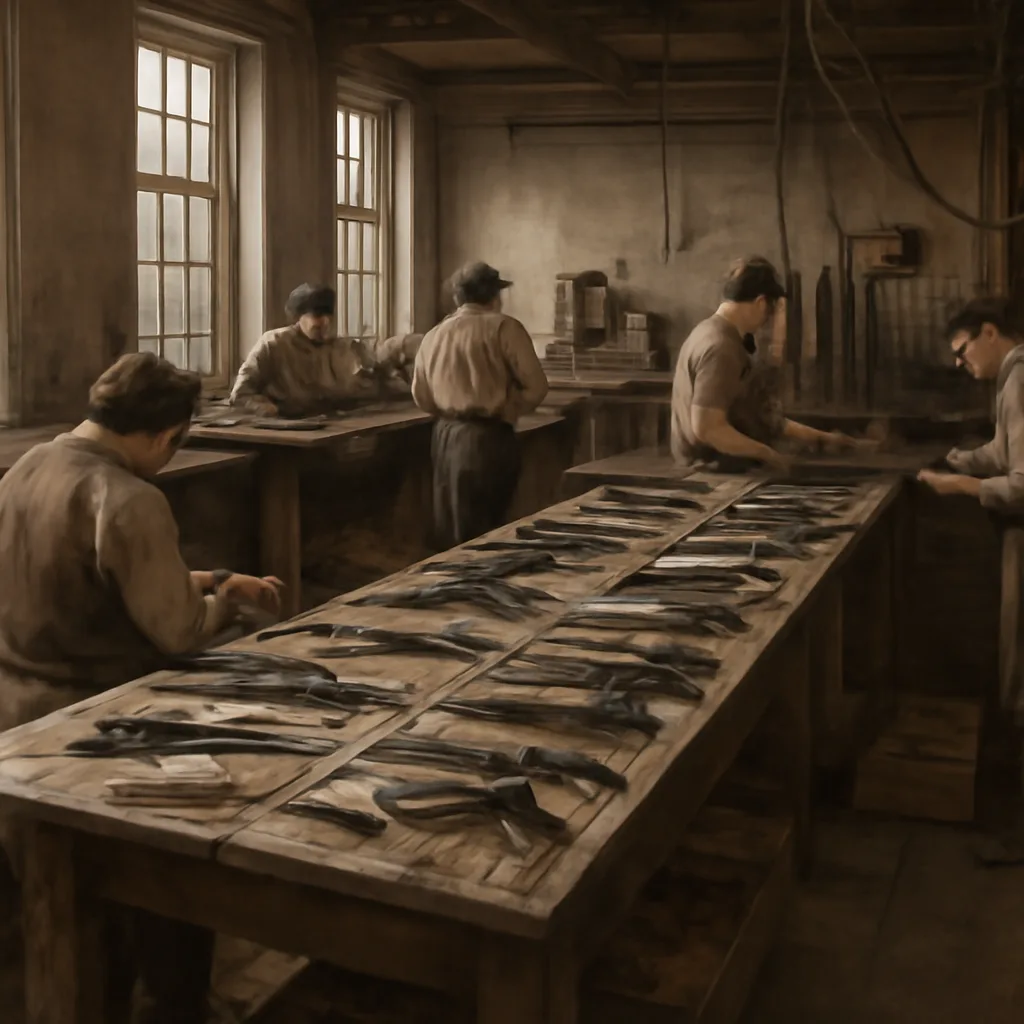
On January 14, 1836, American inventor Samuel Colt publicly demonstrated a revolving percussion pistol that embodied a new approach to firearms manufacture: the use of standardized, interchangeable parts and methods aimed at repeatable, large-scale production. While handguns and multi-shot firearms had existed for centuries, Colt’s design and business methods are widely credited with inaugurating true mass production of handguns in the United States. Background and design Samuel Colt patented his first practical revolving-cylinder pistol in 1836 (U.S. Patent No. 138) after earlier experiments and a brief patent in England. The Colt system paired a rotating cylinder—holding multiple charges—with a single barrel and a single lock, allowing successive shots without reloading the barrel. More important for manufacturing was Colt’s insistence on producing parts to common specifications so components from one gun would fit another of the same model. This emphasis on standardization anticipated later industrial practices. Early production and impact Colt initially produced revolvers at a small Hartford workshop and later at the Patent Arms Manufacturing Company. Early production runs were limited compared with later 19th-century manufacturing, and Colt’s company struggled at times with quality, finance, and market acceptance. Nevertheless, Colt’s revolvers found buyers among civilians, explorers, private militias, and—eventually—regular military forces. The combination of a practical multi-shot handgun and a manufacturing model that could, in principle, deliver uniform parts at scale made Colt’s approach distinctive. Context and caveats It is important to distinguish between earlier multi-shot firearms and Colt’s mass-production claim. Multi-shot handguns and repeating mechanisms (such as pepperbox pistols and various European repeating handguns) predated Colt. What set Colt apart was less the novelty of a multi-shot capability than the integration of a reliable revolving mechanism with business and production methods oriented toward interchangeability and reproducibility. Historians debate when “mass production” properly applies: Colt’s operations in the 1830s and 1840s were significant steps toward industrialized arms production, but truly large-scale factory output with assembly-line techniques developed later in the 19th century. Legacy Colt’s model influenced both firearms technology and manufacturing practices. Revolvers bearing Colt’s name played prominent roles in westward expansion, U.S. military conflicts, and international arms markets throughout the 19th century. Colt’s emphasis on standardized parts contributed to broader industrialization trends that reshaped manufacturing across multiple industries. Because claims about ‘‘firsts’’ can obscure parallel developments elsewhere, a careful account credits Samuel Colt and his revolver with pioneering mass-produced handguns in the American context while acknowledging antecedent repeating firearms and the gradual evolution of large-scale industrial production.