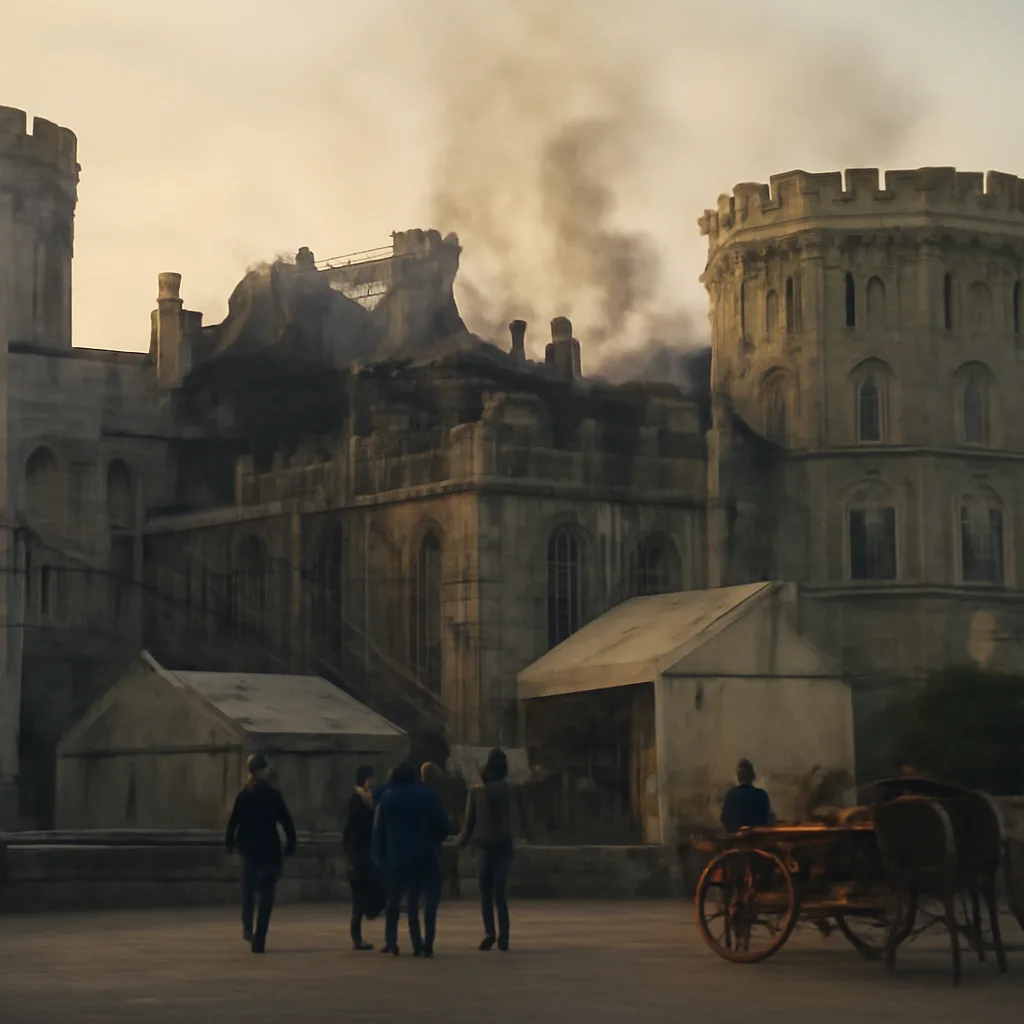
Major 1992 Fire Devastates Windsor Castle’s Historic State Apartments
On the night of 20 November 1992, a severe fire broke out at Windsor Castle, causing extensive damage to the medieval and Georgian State Apartments, destroying irreplaceable interiors and art while prompting a lengthy restoration and public debate over funding.
On 20 November 1992, a fire started in Windsor Castle and rapidly spread through parts of the palace complex, inflicting heavy damage on the State Apartments and other historic interiors. The blaze began in the early evening in the Queen’s Private Chapel and was discovered during routine maintenance; high temperatures, wooden structures and ornate decoration enabled the fire to extend into adjoining rooms. Firefighters, working through the night, contained the worst of the flames before the entire building was lost, but many rooms suffered serious damage from fire, smoke and water.
The fire affected both medieval fabric and later historic interiors created during extensive 19th-century rebuilding under George IV and other monarchs. Notable losses and damages included the destruction of the vaulted ceiling of St George’s Hall, severe harm to the Crimson Drawing Room and other principal state rooms, and damage to furniture, decorative schemes and works of art. The blaze also exposed vulnerabilities in the castle’s electrical systems and heating, which were identified in subsequent investigations.
Beyond physical damage, the 1992 fire had significant institutional and public consequences. The cost of repair and restoration was substantial; initial estimates ran into tens of millions of pounds, and the overall restoration program ultimately cost over £30 million. The scale of the bill prompted public debate in the United Kingdom about the use of public funds for repairs to royal residences. As a direct outcome of those discussions, the Queen agreed to open some royal residences to wider public access and to accept arrangements whereby a proportion of income from the Crown Estate would be allocated to maintenance of the royal palaces — measures that altered the financial relationship between the monarchy and the state.
The restoration effort combined traditional craft techniques with modern conservation practices. Conservators and craftsmen worked to salvage original fabric where possible and to recreate lost decorative schemes using historical records, photographs and surviving examples. Many damaged items — from carved woodwork to tapestries and paintings — underwent careful cleaning, stabilization and repair. Where exact originals could not be recovered, restorers aimed for historically informed reconstructions reflecting the room’s documented appearance prior to the fire.
Windsor Castle itself has a long history as a royal residence dating back to the 11th century, and the 1992 fire is one of the most serious incidents in its modern history. The event highlighted the challenges of protecting historic, inhabited buildings that serve both as living spaces and as public heritage sites. In the years after the fire, improvements were made to fire detection, electrical wiring and other safety measures across the royal estate to reduce the risk of recurrence.
Today, the restored State Apartments at Windsor Castle are again open to visitors, with conservation work and interpretation acknowledging both the castle’s long architectural development and the impact of the 1992 fire. The episode remains a notable moment in late 20th-century British cultural history: it prompted practical changes in heritage management, generated debate about public subsidy for historic properties, and led to a major conservation achievement in restoring a globally recognized royal landmark.