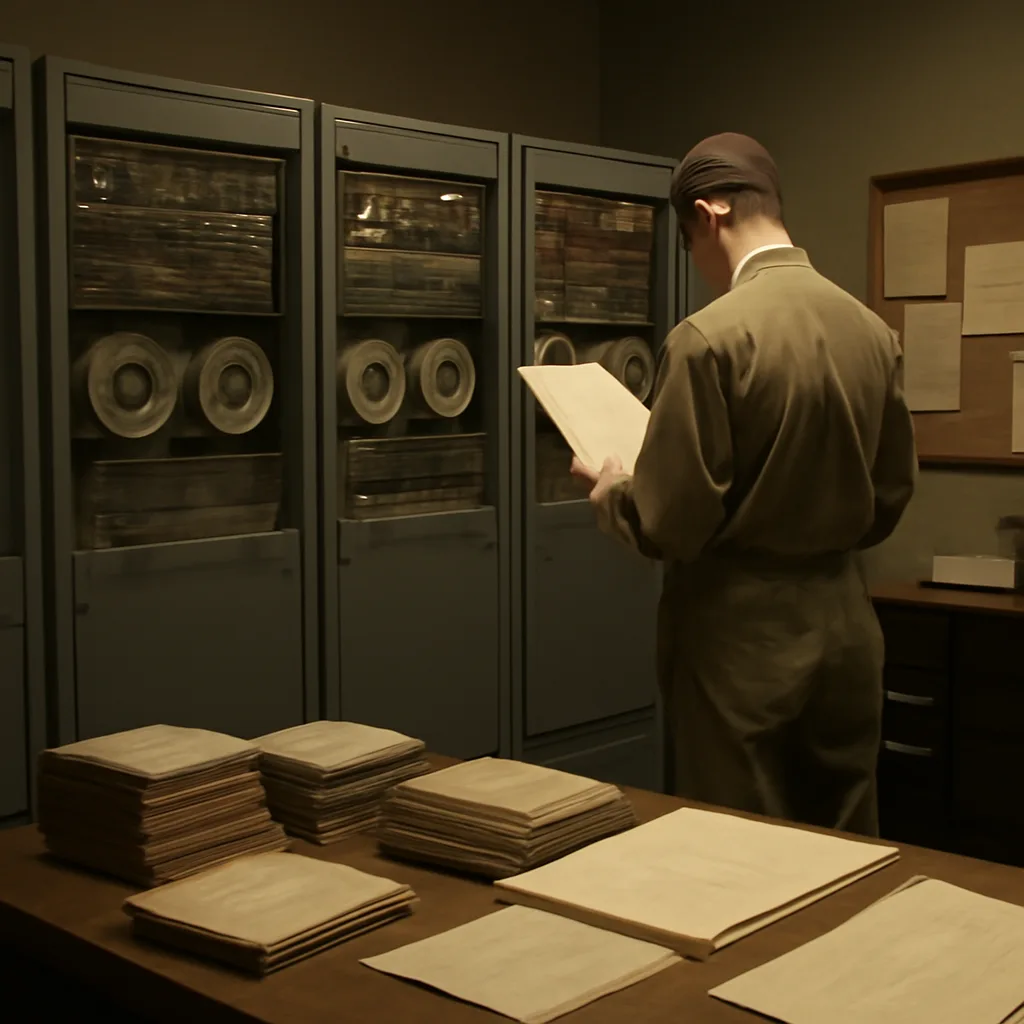
On May 3 (year not firmly established in surviving records), an early conceptual description of a self-replicating computer program was circulated among a small community of researchers and hobbyists. The idea—that a sequence of instructions could cause a machine to produce a duplicate of that sequence—appeared in notes and informal publications before the term "computer virus" entered common use. This exposition belongs to a lineage of thinking that linked biological metaphors and formal models of computation, and that later informed both theoretical work on automata and practical developments in software that could reproduce itself. Historical context The notion of machines or processes that replicate has roots in biology and logic. In the 1940s and 1950s, thinkers such as John von Neumann formulated rigorous models of self-reproducing automata, framing replication as a problem in theory of computation and information. By the 1960s and 1970s, as digital computers became more accessible, informal descriptions and experiments with programs that could copy their code began to appear in technical memos, university newsletters, and users' group bulletins. The May 3 outline fits into this transitional period between abstract theory and practical computing practice. Content and form of the outline Surviving accounts indicate the May 3 document presented the replication idea in plain, operational terms: a program would include a routine to read its own code and write that code into a new file or memory location, possibly appending a small driver to invoke the copy. The outline emphasized mechanisms—reading from storage, writing to storage, and invoking execution—rather than malicious intent. It treated replication as a technical capability and thought experiment, not as a weaponized concept. Where the record is incomplete, contemporary summaries and later references paraphrase the core idea rather than reproduce verbatim text. Influence and subsequent developments The May 3 description was one of several early articulations that diffused through academic papers, conference conversations, and hobbyist mailing lists. These exchanges helped normalize the language and technical patterns used to think about self-replication in software. Later, in academic settings, von Neumann’s formal models and theoretical computer science probed limits and necessary conditions for self-reproduction. In practical settings, programmers and system researchers experimented with copy routines for benign purposes—backup utilities, demonstrative programs, and self-updating code—while others later adapted similar techniques for harmful ends, giving rise to what we now call malware. Limitations of the historical record Precise bibliographic details for the May 3 outline are unclear in surviving sources; some references cite the date without a year, or attribute the idea to a distributed set of contributors rather than a single author. This uncertainty reflects the informal circulation practices of early computing communities, where memos, newsletters, and personal notes were common and formal archival did not always follow. Consequently, some accounts conflate multiple early descriptions of self-replication. Why it matters Tracing early formulations of self-replicating programs clarifies how technical ideas migrate from theoretical inquiry to practical implementations and, eventually, to social and security concerns. The May 3 outline illustrates a key moment when a technical capability—automatic replication of code—was described in operational terms, helping bridge abstract models and hands-on experimentation. Understanding this lineage aids historians and technologists in seeing how design choices and metaphors shaped later debates about responsibility, security, and the ethics of software that can propagate itself. Sources and verification The account above synthesizes patterns documented in histories of computing, published papers on self-reproducing automata (including von Neumann’s work), and retrospective treatments of early computing communities. Because the May 3 item lacks a firmly established year or a widely preserved original text, specific attributions remain tentative; where scholarship has disputed details, those disputes are noted in the academic literature on the history of malware and automata theory.