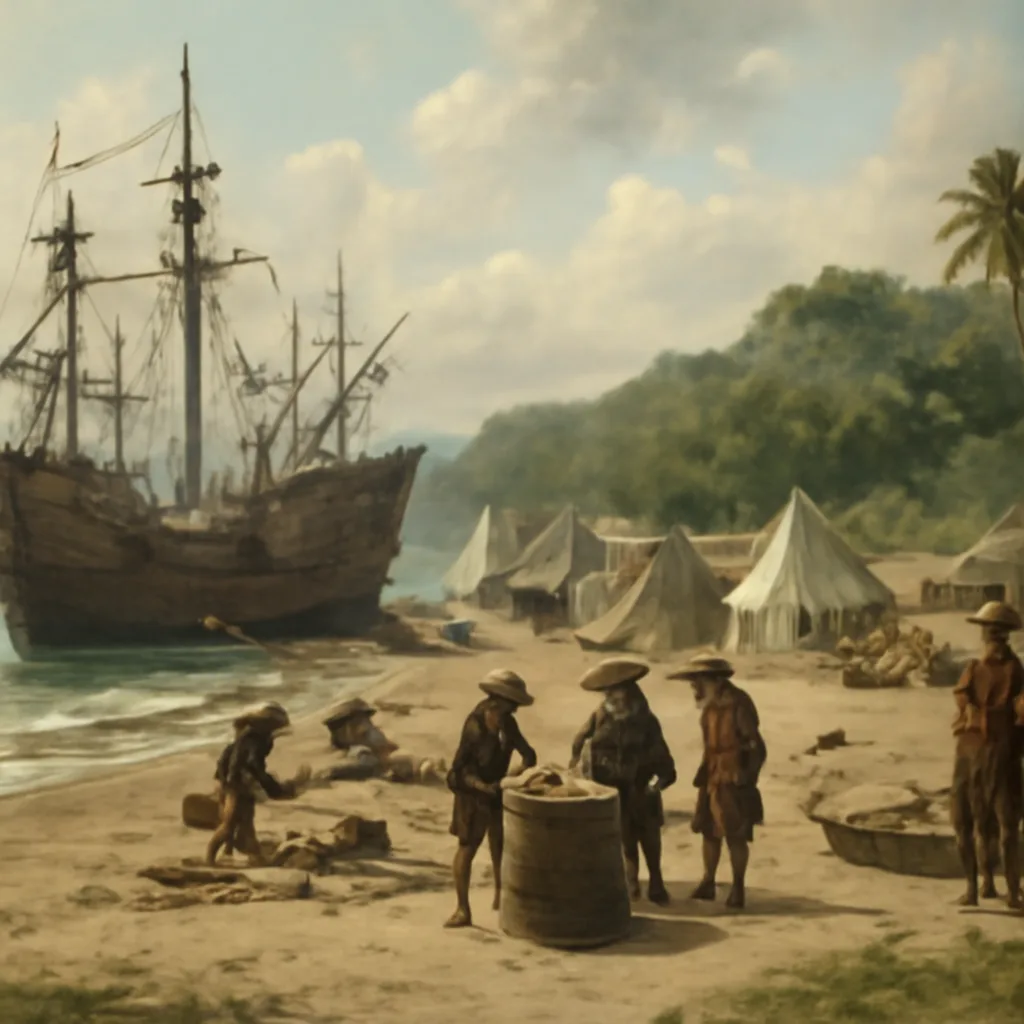
On 5 February 1504 Christopher Columbus and the survivors of his fourth voyage made landfall on Jamaica (then known to Europeans as one of the 'Antilles') after their ships suffered damage and their ability to sail was compromised. The expedition, which had left Spain in 1502 seeking a westward passage to Asia, had encountered storms, hostile encounters, and navigational difficulties. After reaching Jamaica, Columbus and his men found fresh water, food resources, and shelter, but the three remaining vessels were soon unseaworthy. Stranded for about 16 months, Columbus established a temporary camp and tried to maintain order among his officers and crew while negotiating with the island’s indigenous Arawak/Taino inhabitants. Sources from the period indicate a complex and changing relationship: at times the Spanish obtained supplies through trade and persuasion, and at other times tensions and misunderstandings led to conflict. Columbus attempted to manage scarce resources and the morale of his men while repairing at least one vessel, but chronic shortages, illness, and disputes made the situation precarious. Contemporary and near-contemporary Spanish accounts, including Columbus’s own letters and later reports by colonial officials, record that he used astronomical knowledge to assert leverage in dealings with the islanders. Modern historians note the famous episode in which Columbus allegedly predicted a lunar eclipse to frighten local inhabitants into cooperation; some scholars accept the account as broadly plausible given Columbus’s knowledge of celestial phenomena and the timing of an eclipse in 1504, while others caution that the story was shaped by later narratives and should not be treated as unambiguous fact. During the long stay, small-scale raids and thefts from local groups increased friction. Relations among the Spaniards deteriorated as shortages and delays weighed on discipline and leadership. Columbus’s health also declined. Repairs were gradual and constrained by limited tools and materials available on the island. By June 1504, two ships remained but were not seaworthy for an immediate transatlantic crossing. Rescue finally came when a passing Spanish vessel from Hispaniola encountered the castaways in August 1504; some accounts place rescue operations in late June or August, and sources vary on exact dates and sequences. When Columbus and part of his crew left Jamaica, they proceeded to Hispaniola, where Columbus faced legal and political challenges with colonial authorities. The episode on Jamaica contributed to the troubles that marked the end of Columbus’s governorship and his subsequent return to Spain under less than triumphant circumstances. Historians draw on Columbus’s own letters, ship logs, and later official correspondence to reconstruct the Jamaica episode, but interpretations vary. Details such as the exact duration of the stay, the sequence of repairs, and the nature of daily interactions with indigenous people are known imperfectly and are the subject of scholarly debate. What is clear is that the February 1504 landing stranded Columbus and his men for an extended period, complicating the voyage’s objectives and shaping the later administrative and legal fallout of his final voyage to the Americas.