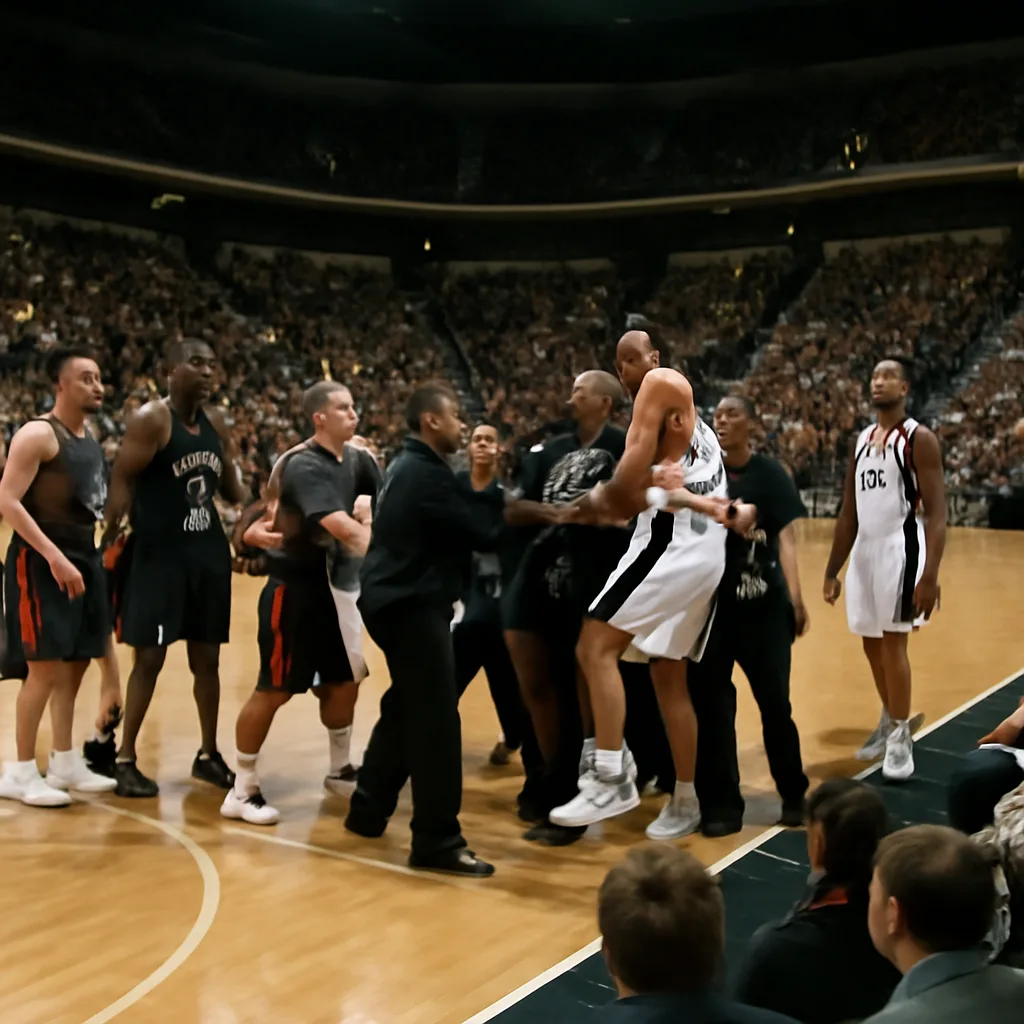
Brawl Erupts at Palace: Pacers–Pistons Game Marred by Court-Side Fight
On November 19, 2004, a violent altercation between Indiana Pacers players and Detroit Pistons fans broke out at The Palace of Auburn Hills late in a game, leading to suspensions, criminal charges, and major changes in NBA security and conduct policies.
On November 19, 2004, during the closing minutes of a regular-season NBA game between the Indiana Pacers and the Detroit Pistons at The Palace of Auburn Hills, an on-court altercation escalated into a wide-ranging brawl involving players and spectators. The incident began after a hard foul by Pacers forward Ron Artest (later known as Metta World Peace) on Pistons center Ben Wallace. Wallace and others reacted; a brief scuffle ensued on the court and was separated by players and officials. As Artest retreated toward his bench and sideline, a spectator tossed a drink that struck him. Artest then ran into the stands and confronted fans; other Pacers players—most notably Stephen Jackson and Jermaine O'Neal—left the bench area and entered the stands as well, leading to multiple physical confrontations between players and fans.
The melee lasted several minutes and involved punches and thrown objects. Players and fans were injured; the scene required intervention by arena security and local police to restore order. The aftermath included several criminal investigations, civil lawsuits, and extensive disciplinary action by the NBA. The league issued long suspensions: Artest received the longest ban (suspended for the remainder of the season, 73 regular-season games plus playoffs), Jackson and O'Neal received multi-game suspensions, and other players were also disciplined. The incident prompted the NBA to tighten security protocols—moving players’ benches farther from the stands in many arenas, increasing security presence, and revising policies regarding player interactions with fans and comment on fan behavior.
Media coverage and public reaction were intense. Some commentators called for criminal charges against players and fans; some fans faced charges, and at least one person was convicted for assaulting a player. The event came to be widely known in sports history as “The Malice at the Palace,” a nickname that encapsulated the unprecedented nature of players entering the stands. The episode had significant consequences for the Pacers franchise and the careers of involved players: Artest’s public image was deeply affected, Jackson publicly apologized and sought reconciliation with those involved, and the Pacers experienced organizational changes and scrutiny.
The brawl also sparked broader discussions about spectator behavior, alcohol sales at sporting events, arena security design, and the responsibilities of professional athletes and leagues in preventing and responding to on-site violence. Over time the NBA and individual teams implemented measures intended to reduce the likelihood of similar incidents, including stricter ejection policies, revised alcohol sales procedures in some venues, and more robust coordination with local law enforcement for crowd control. The Malice at the Palace remains one of the most consequential and studied disturbances in modern sports, cited in discussions of sportsmanship, fan-player boundaries, and league governance.